For creators, brands, agencies, ads, client work, and business videos
Commercial Music Licensing for Creators, Brands & Agencies
Learn how to license Nanashino-chan lo-fi music for YouTube videos, TikTok content, Instagram Reels, business videos, product demos, paid ads, sponsored posts, client work, and brand campaigns.
This page helps you separate casual music use from commercial use, brand use, advertising use, and sync licensing. The goal is simple: choose music by mood, then choose the license that matches the real use of the video.
Commercial Music Licensing Matters Because “Available Online” Is Not the Same as “Cleared for Business Use”
Many creators and businesses find music on streaming platforms, social platforms, audio libraries, or “free music” websites and assume it can be used in commercial videos. In practice, a track may be listenable, streamable, or available inside a platform without granting every commercial right you need.
A business video, sponsored post, client project, paid ad, product demo, brand campaign, or monetized creator video may require permission that is broader than casual listening or platform posting.
日本語:配信サービスやSNS上で聴ける音源であっても、企業動画・広告・ブランド案件・クライアントワークで自由に使えるとは限りません。 商用利用では、動画の用途に合ったライセンス確認が必要です。
What Counts as Commercial Music Use?
Commercial use is not limited to television ads or large campaigns. If the video supports a business, brand, product, service, monetized channel, sponsor, or client, it may fall under commercial use.
Creator business
Monetized videos and channels
YouTube monetization, creator businesses, sponsored videos, affiliate content, and professional social media activity may require commercial music permission.
Brand use
Business and product videos
Product demos, website videos, app explainers, company videos, product launch clips, and organic brand social posts are commercial contexts.
Campaign use
Ads, sponsored posts, and client work
Paid ads, boosted posts, whitelisted influencer content, agency deliverables, and campaign creatives often require sync or custom licensing.
Commercial License vs Sync License
A key licensing decision is whether you need a general commercial creator license or a sync license for advertising, brand campaigns, client work, or broader promotional distribution.
| Use Case | Typical License Starting Point | Why It Matters |
|---|---|---|
| Personal non-commercial video | Personal Use License | Only suitable when there is no business purpose, monetization, client work, sponsorship, or advertising. |
| Monetized YouTube video | Commercial Creator License | Monetized creator content usually needs permission beyond casual listening or platform music use. |
| Business website video or organic brand post | Commercial Creator License | The video supports a business, product, service, or brand identity. |
| Sponsored post or client deliverable | Commercial, Sync, or Custom License | The scope depends on client involvement, campaign purpose, platforms, duration, and distribution. |
| Paid social ad, YouTube ad, or brand campaign | Sync License or Custom License | Advertising and campaign use generally require broader permission than organic creator posting. |
| TV, film, cinema, games, apps, or exclusive use | Custom License Inquiry | These uses usually require project-specific review, scope, duration, territory, and rights terms. |
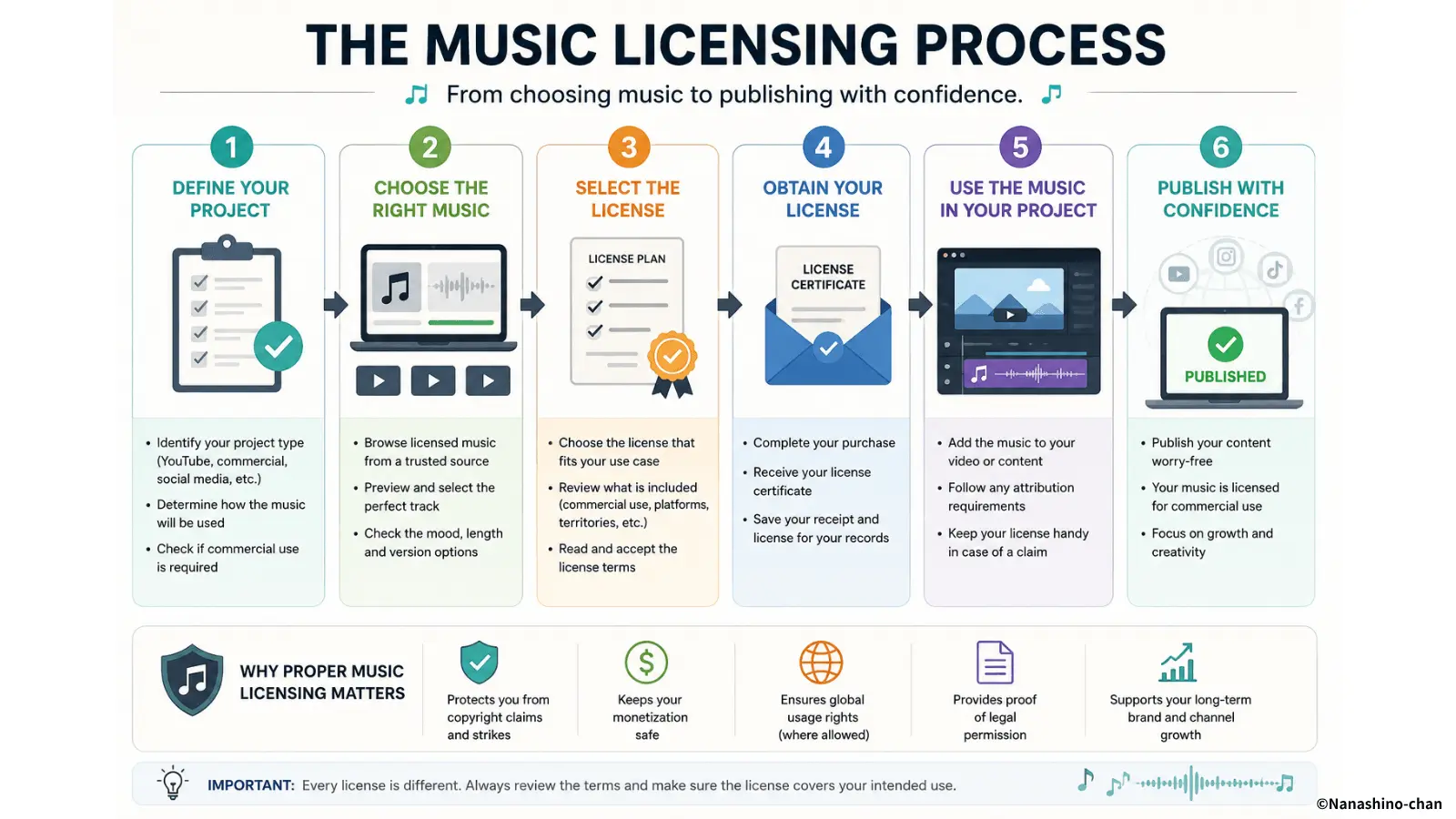
How the Music Licensing Process Works
Commercial video teams should separate two decisions: first, choose a track that fits the video mood; second, choose a license that matches the final use of the video.
For example, a simple organic YouTube upload, a client product demo, and a paid TikTok ad may use the same song, but they may not need the same license.
 Open full-size infographic →
Common Commercial Music Licensing Problems
Most licensing problems happen because the music was selected before the usage scope was understood. The safest workflow is to decide how the video will be used before publishing.
Problem 1
Assuming streaming access includes video rights
Paying for a music streaming service usually gives listening access. It does not automatically grant permission to synchronize that music with commercial video.
Problem 2
Using platform audio for business campaigns
Music available inside a social platform may be useful for casual posting, but it should not be treated as a substitute for a commercial license, sync license, client-work license, or paid advertising license.
Problem 3
Not documenting permission
Agencies, brands, and clients often need written documentation showing what music was licensed, who may use it, where it may be used, and for how long.
Problem 4
Mixing organic use and paid ads
A license that fits an organic brand post may not automatically cover paid ads, boosted posts, campaign creatives, whitelisting, or broad promotional distribution.
Problem 5
Ignoring client and agency scope
If an agency creates a video for a client, the license should account for the client, not only the editor, creator, or production team.
Problem 6
Expecting a license to control platform systems
A license clarifies rights-holder permission, but platforms may still apply their own policies, automated systems, review processes, regional availability, and account-level rules.
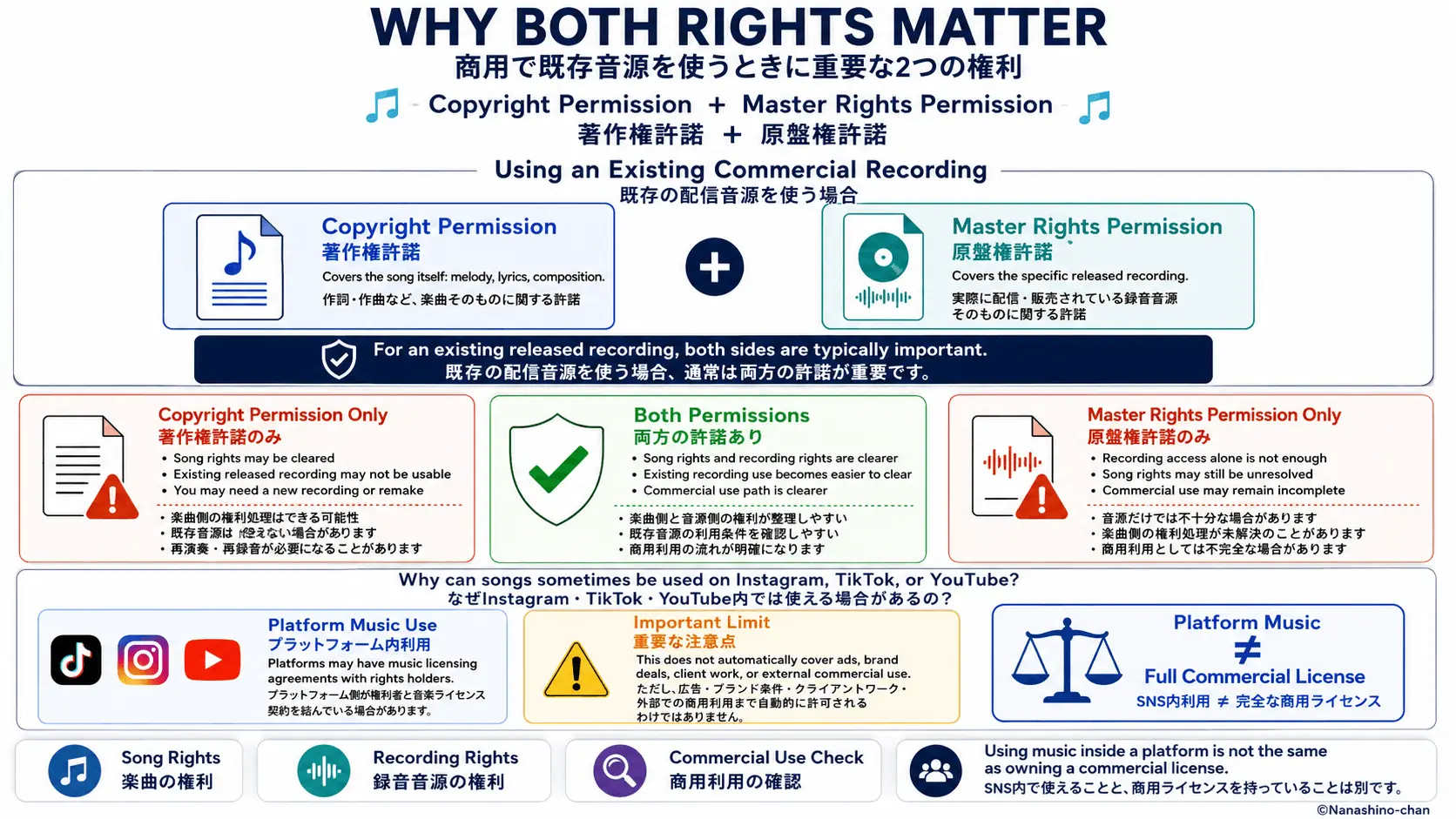
Why Both Rights Matter in Commercial Music Use
Commercial music use can involve more than one right. In many cases, video use may require permission for the composition and permission for the specific recording.
Direct licensing from the relevant rights holder can reduce confusion, especially for commercial videos, ads, client work, and brand campaigns.
 Open full-size infographic →
Commercial Music Licensing Use Cases
Nanashino-chan lo-fi tracks can be considered for a wide range of creator and commercial video contexts, as long as the chosen license matches the intended use.
YouTube
Monetized videos
Creator videos, educational content, product reviews, commentary, Shorts, and monetized channels may need commercial music permission.
Social media
TikTok, Instagram & Reels
Creator reels, brand posts, product clips, lifestyle edits, and sponsored short-form videos should be matched to the correct license.
Business
Product demos
App demos, SaaS explainers, product launch videos, website videos, startup content, and business presentations.
Advertising
Paid campaigns
Paid social ads, YouTube ads, campaign videos, launch campaigns, boosted posts, and promotional brand creatives.
Agency
Client projects
Client deliverables, commercial edits, brand assets, proposal videos, and ongoing content packages for businesses.
AI video
AI-generated content
AI-assisted videos, generated visual campaigns, synthetic video workflows, and creator tools still need properly licensed music.
Lifestyle
Café and brand mood videos
Café scenes, fashion visuals, reading content, study videos, wellness clips, and soft lifestyle campaigns.
Premium mood
Luxury and fashion visuals
Polished social videos, premium product visuals, boutique brands, fashion content, and cinematic night scenes.
Recommended Tracks for Commercial Video Use
If you are choosing music for a commercial video, start by listening to a curated list instead of searching the full catalog from scratch. The recommended track page includes playable previews for brand videos, product demos, TikTok-style edits, AI videos, café content, Tokyo night visuals, luxury mood videos, and short social clips.
Listen
Preview selected Nanashino-chan tracks that are easier to match with common commercial video types.
Choose
Match the track to the video style: product demo, brand reel, social post, ad, AI video, or lifestyle content.
License
Select the license based on actual usage scope, not just the platform where the video will be uploaded.
Commercial Music License Options
The best license depends on how the final video will be used. These options are starting points for common creator, business, and campaign scenarios.
Personal Use License
$19
For personal, non-commercial, small-scale use only. Not for monetized videos, client work, paid ads, business promotion, or sponsored content.
Open GumroadCommercial Creator License
$500
For monetized YouTube videos, business videos, organic brand posts, product demos, website videos, and non-ad commercial online videos.
Open Gumroad1-Month Sync License
$500
For short-term paid ads, social campaigns, brand campaign videos, promotional use, and sync use during a limited period.
Open Gumroad3-Month Sync License
$1,200
For longer campaign periods, extended promotional visibility, paid social distribution, and broader commercial campaign use.
Open GumroadSimple Commercial Licensing Checklist
Before publishing a video with music, confirm the commercial context. This checklist helps you decide whether you need personal, commercial, sync, or custom licensing.
- Is the video monetized? If yes, personal use is usually not enough.
- Does the video promote a business, product, app, service, brand, or client? If yes, treat it as commercial use.
- Is there a sponsor, affiliate relationship, or paid partnership? If yes, check the license scope carefully.
- Will the video be used as a paid ad, boosted post, or campaign creative? If yes, start from sync licensing.
- Is an agency delivering the video to a client? If yes, make sure the client and project scope are covered.
- Will the same video appear across multiple platforms? If yes, confirm platform coverage and usage duration.
- Do you need written documentation? If yes, direct licensing is usually better than relying only on platform availability.
Important: Commercial Licensing Does Not Guarantee Platform Behavior
A commercial license clarifies permitted use from the rights holder. It does not guarantee monetization approval, ad approval, platform reach, upload success, or the behavior of automated systems on YouTube, TikTok, Instagram, Facebook, or other platforms.
Content ID systems, platform audio rules, account type, regional availability, ad review systems, metadata, and future policy changes may still affect how a video is processed.
日本語:商用ライセンスは権利者からの使用許諾を明確にするものですが、 YouTube Content ID、TikTok、Instagram、Facebook、広告審査、地域差、アカウント設定、 将来の仕様変更まで保証するものではありません。
Related Commercial Music Licensing Guides
Continue with these related guides if you need a more specific explanation for YouTube, TikTok, Instagram, paid social ads, product videos, AI videos, or license selection.
FAQ
What is commercial music licensing?
Commercial music licensing is permission to use music in content with a business, promotional, monetized, client, brand, or advertising purpose. The exact license needed depends on the video type, platform, campaign scope, distribution, and whether paid advertising or client work is involved.
Do I need a commercial music license for YouTube monetization?
Monetized YouTube videos often require a license that covers commercial or monetized use. A Commercial Creator License may be suitable for many non-ad creator and business videos, while paid ads, brand campaigns, and broader promotional use may require a Sync License or custom permission.
Is commercial music licensing the same as sync licensing?
Not always. A commercial creator license may cover certain monetized or business video uses. Sync licensing is typically used when music is synchronized with video for ads, campaigns, brand promotion, film, media projects, or broader commercial distribution.
Can agencies use Nanashino-chan music for client projects?
Agencies may be able to license Nanashino-chan music for client projects, but the license should match the client, project type, platform, campaign duration, advertising scope, and distribution.
Can I use platform audio instead of buying a commercial license?
Platform-library or credit-based usage may be suitable for non-commercial or small-scale projects, but it should not be treated as a substitute for a commercial license, sync license, paid advertising license, client-work license, or brand campaign license.
Can a license guarantee no Content ID claims or platform restrictions?
No. A license clarifies permitted use from the rights holder, but platform systems such as YouTube Content ID, TikTok audio systems, Instagram, Facebook, advertising review systems, and future platform policy changes may still behave according to each platform's rules.
Where can I preview recommended tracks for commercial video use?
You can preview recommended Nanashino-chan tracks on the Recommended Tracks for Commercial Video Use page before choosing the correct license.
Choose the Music First. Choose the Correct License Before Publishing.
If your video is monetized, sponsored, client-based, promotional, or used in paid advertising, choose a commercial or sync license that matches the actual use of the video.
Disclaimer
This page provides general information about commercial music licensing. It is not legal advice and does not guarantee platform behavior, monetization approval, advertising approval, reach, claim outcomes, or revenue results.
A license clarifies permitted use from the rights holder, but platforms may apply their own rules, account settings, regional restrictions, automated systems, advertising review systems, and future policy changes.
免責事項
このページは、商用音楽ライセンスに関する一般的な情報を提供するものです。 法的助言ではなく、各プラットフォームでの表示、収益化、広告審査、リーチ、Content IDの挙動、 収益結果を保証するものではありません。