Nanashino-chan Music Licensing
Music Licensing FAQ for Creators, Brands, and Production Teams
This page explains when to use a Personal, Commercial, Sync, or Custom License for Nanashino-chan music. The correct route depends on how the track is accessed, whether it is embedded into a finished work, the purpose of the content, and how the completed content is distributed.
In short: official social-platform library use for business promotion is handled differently from music embedded directly into an exported video. Audio-focused online content such as podcasts is also treated differently from audiovisual synchronization.
Last reviewed and updated: August 23, 2026
Quick Guide: Which License Route Applies?
Use this table as a starting point. The purchased license terms and the facts of the actual project determine the final permission. A platform's own rules also continue to apply.
| Use | Typical Route | Key Condition |
|---|---|---|
| Limited personal, non-commercial use | Personal License | Only for uses expressly permitted by the Personal License. No business, client, advertising, redistribution, or ownership claim. |
| A company or brand selects the track from an official social-platform music library for its own promotional post | Commercial License | The track remains platform-native and is not downloaded and embedded into an externally edited video. Platform rules must permit the intended use. |
| Podcast or other audio-focused online content | Commercial License | The use must stay within the stated project, account, platform, and distribution conditions. |
| Music is downloaded or supplied and embedded into a video, commercial, brand film, animation, trailer, or other audiovisual work | Sync License | Applies when the recording becomes part of the rendered or exported audiovisual work. |
| Television broadcast, TV commercial, theatrical use, major film distribution, or another broadcast-scale use | Contact / Custom Agreement | Not automatically covered by a standard online license. |
| App, game, template, SaaS product, dataset, music tool, or product-level integration | Custom License | Embedding, repeated generation, end-user access, or redistribution requires individual review. |
The simplest distinction
Platform-library business use or audio-only online use: Commercial License.
Music embedded directly into a finished audiovisual file: Sync License.
TV, broadcast, theatrical, interactive product, or unusual scope: contact Nanashino-chan before use.
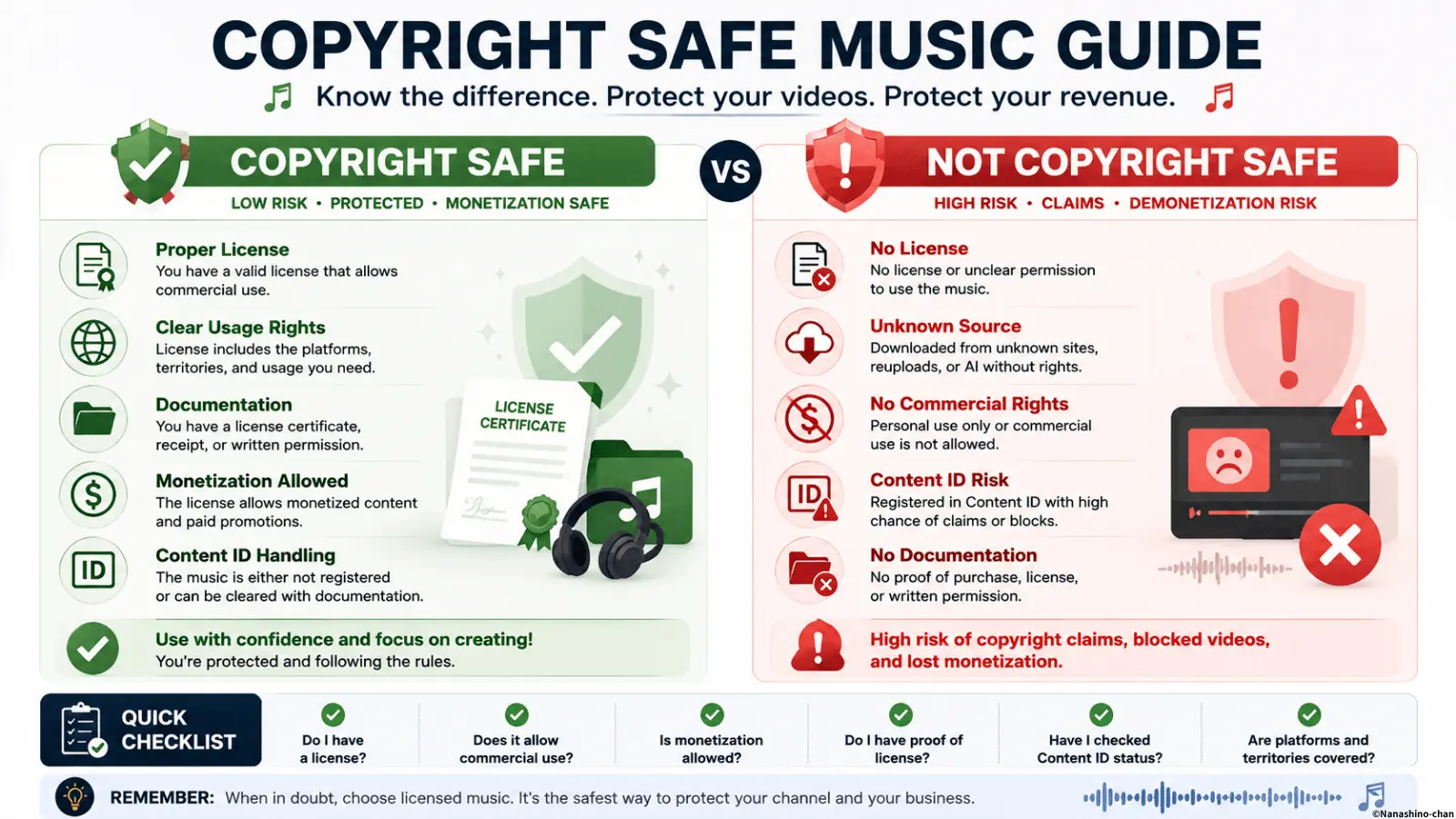
FAQ Categories
Choose the section that matches your project or platform.
About the Catalog and Rights
Nanashino-chan is a Tokyo-based independent music licensing brand and original character project. The catalog includes more than 2,000 original tracks for creators, brands, agencies, production teams, animation, webtoon-related content, games, podcasts, and digital media.
One-stop rights management
For eligible tracks, Nanashino-chan directly manages the composition rights and the master recording rights. This allows both permissions to be reviewed through a single point of contact instead of requiring the licensee to approach separate publishers and master owners.
A license does not override platform rules and does not guarantee monetization, reach, claim behavior, ad performance, or regional availability.
Learn more on the About page, review publicly observed uses, or see the current licensing options.
License Basics
These answers explain ownership, copyright, and the difference between the Personal, Commercial, Sync, and Custom routes.
1. Is Nanashino-chan music copyright-free?
No. Nanashino-chan music is original, copyrighted, and rights-managed. It is not public-domain music and is not available for unrestricted copying, resale, redistribution, ownership claims, or AI training.
The music may be used only through applicable platform rules, direct permission, or the appropriate Nanashino-chan license.
2. What does “one-stop licensing” mean?
Using a released recording can involve both the musical composition and the specific master recording. For eligible Nanashino-chan tracks, both rights are directly managed by Nanashino-chan and can be reviewed through one licensing contact.
The exact rights granted are defined by the purchased license or custom agreement.
3. What is the Personal License for?
The Personal License is for limited, non-commercial uses expressly stated in the product terms. It does not cover a company, brand, client, sponsored project, paid promotion, advertising campaign, redistribution, resale, or ownership registration.
If a personal project involves publishing an audiovisual work with the music embedded in the exported file, check the exact Personal License terms or contact Nanashino-chan before use.
4. What is the Commercial License for?
The Commercial License applies when a company or brand selects a Nanashino-chan track from an official social-platform music library and uses it for its own promotional, branded, corporate, or product-related post.
It also applies to approved audio-focused online content such as podcasts. It does not cover downloading the audio and embedding it directly into an externally edited video, commercial, or other audiovisual master. That use requires a Sync License.
5. What is the Sync License for?
The Sync License is required when a Nanashino-chan recording is downloaded or supplied and then embedded directly into a video, commercial, branded production, product video, animation, trailer, or other audiovisual work.
Cutting, looping, fading, shortening, importing the track into editing software, mixing it under dialogue, and exporting it as part of the finished audiovisual file are treated as sync use.
6. What is a Custom License for?
A Custom License is used when the standard Personal, Commercial, or Sync terms do not match the project. Examples include television, broadcast-scale distribution, theatrical use, apps, games, SaaS products, templates, multi-client systems, repeated automated generation, or other product-level integration.
7. Which document controls if this FAQ and a purchased license differ?
The purchased license agreement, product terms, invoice, and any written custom agreement control the permitted use. This FAQ is a general guide and does not expand the rights granted by a specific license.
Platforms, Business Posts, Podcasts & Content ID
Platform-library availability, direct permission from the rights holder, and the platform's own advertising rules are separate considerations.
8. Can a company use the music from an Instagram or TikTok music library?
Yes, when the track is available through the official platform music library, the platform permits the intended use, and the company has the appropriate Commercial License from Nanashino-chan.
The Commercial License does not override platform restrictions relating to business accounts, advertising tools, territory, account type, or music availability.
9. Can I use official platform audio for a brand or promotional post?
Official in-app availability does not by itself prove that every business, branded, sponsored, or advertising use is covered. Confirm both the platform rules and the Nanashino-chan Commercial License conditions.
If the music is downloaded and embedded into an externally edited video instead of being selected as platform-native audio, use the Sync License route.
10. Can I use the music in a paid social media advertisement?
If the advertisement uses an official platform music library and that platform permits the track to be used in the relevant advertising format, the Commercial License route may apply.
If the ad video is created in external editing software and the recording is embedded into the exported video file, a Sync License is required. Ad whitelisting, multiple advertiser accounts, and unusually large campaigns may require an add-on or custom agreement.
11. Can I use Nanashino-chan music on YouTube?
Yes, but the correct route depends on the format. Platform-native audio selected through an official feature is different from a long-form or short-form video that contains an embedded music file.
If the recording is embedded into the rendered YouTube video, review the Sync License. If the use is business-related, sponsored, promotional, or made for a client, do not rely on personal-use conditions.
Related: Can I Use Music on YouTube?
12. Can I monetize a YouTube video that uses the music?
Monetization may be possible when the video use is covered by the applicable license and follows YouTube's rules. A license does not guarantee channel approval, monetization, ad revenue, reach, visibility, or platform behavior.
A monetized video containing an embedded recording should be reviewed as audiovisual sync use, unless the purchased terms expressly state otherwise.
13. Can licensed music still trigger a Content ID claim?
Yes. Automated matching systems may detect copyrighted audio even when the user has permission. A valid license does not prevent technical detection by itself.
Keep the license, receipt, track title, project name, publication URL, and claimant information. These records help determine whether the use is covered and whether further action is appropriate.
Related: YouTube Content ID Guide
14. What should I do if I receive a Content ID claim?
First, confirm the track, claimant, affected video, and whether your actual use matches the purchased license. A Content ID claim is not automatically a copyright strike.
If you hold a valid Nanashino-chan license and believe the claim is incorrect, contact Nanashino-chan with:
- the video or content URL;
- the track title;
- the claimant name and claim screenshot;
- your purchase receipt or transaction reference;
- the license type and project details.
15. Can I use the music in a podcast or audio-focused online program?
Yes. Approved podcast and audio-focused online use is handled through the Commercial License rather than the audiovisual Sync License.
The license must match the podcast, account, distribution, sponsorship status, number of episodes, term, and any advertising or client involvement. Providing the music as a separate downloadable asset is not allowed.
16. Does YouTube Audio Library music always require a separate commercial license?
No. A separate license may not be required when the intended use is fully covered by the applicable YouTube Audio Library terms. Check the conditions attached to the individual track and the intended platform use.
A direct license may be more appropriate when a brand, client, advertising campaign, defined territory, external platform, or documented rights package is involved.
Sync Licensing and Professional Production
Sync use occurs when the recording is incorporated into an audiovisual production rather than selected only as platform-native audio.
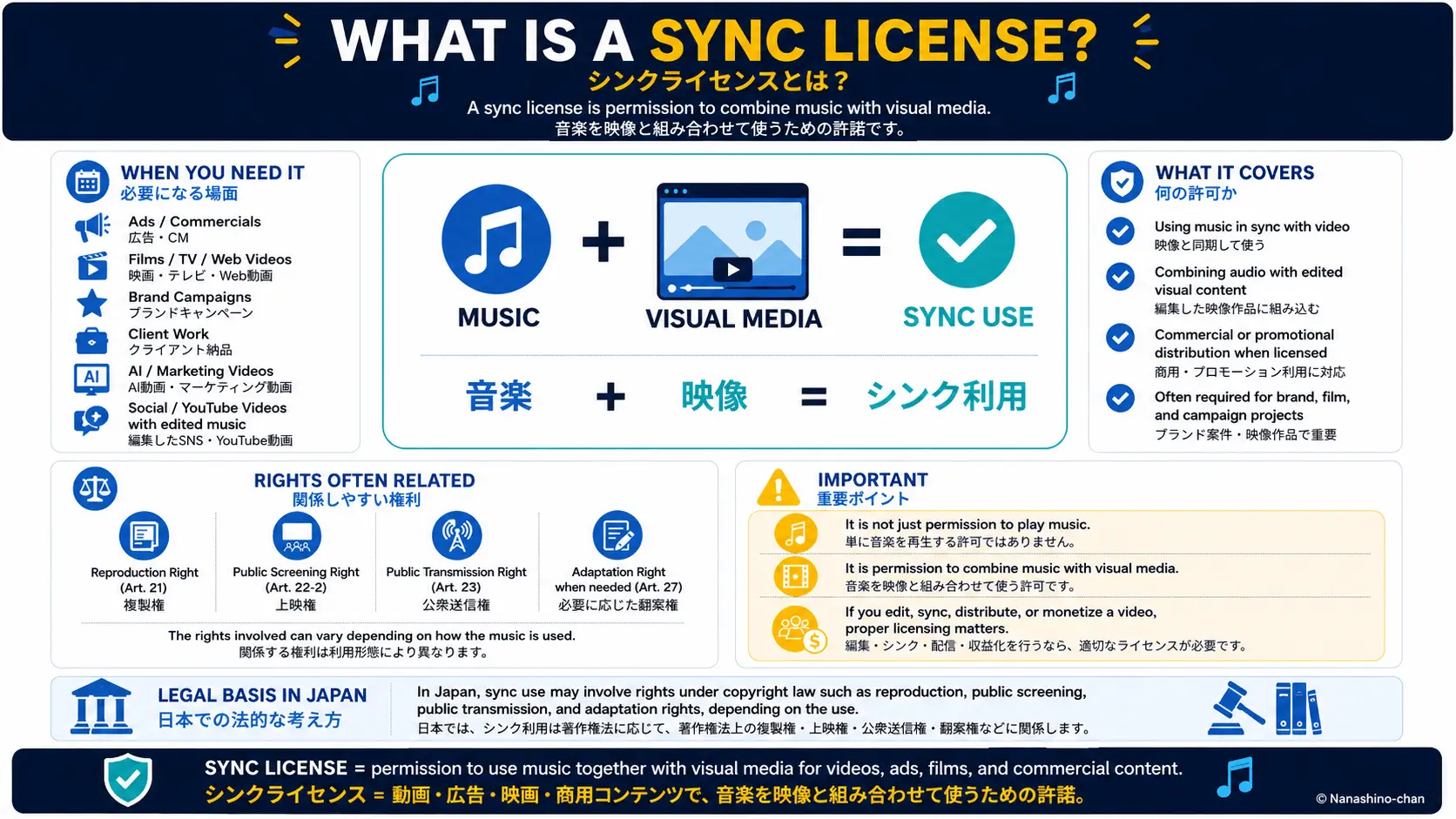
17. Does editing, cutting, looping, or fading require a Sync License?
When the recording is imported into video-editing software and becomes part of the exported audiovisual work, a Sync License is required. This includes cutting, looping, fading, shortening, mixing under narration, and aligning the music with visual scenes.
Remixing, creating derivative music, or materially altering the composition may require separate written permission beyond an ordinary Sync License.
18. What license applies to a brand collaboration or sponsored video?
If the track is selected as official platform-library audio and the platform permits the business use, the Commercial License route may apply.
If the recording is embedded into an edited and exported video, commercial, product film, sponsored production, or client deliverable, a Sync License is required.
19. Can companies use the music in corporate or product videos?
Yes. Corporate videos, product demonstrations, recruitment films, training videos, landing-page videos, event films, and brand stories that contain embedded music require a Sync License or custom agreement.
If the company only selects the track through an approved social-platform music library for a platform-native post, review the Commercial License instead.
20. Can an agency, freelancer, or editor use the music for a client?
Yes, but the license must identify or appropriately cover the licensee, client, project, publishing accounts, platforms, term, and distribution. A personal license cannot be transferred to a client or used as a general agency music library.
Client video production containing embedded music normally requires a Sync License or custom agreement.
21. Can I use the music in a commercial, animation, webtoon trailer, film, or documentary?
Yes, subject to a Sync License or custom agreement. The correct scope depends on the project type, media, territory, term, campaign scale, audience, distribution, and whether the use is online-only or extends to broadcast, theatrical, festival, or other channels.
22. Is television broadcasting included in a standard Sync License?
No, not automatically. Television programs, television commercials, broadcast simulcasts, and similar broadcast-scale uses require prior consultation and a written custom agreement before use.
Provide the program or campaign name, broadcaster, territory, term, number of broadcasts, online catch-up use, paid media scope, and expected launch date when contacting Nanashino-chan.
AI Video, Apps, Games, Templates & Digital Products
AI-assisted production does not change the underlying music rights. The relevant question is how the Nanashino-chan recording is used, embedded, distributed, or made available to end users.
23. Can I use Nanashino-chan music in an AI-generated video?
Yes. If the recording is embedded into the completed AI-generated video, AI-avatar video, AI advertisement, or AI marketing video, use the Sync License route.
The Sync License covers the permitted audiovisual use of the music; it does not grant permission to use the music as AI training data.
24. Can I use the music to train an AI model or create a dataset?
No. Standard Personal, Commercial, and Sync Licenses do not allow AI training, dataset creation, model development, music-generation training, machine-learning input, model evaluation datasets, or similar data use.
Any proposed model- or dataset-related use requires a separate written agreement and may be declined.
25. Can I include the music in an AI template or automated video product?
Not under a standard license. Templates, automated generation systems, downloadable media packages, UGC products, user-selectable music tools, and repeated-output systems may involve redistribution or product-level integration and require a Custom License.
26. Can I use the music inside a game, app, website, or SaaS product?
Interactive or product-level embedding generally requires a Custom License. This includes in-game playback, app background music, user-triggered audio, bundled music, downloadable content, templates, and software that generates or exports content containing the recording.
A promotional video for an app or game is different: if the music is embedded only into the promotional video, the Sync License route may apply.
License Pricing and Administration
The following prices summarize the current standard structure. Always review the licensing page and product terms before purchase because scope and availability may change.
| License | Current Standard Price | Typical Route |
|---|---|---|
| Personal Use License | $19 | Limited non-commercial use stated in the product terms. |
| Commercial License | $500 | Approved official platform-library business use and approved audio-focused online content such as podcasts. |
| Sync License — 1 Month | $500 | Time-limited audiovisual use with the recording embedded into the finished work. |
| Sync License — 3 Months | $1,200 | Three-month audiovisual campaign or distribution term. |
| Sync License — 1 Year | $3,000 | One-year audiovisual campaign or distribution term. |
| Perpetual Sync License | $5,000 | Perpetual use within the exact project and scope stated in the license. |
| Custom License | Custom quote | TV, broadcast, theatrical, games, apps, SaaS, templates, multi-client, or unusual scope. |
27. What happens if I choose the wrong license?
If the selected license does not match the actual project, the use may fall outside the granted permission. Contact Nanashino-chan before publishing or distributing the content.
If the scope changes after purchase, an upgrade, add-on, or custom agreement may be required.
28. Can one license cover multiple accounts, platforms, brands, or clients?
Not automatically. Coverage depends on the named licensee, project, account, platform, brand, client, campaign, term, and distribution scope. Multi-platform, multi-account, whitelisting, or multiple-client use may require an add-on or custom agreement.
29. Can I transfer the license to a client or another account?
No, unless the license or a written agreement expressly permits it. A license may not be freely transferred, assigned, resold, or sublicensed.
Agencies and production teams should arrange the license around the actual client project before delivery.
30. What records should a licensee keep?
Keep the license document, receipt, order or transaction reference, track title, artist name, project name, client or brand name, account names, platforms, publication URL, launch date, term, territory, and a description of how the music is used.
31. Is credit required?
Follow the credit requirement stated in the applicable license or platform feature. Credit is appreciated, but credit alone does not create permission and does not replace the correct license.
A simple credit format is:
Music by Nanashino-chan
https://nanashino-chan.github.io/site/
32. Is this less expensive than licensing a famous song?
Licensing a well-known commercial recording may require separate approval from the composition rights holders and the master recording owner. Approval, price, media, territory, term, exclusivity, and brand association can vary substantially.
Nanashino-chan's eligible catalog is structured for clearer one-stop review and more predictable standard pricing. This does not mean every project has the same risk or cost; the actual license scope remains important.
For context, in Beastie Boys v. Monster Energy, the jury awarded $1.2 million on copyright claims and $500,000 on a false-endorsement claim, for a total of $1.7 million. See the court opinion and case record.
Restrictions and Prohibited Uses
These are general restrictions. The purchased license and formal terms contain the controlling conditions for a specific use.
33. Can I re-upload, redistribute, resell, or sublicense the music?
No. The recording may not be provided as standalone audio, a music-only upload, a download, a music pack, a sample pack, a resale library, a stock-music listing, or a separately accessible client asset.
34. Can I upload the music to a distributor or streaming service?
No. Do not upload Nanashino-chan music to Spotify, Apple Music, YouTube Music, SoundCloud, Bandcamp, stock-music services, distributors, or other music platforms as your own release or catalog.
35. Can I register the music with Content ID or claim ownership?
No. Licensees may not register the music with Content ID, fingerprinting systems, copyright-claim services, publishing databases, rights-management systems, or music-recognition databases as their own work.
Licensees also may not claim authorship, master ownership, composition ownership, publishing ownership, or exclusive rights.
36. Are there restrictions on the surrounding content?
Use may be refused or restricted for unlawful, fraudulent, deceptive, hateful, harassing, discriminatory, explicitly sexual, or otherwise prohibited content. Political advertising, impersonation, manipulated endorsement, harmful misinformation, and regulated or high-risk claims may require prior written review or may be declined.
Check the formal license terms before publishing if the context could create an endorsement, reputational, legal, or safety concern.
日本語FAQまとめ
Nanashino-chanのライセンスは、「誰が使うか」だけでなく、「どのように音楽を利用するか」によって区分されます。
基本的な判断方法
企業がSNSの公式音源ライブラリから楽曲を選び、自社の宣伝投稿に使用:Commercial License
ポッドキャストなど音声主体のオンラインコンテンツ:Commercial License
音源を動画、CM、アニメーションなどの完成ファイルへ直接埋め込んで配信:Sync License
TV放送、テレビCM、劇場利用、アプリ、ゲーム、SaaS、テンプレートへの組み込み:事前相談・Custom License
Commercial Licenseとは何ですか?
InstagramやTikTokなどの公式音源ライブラリからNanashino-chanの楽曲を選択し、企業やブランドが自社の宣伝、広報、商品紹介、商用投稿に使用する場合に適用されます。
ポッドキャストなど、音声を中心としたオンラインコンテンツでの使用も対象です。音源ファイルをダウンロードし、編集した動画や広告素材へ直接埋め込む使用は含まれません。
Sync Licenseとは何ですか?
Nanashino-chanの音源を動画、CM、ブランドコンテンツ、商品紹介、アニメーション、トレーラーなどの映像作品へ直接埋め込み、完成作品を投稿・公開・配信する場合に必要です。
音源のカット、ループ、フェード、尺調整、映像編集ソフトへの読み込み、ナレーションとのミックスなどもSync利用に含まれます。
ワンストップ・ライセンスとは何ですか?
対象楽曲では、作曲著作権と原盤権の両方をNanashino-chanが直接管理しています。そのため、映像と楽曲を組み合わせる許諾と、実際の録音物を使用する許諾を一つの窓口で確認できます。
SNSの有料広告ではどちらのライセンスが必要ですか?
SNSの公式音源ライブラリから選択し、そのプラットフォームが該当する広告利用を認めている場合は、Commercial Licenseが適用される場合があります。
広告動画を外部編集し、音源を完成動画ファイルへ埋め込んでアップロードする場合はSync Licenseが必要です。複数アカウント、ホワイトリスティング、大規模キャンペーンなどは追加条件または個別契約の対象になる場合があります。
YouTube動画に使用できますか?
用途に応じて使用できます。YouTube上の公式機能から音源を選択する場合と、編集した動画ファイルへ音源を埋め込んでアップロードする場合では、必要な許諾が異なります。
音源を完成動画へ直接埋め込む場合は、基本的にSync Licenseを確認してください。ライセンスはYouTubeの収益化、表示、再生数、Content IDの挙動を保証するものではありません。
ポッドキャストで使用できますか?
はい。承認されたポッドキャストなど音声主体のオンラインコンテンツはCommercial Licenseの対象です。番組名、配信先、エピソード数、利用期間、スポンサーや広告の有無などが利用条件と一致している必要があります。
TV番組やテレビCMで使用できますか?
標準のオンライン向けSync Licenseには自動的に含まれません。放送局、番組・広告名、地域、期間、放送回数、見逃し配信、広告配信範囲などを記載して、使用前にご相談ください。
Content IDクレームが発生する可能性はありますか?
自動検出システムにより、正規利用でも音源が検出される可能性があります。クレームが発生した場合は、動画URL、楽曲名、申立人名、クレーム画面、購入記録、ライセンス名、プロジェクト情報を添えてご連絡ください。
AI動画やAI学習に使用できますか?
AI生成動画に音源を埋め込む場合はSync Licenseの対象です。一方、AI学習、データセット作成、モデル開発、音楽生成AIの訓練などは、Personal、Commercial、Syncのいずれの標準ライセンスでも許可されません。
Publicly Observed Uses
Nanashino-chan tracks have appeared in publicly accessible content published by companies, brands, and creators in multiple countries. These references do not necessarily indicate commissioned work, sponsorship, endorsement, or a direct licensing relationship.
View Publicly Observed UsesOfficial Platform Policies
A direct license confirms permission from the rights holder within its stated scope. The platform may still apply its own account, advertising, copyright, region, monetization, and music-library rules.
Disclaimer
This FAQ provides general information about Nanashino-chan music usage and licensing. It is not legal advice and does not replace the terms of a purchased license or a written custom agreement.
Music availability and platform behavior may be affected by account type, region, metadata, platform policy, copyright systems, distribution settings, and changes outside the control of Nanashino-chan. A license does not guarantee monetization approval, reach, visibility, advertising results, claim behavior, or continued platform availability.
このFAQは、Nanashino-chanの楽曲利用とライセンスに関する一般的な案内であり、法的助言ではありません。購入したライセンス、商品規約、請求書、個別の書面契約に記載された条件が優先されます。
Need Music for a Brand, Podcast, Video, Ad, or AI Project?
Review the current license options before publishing. For TV, broadcast, large campaigns, games, apps, templates, multi-client use, or an unusual workflow, contact Nanashino-chan first.