How to Use Music Legally on YouTube
To use music legally on YouTube, you need permission for the exact way you use the music. That permission may come from your own original music, YouTube Audio Library, a commercial music license, or direct approval from the rights holder.
Buying a song, streaming a track, downloading a file, or giving credit does not automatically give you the right to upload that music in monetized videos, Shorts, sponsored content, ads, or client work.
This guide explains the legal music options for YouTube creators, what to check before upload, how Content ID affects music use, and when a commercial license is the safer choice.
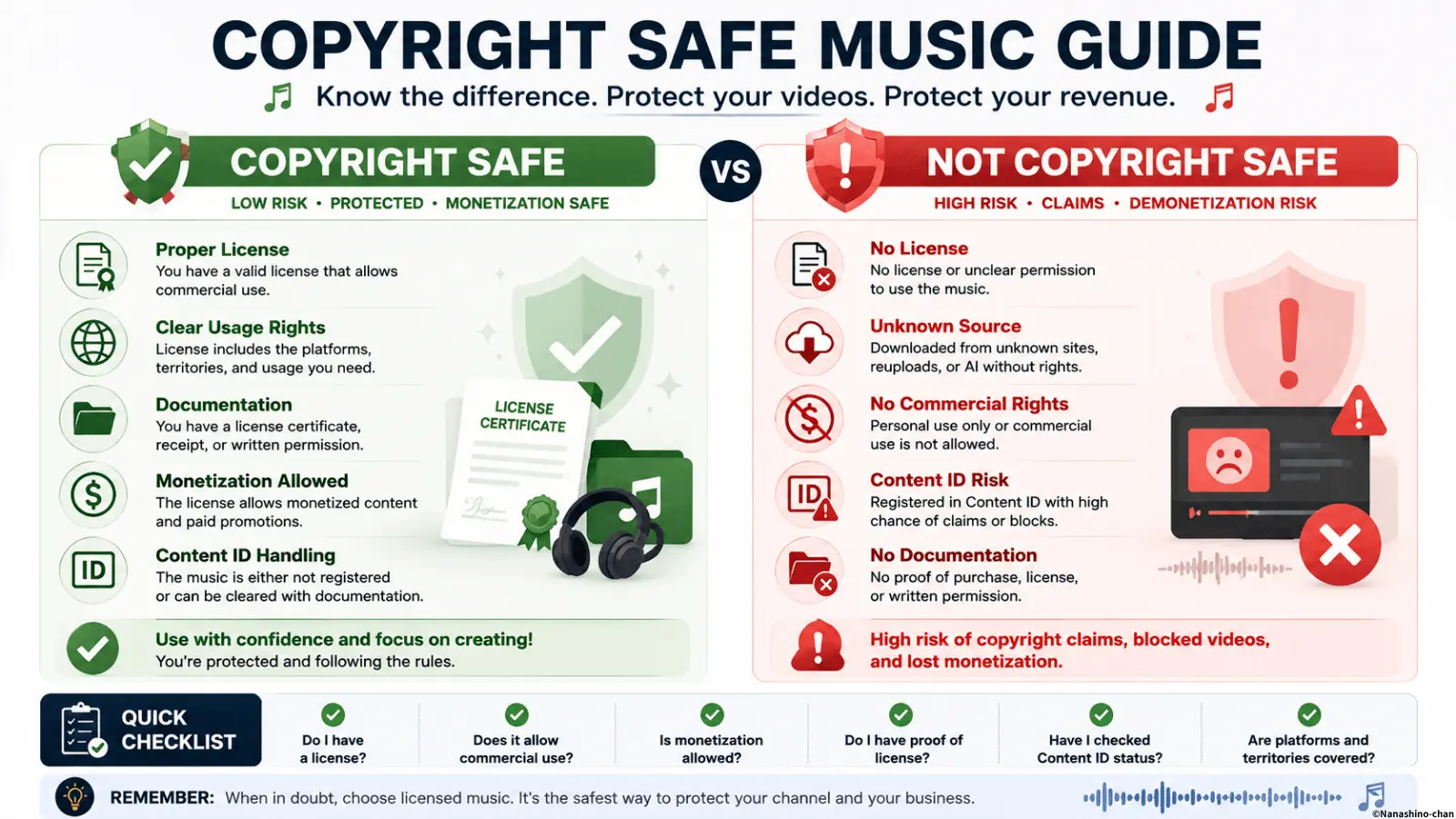
Direct Answer: How Can You Use Music Legally on YouTube?
You can use music legally on YouTube when you have the correct rights for your video. The music must be allowed for your platform, content type, monetization status, commercial purpose, and publishing workflow.
For most creators, the safest legal music options are:
- • Music you created yourself
- • Music from YouTube Audio Library, used under its terms
- • Music with a valid commercial or creator license
- • Music where you have direct permission from the rights holder
- • Public domain music, only when you verify the recording and composition status
If your video is monetized, sponsored, made for a client, connected to a business, or used in ads, choose music with clear commercial-use permission.
Why Legal Music Use Matters on YouTube
Music can affect YouTube monetization, visibility, Content ID claims, brand approvals, client delivery, and long-term channel safety. A video can stay online for years, so unclear music rights can become a problem long after upload.
This matters especially when your channel is no longer just personal. If your videos include ads, affiliate links, sponsorships, product reviews, paid promotions, business education, client work, or brand partnerships, music usage becomes part of your business workflow.
- • Copyright claims may affect monetization
- • Content ID may redirect ad revenue
- • Music can be blocked in some regions
- • Sponsors may require clear usage rights
- • Client videos may need license documentation
- • Paid ads and brand campaigns need stronger permission
Legal Music Options for YouTube Creators
There is no single music source that fits every YouTube project. The right option depends on whether the video is personal, monetized, sponsored, commercial, or client-facing.
| Music Source | Can It Be Legal? | What to Check |
|---|---|---|
| Your own original music | Yes, if you control the rights | Make sure no samples, loops, or collaborators create extra rights issues. |
| YouTube Audio Library | Yes, under YouTube’s terms | Check license type, attribution, and whether the project fits the allowed use. |
| Commercial licensed music | Yes, if license scope matches | Check YouTube use, monetization, commercial rights, Content ID policy, and proof of license. |
| Royalty-free music | Sometimes | Royalty-free can still include restrictions, attribution, platform limits, or Content ID rules. |
| Public domain music | Sometimes | Verify both the composition and the specific recording. A modern recording may still be protected. |
| Streaming music | Usually no for uploads | Listening access does not usually grant YouTube upload or monetization rights. |
| Trending social audio | Depends on platform and use | Check whether YouTube reuse, monetization, business use, or ads are allowed. |
What You Should Not Assume
Most YouTube music problems happen because creators assume that access equals permission. A song can be easy to hear, download, or share, but still not be legally usable in your video.
“I bought the song, so I can use it.”
Buying music for listening does not usually grant video upload, monetization, or commercial-use rights.
“I gave credit, so it is legal.”
Credit may be required by some licenses, but credit alone usually does not replace permission.
“Royalty-free means unlimited use.”
Royalty-free music can still have limits for ads, client work, broadcasts, paid campaigns, or Content ID systems.
“If the video is not monetized, copyright does not matter.”
Copyright can still matter even if the video is not monetized, especially if the video is public, promotional, or uses protected music.
Checklist Before You Upload Music to YouTube
Before publishing a video with music, check the license and keep records. This is especially important for monetized channels, Shorts, sponsored videos, and client projects.
- • Do I know the exact track title and artist?
- • Do I know who owns or licenses the music?
- • Is YouTube use allowed?
- • Is monetization allowed?
- • Is YouTube Shorts use allowed?
- • Is sponsored content allowed?
- • Is commercial use allowed?
- • Is client work or agency work allowed?
- • Is attribution required?
- • Is the track registered with Content ID?
- • What should I do if a Content ID claim appears?
- • Do I have proof of license or permission?
How Content ID Affects Legal Music Use
YouTube Content ID can detect copyrighted audio or video in uploaded content. If the system finds a match, a Content ID claim may appear. This can affect monetization, ads, visibility, or regional availability depending on the rights holder’s policy.
Using licensed music does not always mean a claim can never appear. Some licensed music is still registered with Content ID. The difference is that a proper license gives you documentation and instructions for resolving or verifying the claim.
- • Check the track’s Content ID policy before upload
- • Keep proof of license
- • Save track title and artist name
- • Follow the license holder’s claim release process
- • Do not dispute claims casually without valid documentation
For more detail, see: YouTube Content ID Guide.
What License Do You Need for YouTube Music?
The license you need depends on what the video is for. A casual upload, monetized video, sponsored post, paid ad, and client video may require different permissions.
| YouTube Use Case | Recommended License | Notes |
|---|---|---|
| Personal non-commercial video | Personal / platform-permitted music | Check attribution and platform rules. |
| Monetized YouTube video | Commercial license | The license should clearly allow monetization. |
| YouTube Shorts | Creator / commercial license | Check whether short-form and platform reuse are covered. |
| Sponsored video | Commercial / sync license | Brand involvement usually requires clearer permissions. |
| YouTube ad | Sync / campaign license | Advertising use needs stronger commercial scope. |
| Client video | Commercial / custom license | Confirm client-facing usage, platforms, duration, and proof of license. |
Does Attribution Make Music Legal on YouTube?
Attribution means giving credit to the creator or rights holder. Some music licenses require attribution, and YouTube Audio Library may provide attribution text for certain tracks.
However, attribution is not the same as permission. If the music license does not allow YouTube use, monetization, commercial use, or ads, simply crediting the artist may not make the use legal.
- • Attribution may be required by some licenses
- • Attribution does not automatically replace permission
- • Always follow the exact credit format if provided
- • Keep a copy of the attribution requirement
- • For commercial videos, confirm the license scope separately
What Proof Should You Keep?
If a Content ID claim, copyright question, sponsor review, or client verification request appears later, your documentation matters.
- • Track title
- • Artist name
- • License holder or buyer name
- • Purchase receipt or license confirmation
- • License terms at the time of use
- • Permitted platforms
- • Monetization permission
- • Commercial-use permission
- • Attribution text, if required
- • Content ID instructions
- • Project name and video URL
Commercial-Ready Lo-Fi Music for YouTube Creators
Nanashino-chan provides original lo-fi music with commercial licensing options for YouTube creators, monetized videos, Shorts, podcasts, sponsored content, brand campaigns, AI videos, product videos, and client projects.
The music is designed for modern creator workflows: calm background music, study videos, productivity content, tutorials, narration, product reviews, brand storytelling, and commercial social media campaigns.
YouTube Monetization
Music for monetized channels, Shorts, tutorials, podcasts, and creator businesses.
Commercial Projects
Music for sponsored content, brand campaigns, product videos, ads, and client work.
Rights Clarity
Licensing helps creators keep documentation and reduce copyright uncertainty.
ISRC, Track Identification, and Rights Clarity
ISRC stands for International Standard Recording Code. It helps identify a specific sound recording. ISRC is not a music license, but it can help clarify recording identity and release information.
Nanashino-chan’s officially distributed music is managed as identifiable recordings. Many releases are associated with formal recording metadata such as ISRC-based identification.
- ✔ Identifiable recordings
- ✔ Clearer artist and track identity
- ✔ Commercial licensing available
- ✔ Useful for YouTube creators, brands, agencies, and monetized videos
Track identification supports rights clarity, but it does not replace licensing. Always use the appropriate license for videos, ads, sponsored content, client work, or commercial campaigns.
Preview Music Before You License
Listen to original lo-fi tracks before using them in YouTube videos, Shorts, sponsored content, AI videos, ads, brand campaigns, or client projects.
Browse the catalog → All Tracks
Official YouTube Copyright & Music Resources
YouTube policies and music usage rules may change over time. Always review the latest official YouTube Help pages before publishing monetized, commercial, sponsored, or client-facing content.
- YouTube Copyright Guidelines
- YouTube Audio Library Help
- YouTube Content ID Overview
- YouTube Content ID Claims
- YouTube Copyright Strikes
This page is an educational guide and not legal advice. Always review official YouTube guidance and the specific license terms for any music you use.
FAQ
How can I use music legally on YouTube?
You can use music legally on YouTube by using music you created yourself, music from YouTube Audio Library under its terms, music with a valid license, or music where you have permission from the rights holder.
Does buying a song let me use it in a YouTube video?
No. Buying or streaming a song for listening usually does not grant rights to upload, monetize, or commercially use that music in a YouTube video.
Can I use copyrighted music on YouTube if I give credit?
Credit alone usually does not replace permission. Some licenses require attribution, but attribution does not automatically grant the right to use copyrighted music.
What music can YouTube creators use safely?
Creators should use music with clear licensing terms, documented permission, YouTube usage rights, monetization permission, and a clear Content ID or claim policy.
Can licensed music still get a Content ID claim?
Yes. Some licensed music may still be registered with Content ID. If a claim appears, creators may need to follow the license holder's release process or provide proof of permission.
Do monetized YouTube videos need a commercial music license?
Monetized YouTube videos often need music that clearly allows commercial or monetized usage. Sponsored content, ads, client work, and brand videos may require broader licensing.
Need Music You Can Use on YouTube?
Use original lo-fi music with commercial licensing options for YouTube creators, monetized videos, Shorts, sponsored content, brand campaigns, AI videos, ads, and client projects.
Related Pages
- Can I Use Music on YouTube?
- Music License for YouTube Creators
- YouTube Audio Library vs Commercial Music
- YouTube Content ID Guide
- How to Avoid Content ID Claims
- Best Music Licenses for YouTube Monetization
- How to Check If Music Is Copyright-Safe
- Commercial Use Music Guide
- ISRC and Shazam Music Identification
- Licensing Page