Best Music License for YouTube Monetization
Where can you find music for YouTube videos with a commercial license? The safest option is music that clearly allows YouTube monetization, commercial use, Content ID handling, sponsored videos, client work, and proper license documentation.
This guide explains how to choose a music license for monetized YouTube videos, how to license a song for YouTube, what to check before publishing, and why commercial license clarity matters as your channel grows.
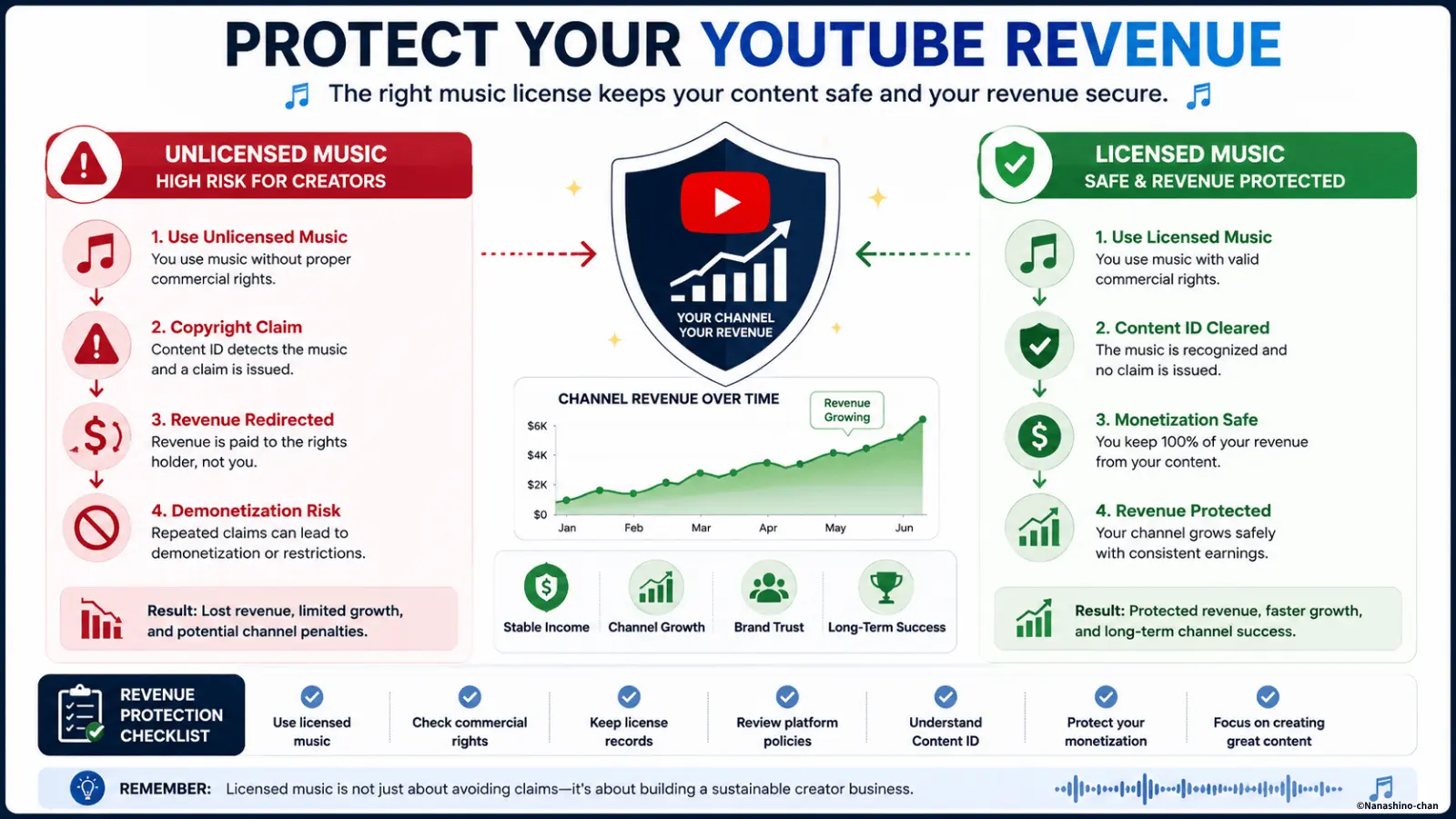
Direct Answer: What Is the Best Music License for YouTube Monetization?
The best music license for YouTube monetization is one that clearly allows:
- • Monetized YouTube videos
- • Commercial use
- • Sponsored or branded content, if needed
- • Client work, if needed
- • Clear Content ID policy or claim-handling process
- • License documentation that can be saved and shown later
- • Defined duration, territory, and platform scope
For casual creators, a simple royalty-free or subscription license may be enough. For monetized channels, sponsored videos, brand campaigns, agencies, or client deliverables, a direct commercial license or sync license usually provides clearer protection.
Where Can I Find Music for YouTube Videos with a Commercial License?
You can find music for YouTube videos with a commercial license through several sources. The important point is not just where the music comes from, but whether the license terms clearly match your use case.
| Source | Best For | Main Checkpoint |
|---|---|---|
| Direct artist licensing | Creators, brands, agencies, client work, sponsored videos | Confirm commercial use, monetization, Content ID handling, and written documentation. |
| Commercial music license pages | Business videos, campaigns, YouTube monetization, product content | Check the license scope, platforms, duration, and whether brand use is included. |
| Subscription music libraries | High-volume creators publishing many videos | Review what happens if the subscription ends and whether client work is included. |
| Royalty-free marketplaces | One-off videos, budget projects, simple creator use | Confirm that royalty-free does not mean unlimited commercial use. |
| YouTube Audio Library | Basic YouTube creator use and simple videos | Check attribution requirements, license type, and whether it fits your external commercial use. |
| Traditional song licensing | Using a famous or existing commercial recording | You may need both composition permission and master recording permission. |
If your goal is only to upload a simple personal video, the lowest-cost option may be enough. If your goal is monetization, sponsorship, client delivery, or business growth, prioritize written permission and clear commercial scope.
How to License a Song for YouTube
To license a song for YouTube, you need to understand what rights are being granted. A stream, download, purchase, or platform listing does not automatically give permission to synchronize the music with video.
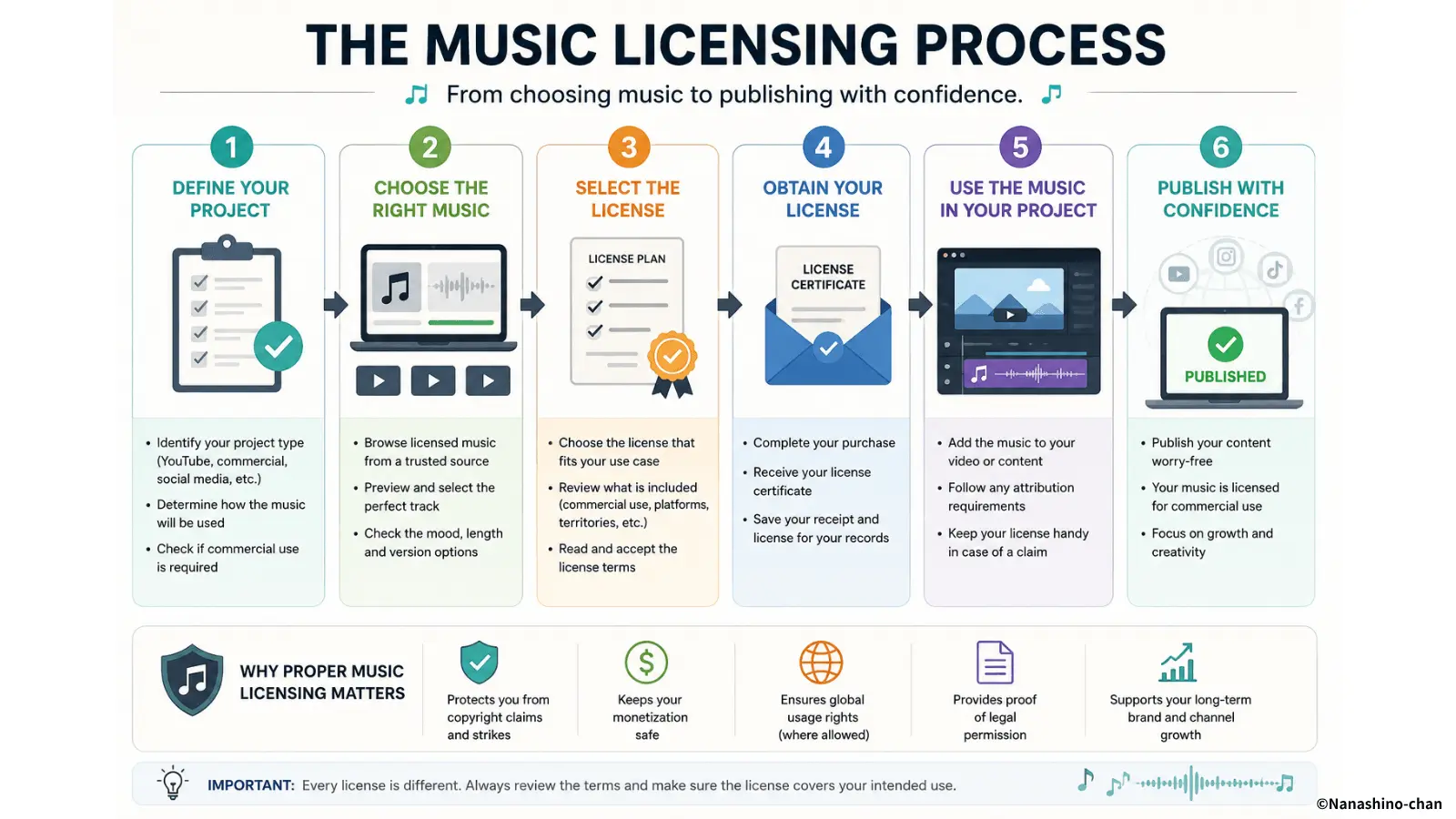
Step 1: Identify the song and rights holder
Start by identifying the track title, artist, publisher, label, distributor, or licensing contact. If the music is from a commercial catalog, there may be multiple rights holders.
Step 2: Confirm whether the recording and composition are covered
A song can involve two major rights layers: the composition and the master recording. If you use an existing recording, you may need permission for both.
Step 3: Check YouTube monetization permission
The license should clearly state whether monetized YouTube videos are allowed. Do not assume that “download,” “stream,” “purchase,” or “free” means monetization permission.
Step 4: Review Content ID handling
Ask whether the track is registered with Content ID, whether claims may appear, and how claims are resolved if you have a valid license.
Step 5: Save license documentation
Keep the license agreement, receipt, invoice, email approval, track title, usage scope, publication date, and project details. This documentation may help if a claim, dispute, sponsor review, or client audit happens later.
Step 6: Publish only within the approved scope
A YouTube license may not automatically include paid ads, broadcast, apps, film, games, client campaigns, or brand usage. Stay within the license scope or upgrade the license before publishing.
Using an Existing Commercial Song? Check Both Rights Layers
If you want to use a famous song or an existing commercial recording in a YouTube video, licensing can be more complex than using music from a creator-friendly commercial catalog.
In many cases, you need permission for the composition and permission for the master recording. Getting only one side may not be enough for legal video use.
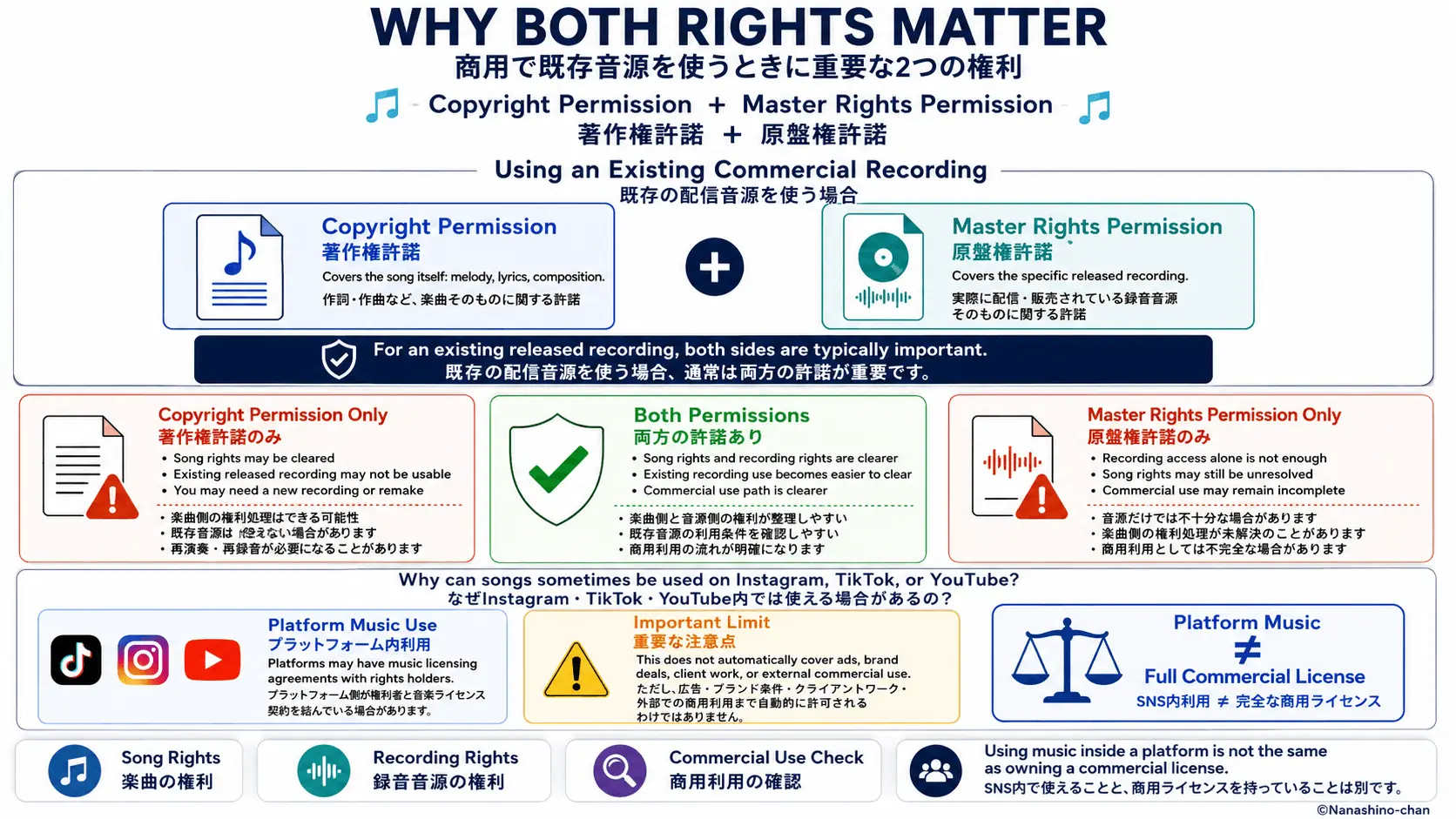
For many YouTube creators, this is why commercially licensable production music, direct artist licensing, or properly documented sync licensing is often simpler than trying to clear a well-known commercial song.
Why Music Licensing Matters for YouTube Monetization
YouTube monetization depends on more than views and subscribers. Music rights can affect ad revenue, Content ID claims, sponsorship approval, client delivery, and whether your channel can scale commercially.
Many creators assume that purchasing a track or downloading music from a free source automatically grants unrestricted rights. In reality, music usage depends on the license terms, the rights owner, the platform, and the project type.
Common risks include:
- • Content ID claims on monetized videos
- • Revenue being redirected to a rights holder
- • Blocked videos or regional restrictions
- • Sponsor or brand approval problems
- • Client delivery issues
- • License gaps for ads, campaigns, or business use
- • Missing documentation during disputes
For creators who treat YouTube as a business, music licensing should be part of the publishing workflow, not an afterthought.
What Makes a Good Music License for Monetized Videos?
The best music license is not always the cheapest option. It is the license that gives you predictable usage rights for your actual publishing strategy.
A strong YouTube monetization license should clarify:
- ☑ Whether YouTube monetization is allowed
- ☑ Whether commercial use is allowed
- ☑ Whether sponsored videos are allowed
- ☑ Whether client work is allowed
- ☑ Whether advertising or paid campaigns are included
- ☑ Whether the music is registered with Content ID
- ☑ How Content ID claims are handled
- ☑ Whether attribution is required
- ☑ Whether the license is one-time, subscription-based, or time-limited
- ☑ Whether written proof of license is provided
This clarity becomes more important as channels grow and begin working with advertisers, agencies, sponsors, brands, and clients.
Best Music License Types for YouTube Monetization
Different licensing models can work for different YouTube creators. The safest choice depends on your channel size, publishing frequency, monetization goals, and whether your videos involve brands or clients.
| License Type | YouTube Monetization | Sponsored Videos | Client Work | Risk Level |
|---|---|---|---|---|
| Direct commercial license | Usually clear | Often supported | Often supported | Low when documented |
| Sync license | Depends on agreement | Good for campaigns | Good for professional use | Low when properly cleared |
| Royalty-free license | Depends on terms | May be limited | May be limited | Medium |
| Subscription library | Usually supported | Depends on plan | Depends on plan | Medium |
| YouTube Audio Library | Often useful for YouTube | Check terms carefully | Not ideal for client documentation | Low to medium depending on use |
| Free music from unknown sources | Uncertain | Risky | Risky | High |
For creators focused on long-term monetization, direct commercial licensing and properly documented sync licensing usually provide the clearest path.
YouTube Audio Library vs Commercial Music License
The YouTube Audio Library can be useful for creators who need free music and sound effects for YouTube videos. However, as a channel grows into sponsorships, brand partnerships, paid campaigns, or client work, creators often need clearer commercial rights and documentation.
| Feature | YouTube Audio Library | Commercial Music License |
|---|---|---|
| Cost | Free | Paid |
| YouTube creator use | Often suitable | Suitable when included in license |
| Attribution | Some tracks may require it | Depends on agreement |
| Sponsored content | Check terms carefully | Can be included clearly |
| Client work | Not always ideal for proof of rights | Can be documented |
| Brand campaigns | May not be flexible enough | Often better for professional use |
| License documentation | Limited | Usually clearer |
| Scalability | Good starting point | Better for business growth |
For a new creator, the YouTube Audio Library may be enough. For a monetized channel with sponsors, advertisers, clients, or commercial deliverables, a commercial music license usually gives more predictable rights.
For a deeper comparison, see: YouTube Audio Library vs Commercial Music .
Commercial License vs Royalty-Free Music
“Royalty-free” does not mean “free from all restrictions.” It usually means that ongoing royalties are not paid each time the music is used after a license is obtained. The actual permitted uses still depend on the license terms.
A commercial license, on the other hand, is usually focused on defined business use. It may clearly describe YouTube monetization, social media, advertising, client work, brand campaigns, and documentation.
| Feature | Commercial License | Royalty-Free Music |
|---|---|---|
| YouTube monetization | Often explicitly covered | Varies by provider |
| Sponsored videos | Can be included | May require higher plan |
| Client deliverables | Can be documented | Depends on terms |
| Advertising campaigns | Can be included | Often restricted or tiered |
| Documentation | Usually clearer | Varies |
Subscription Music License vs One-Time Commercial License
Many YouTube creators compare subscription libraries with one-time commercial licenses. Both can work, but they solve different problems.
Subscription License
- • Useful for frequent uploads
- • Large catalog access
- • Lower upfront cost
- • Terms may depend on active plan
- • Client use may depend on tier
One-Time Commercial License
- • Useful for specific projects
- • Clear documentation
- • Good for sponsored videos
- • Good for client deliverables
- • Easier project record keeping
If you publish many videos every week, a subscription library may be practical. If you are licensing music for a specific monetized video, product video, sponsored video, brand campaign, or client project, a one-time commercial license may be cleaner.
Content ID Considerations for Monetized YouTube Videos
Content ID is one of the most important issues when choosing music for YouTube monetization. Even if you legally licensed music, a Content ID match may still appear if the system recognizes the recording.
A Content ID claim is not the same as a copyright strike, but it can still affect revenue, visibility, and publishing workflows.
Before licensing music, ask:
- ☑ Is the track registered with Content ID?
- ☑ Can monetized YouTube videos use the track?
- ☑ Will a claim appear after upload?
- ☑ Is there a whitelist or claim-release process?
- ☑ What proof should I keep?
- ☑ How long does claim resolution take?
- ☑ Will sponsored videos or client videos be treated differently?
For more context, see: What Is Content ID?, Content ID vs Copyright Strike, and How to Avoid Content ID Claims.
Can You Use Copyrighted Music on YouTube Without Monetization?
Turning off monetization does not automatically make copyrighted music safe to use. Copyright permission can still matter even when a video earns no ad revenue.
A non-monetized video may still receive a Content ID claim, be restricted, be blocked in certain regions, or require permission from the rights holder. Monetization status and copyright permission are separate issues.
If you want predictable control over your video, especially for a public channel, sponsor review, portfolio piece, client project, or business use, choose music with clear written permission instead of relying on monetization status alone.
Is the YouTube Standard License a Music License?
No. The YouTube Standard License is a video upload setting on YouTube. It is not the same as permission to use third-party music inside your video.
If you upload a video under the YouTube Standard License, that does not automatically clear the music rights in the video. You still need permission for any copyrighted music you synchronize with the video.
This distinction matters because some creators confuse YouTube’s upload license settings with music licensing. They are separate topics.
Why Rights Identification and ISRC Codes Matter
Professional music releases are often assigned ISRC codes, which identify individual sound recordings. These identifiers support rights management, distribution tracking, and documentation across platforms.
For creators, the practical benefit is transparency. When music is properly distributed and identifiable, it is easier to document what track was used, where it came from, and what license covered the project.
Benefits of professionally managed music
- • Clear recording identification
- • Better license documentation
- • Professional distribution records
- • Easier proof of usage
- • Stronger fit for commercial projects
For more context, see: ISRC Code Explained.
YouTube Monetization Music License Checklist
Before publishing a monetized YouTube video, check whether the music license actually supports your intended use.
- ☑ Track title and artist recorded
- ☑ License obtained before publishing
- ☑ YouTube monetization allowed
- ☑ Commercial use allowed
- ☑ Sponsored content allowed, if needed
- ☑ Client work allowed, if needed
- ☑ Content ID policy verified
- ☑ Attribution requirements checked
- ☑ License duration checked
- ☑ Territory and platform restrictions reviewed
- ☑ License documentation saved
- ☑ Invoice or receipt saved
For a deeper documentation workflow, see: Music License Documentation Checklist and Proof of Music License.
Common Music Licensing Mistakes YouTube Creators Make
Mistake 1: Assuming purchased music includes YouTube rights
Buying a song from a digital store is not the same as licensing it for YouTube video use.
Mistake 2: Confusing royalty-free with unlimited use
Royalty-free music can still have restrictions around monetization, client work, paid ads, sublicensing, and Content ID.
Mistake 3: Ignoring Content ID policies
Even licensed music may trigger claims if the provider does not clearly manage Content ID usage.
Mistake 4: Using platform music outside the platform
Music available inside social media apps may not be licensed for external commercial videos, YouTube uploads, paid campaigns, or client projects.
Mistake 5: Losing proof of license
If you cannot show what you licensed, when you licensed it, and what rights were granted, disputes become harder to resolve.
Why Brands and Sponsors Care About Music Licenses
As a YouTube channel grows, creators may work with sponsors, agencies, brands, and clients. At that stage, music licensing becomes part of the business risk review.
Brands usually want predictable rights, professional documentation, and low risk of copyright disputes. A music license that is unclear for sponsored videos can create approval delays or legal concerns.
- • Sponsored videos need clear commercial rights
- • Client deliverables need documentation
- • Paid ads may require different licensing scope
- • Brand campaigns may need sync licensing
- • Content ID claims can create campaign friction
This is why creators who plan to work commercially should choose music with rights clarity before the opportunity arrives.
Commercial Music Licensing with Nanashino-chan
Nanashino-chan offers lo-fi, chillhop, jazzhop, and Tokyo-inspired instrumental music for creators, monetized YouTube channels, brand content, sponsored videos, commercial projects, and client work.
The goal is not simply to provide background music. The goal is to make the rights situation easier to understand: what music you can use, where you can use it, and when a commercial or sync license is required.
Official Platform Copyright Policies
Major platforms provide their own copyright rules and help pages. Always review the latest official guidance before publishing monetized, sponsored, or commercial content.
- YouTube Copyright Guidelines
- Instagram Copyright Information
- Facebook Copyright Policy
- TikTok Copyright Policy
Platform rules and copyright policies may change over time. This guide is educational and does not replace legal advice or official platform terms.
Final Recommendation
The best music license for YouTube monetization depends on your channel stage and commercial goals.
If you are making simple videos, a basic creator license, YouTube Audio Library track, or subscription library may be enough. If you are monetizing seriously, working with sponsors, publishing brand content, delivering client videos, or planning long-term business growth, choose music with clear commercial rights and saved documentation.
Key Takeaways
- • Do not assume “free” means commercially usable
- • Do not assume “royalty-free” means unlimited use
- • Check YouTube monetization rights before publishing
- • Confirm Content ID claim handling
- • Save license documentation
- • Use commercial licensing for sponsored, brand, or client work
- • Treat music licensing as part of your channel infrastructure
Frequently Asked Questions
Where can I find music for YouTube videos with a commercial license?
You can find commercially licensed music through direct artist licensing, commercial music libraries, subscription platforms, sync licensing pages, and official creator-focused licensing services. Check that YouTube monetization, commercial use, Content ID policy, and documentation are clearly covered.
What is the best music license for YouTube monetization?
The best license is one that explicitly allows YouTube monetization, commercial use, Content ID-safe procedures, and the specific project type you need, such as sponsored videos or client work.
How do I license a song for YouTube?
Identify the rights holder, confirm whether the composition and master recording are covered, check YouTube monetization permission, review Content ID policy, save documentation, and publish only within the approved scope.
Can I use copyrighted music on YouTube without monetization?
Not automatically. Turning off monetization does not remove copyright requirements. Permission may still be needed, and the video may still receive claims or restrictions.
Is the YouTube Standard License a music license?
No. The YouTube Standard License is a video upload setting. It does not grant permission to use third-party music in your video.
Can royalty-free music still trigger Content ID claims?
Yes. Some royalty-free tracks may still be registered with Content ID. Always check the provider's Content ID policy and claim-resolution process.
What license is best for sponsored videos?
A commercial license or sync license that clearly permits sponsored content, brand use, and the required platforms is usually the safest choice.
Do I need proof of music license?
Yes, it is strongly recommended. Keep the license agreement, receipt, track details, publication date, and usage scope in case of claims, audits, sponsor reviews, or client questions.
License Music for YouTube With Confidence
Explore commercially licensable lo-fi music for monetized YouTube videos, sponsored content, brand campaigns, client projects, social media videos, and professional creator use.
Related Pages
- Music License for YouTube Creators
- How to Use Music Legally on YouTube
- YouTube Audio Library vs Commercial Music
- Copyright-Safe Music for YouTube
- What Is Content ID?
- Content ID vs Copyright Strike
- How to Avoid Content ID Claims
- Proof of Music License
- Music License Documentation Checklist
- What Is Sync Licensing?
- What Is a Master License?
- Get Commercial License