What Does Content ID Mean?
Content ID means YouTube’s automated content identification system. It helps copyright owners identify and manage copyrighted audio or video when someone uploads a video to YouTube.
If you saw the words “Content ID,” “Content ID claim,” “copyright claim,” or “copyright ID” in YouTube Studio, this guide explains what those terms mean, how the system works, and what creators should check before using music in videos.
This page focuses on the basic meaning of Content ID first, then explains claims, copyright strikes, music detection, and safer music workflows for creators.
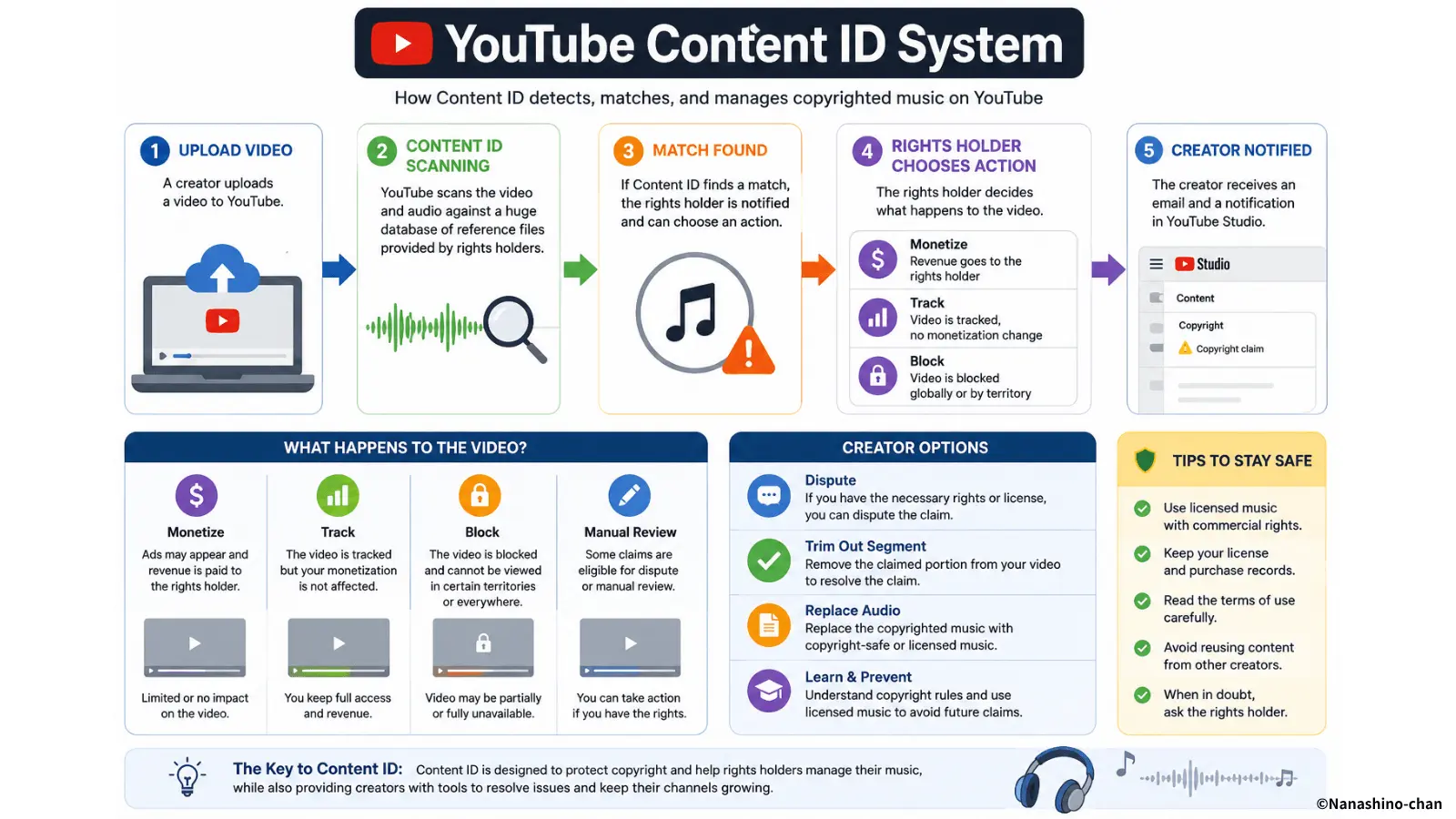
What Is Content ID?
Content ID is YouTube’s automated copyright identification system. It compares uploaded videos against reference files provided by copyright owners. These reference files can include music recordings, video clips, or other copyrighted material.
When YouTube finds a match, the system can apply a Content ID claim. The copyright owner can then choose what happens to the video, depending on their settings and YouTube’s policies.
- • Content ID is a YouTube copyright identification system
- • It scans uploaded videos for matching audio or video
- • It is mainly used by eligible copyright owners
- • It can create Content ID claims when matches are found
- • It is not the same as a copyright strike
What Does Content ID Mean?
In simple terms, Content ID means “content identification.” It is YouTube’s system for identifying copyrighted content inside uploaded videos.
The phrase can sound confusing because people sometimes use similar terms such as “content identification,” “copyright ID,” “copyright claim,” or “Content ID claim.” These terms are related, but they do not all mean the same thing.
- • Content ID = YouTube’s automated identification system
- • Content identification = the general idea of identifying media content
- • Content ID claim = a claim created after a match is detected
- • Copyright claim = a broader term for a copyright-related claim
- • Copyright strike = a different and more serious copyright enforcement action
Content ID vs Content Identification
Content identification is a general concept. It means identifying audio, video, images, or other media content. Many platforms and technologies can use content identification in different ways.
YouTube Content ID is a specific system built for YouTube. It is used to help eligible copyright owners identify and manage their copyrighted content on YouTube.
Content Identification
A general term for identifying media such as audio, video, images, or recordings.
YouTube Content ID
YouTube’s specific automated system for identifying copyrighted audio and video on YouTube.
Copyright ID
A common search phrase, but not the best term. Most users mean Content ID or a copyright claim.
What Is the Content ID System?
The Content ID system works by comparing uploaded videos against reference content submitted by copyright owners. If the uploaded video contains matching audio or video, YouTube can automatically detect the match.
The system is especially important for music because a creator may use a song, background track, remix, sample, or short audio clip without realizing that the recording is protected and registered in Content ID.
- Copyright owners provide reference files to YouTube
- A creator uploads a video
- YouTube scans the uploaded video
- The system compares the upload with reference files
- If a match is found, a Content ID claim may appear
- The copyright owner’s policy may affect monetization, visibility, or tracking
What Is a Content ID Claim?
A Content ID claim is a copyright-related notice that can appear when YouTube’s Content ID system finds matching copyrighted content in an uploaded video.
A claim does not always mean your video will be removed. Depending on the rights holder’s policy, the video may stay online, have ads placed on it, have revenue redirected, be blocked in some regions, or be tracked.
- • A Content ID claim can appear automatically
- • It usually comes from an audio or video match
- • The copyright owner decides the policy applied to the match
- • The video may still remain visible depending on the claim
- • Monetization may be affected
Content ID Claim vs Copyright Strike
A Content ID claim and a copyright strike are not the same thing. Many creators confuse them, but the difference is important.
| Term | Meaning | Typical Impact |
|---|---|---|
| Content ID | YouTube’s automated copyright identification system | Scans uploads and detects matches |
| Content ID claim | A claim created when Content ID finds a match | May affect monetization, ads, visibility, or tracking |
| Copyright claim | A general copyright-related claim | Can refer to Content ID or other copyright issues |
| Copyright strike | A more serious copyright enforcement action, usually related to a copyright removal request | Can affect channel standing |
What Happens When Content ID Finds a Match?
When Content ID finds a match, YouTube applies the policy chosen by the copyright owner. Different rights holders may choose different actions.
- • The video may remain online
- • Ads may appear on the video
- • Revenue may go to the copyright owner
- • The video may be blocked in some regions
- • The copyright owner may track viewership data
- • The creator may need to review, replace, mute, or dispute the claim
For casual creators, this can be confusing. For monetized creators, brands, agencies, and client projects, it can create revenue, delivery, or approval problems.
Why Music Often Triggers Content ID
Music is one of the most common reasons creators receive Content ID claims. A song, beat, background track, remix, sample, or short audio clip can match a reference recording if the rights holder has registered it with Content ID.
This can happen even if the music was found online, downloaded for free, used from a social media clip, purchased for listening, or included in an editing workflow.
- • Famous songs are often protected and registered
- • Commercial releases may be detected automatically
- • Royalty-free music can still have restrictions
- • Reposted social media audio can be unclear
- • Buying or streaming a song does not automatically grant YouTube usage rights
- • Licensed music should come with clear usage terms and documentation
Common Misunderstandings About Content ID
Many Content ID problems happen because creators misunderstand what permission they have. A song may be easy to find, but that does not always mean it is cleared for YouTube use.
“I bought the song, so I can use it.”
Buying music for listening does not automatically grant rights to upload it in a YouTube video.
“Giving credit prevents Content ID claims.”
Credit may be required by some licenses, but attribution alone usually does not replace permission.
“Royalty-free means claim-free.”
Royalty-free music can still have license limits, attribution requirements, or Content ID policies.
“A Content ID claim is always a copyright strike.”
A Content ID claim and a copyright strike are different. A claim may affect monetization, but it is not automatically the same as a strike.
How Creators Can Reduce Content ID Problems
Creators cannot control every platform system outcome, but they can reduce uncertainty by choosing music carefully and keeping records.
- • Use music with clear licensing terms
- • Check whether monetized YouTube use is allowed
- • Avoid anonymous or reposted audio sources
- • Check whether the track has a Content ID policy
- • Keep proof of license or purchase
- • Keep track title, artist name, and license details
- • Use officially distributed and identifiable recordings
- • For brand or client work, choose commercial licensing
Can Licensed Music Still Receive a Content ID Claim?
Yes. Licensed music can still receive a Content ID claim if the track is registered in the system. This does not always mean the creator did something wrong. It may mean the creator needs to follow the license holder’s claim release process or provide proof of permission.
This is why license documentation matters. A good music license should explain the track, artist, license holder, permitted platforms, commercial use rights, monetization rights, and any Content ID instructions.
- • Keep proof of license
- • Save purchase or permission records
- • Follow claim dispute or release instructions
- • Use music sources with transparent policies
- • Avoid assuming “licensed” automatically means “no claim will ever appear”
ISRC, Music Identification, and Content ID
ISRC stands for International Standard Recording Code. It helps identify a specific sound recording. ISRC is not the same as Content ID, but both relate to identifying music recordings.
For creators, identifiable music is usually easier to verify than anonymous audio files. Nanashino-chan’s officially distributed music is managed as identifiable recordings, and many releases are associated with formal recording metadata such as ISRC-based identification.
- ✔ ISRC helps identify specific recordings
- ✔ Content ID helps detect matching copyrighted content on YouTube
- ✔ Official distribution can make music easier to verify
- ✔ Licensing documentation is still required for commercial use
Music identification supports rights clarity, but it does not replace licensing. Always use the appropriate license for videos, ads, client work, or monetized content.
Official YouTube Copyright & Content ID Resources
YouTube policies and Content ID systems may change over time. Always review the latest official YouTube Help pages before publishing monetized, commercial, or client-facing content.
- YouTube Content ID Overview
- YouTube Content ID Claims
- YouTube Copyright Guidelines
- YouTube Copyright Strikes
This page is an educational guide and not legal advice. Always review official YouTube guidance and the specific license terms for any music you use.
FAQ
What does Content ID mean?
Content ID means YouTube’s automated content identification system. It helps copyright owners identify and manage copyrighted audio or video when someone uploads a video to YouTube.
What is a Content ID claim?
A Content ID claim is a copyright-related notice that can appear when YouTube’s Content ID system finds matching copyrighted content in an uploaded video.
Is Content ID the same as copyright?
No. Copyright is the legal right. Content ID is YouTube’s automated system for identifying and managing copyrighted content on YouTube.
Is a Content ID claim the same as a copyright strike?
No. A Content ID claim is usually different from a copyright strike. A copyright strike is generally connected to a formal copyright removal request, while Content ID claims are generated through YouTube’s automated matching system.
Can Content ID detect music?
Yes. Content ID can detect matching audio, including music recordings, when copyright owners have provided reference files to YouTube’s Content ID system.
Can licensed music still receive a Content ID claim?
Yes. Some licensed music may still be registered with Content ID. If that happens, the creator may need to follow the license holder’s instructions or provide proof of permission.
How can creators reduce Content ID problems?
Creators can reduce Content ID problems by using music with clear licensing terms, keeping proof of license, avoiding unclear audio sources, and checking whether tracks are registered with Content ID before publishing.
Need Music with Clear Licensing for YouTube?
Use original lo-fi music with licensing options for YouTube creators, monetized videos, Shorts, sponsored content, brand campaigns, AI videos, and commercial projects.
Related Pages
- YouTube Content ID Guide
- How Content ID Works
- Content ID vs Copyright Strike
- How to Avoid Content ID Claims
- How to Avoid Copyright Claims
- Music License for YouTube Creators
- Best Music Licenses for YouTube Monetization
- How to Check If Music Is Copyright-Safe
- ISRC and Shazam Music Identification
- Licensing Page