What Is Sync Licensing?
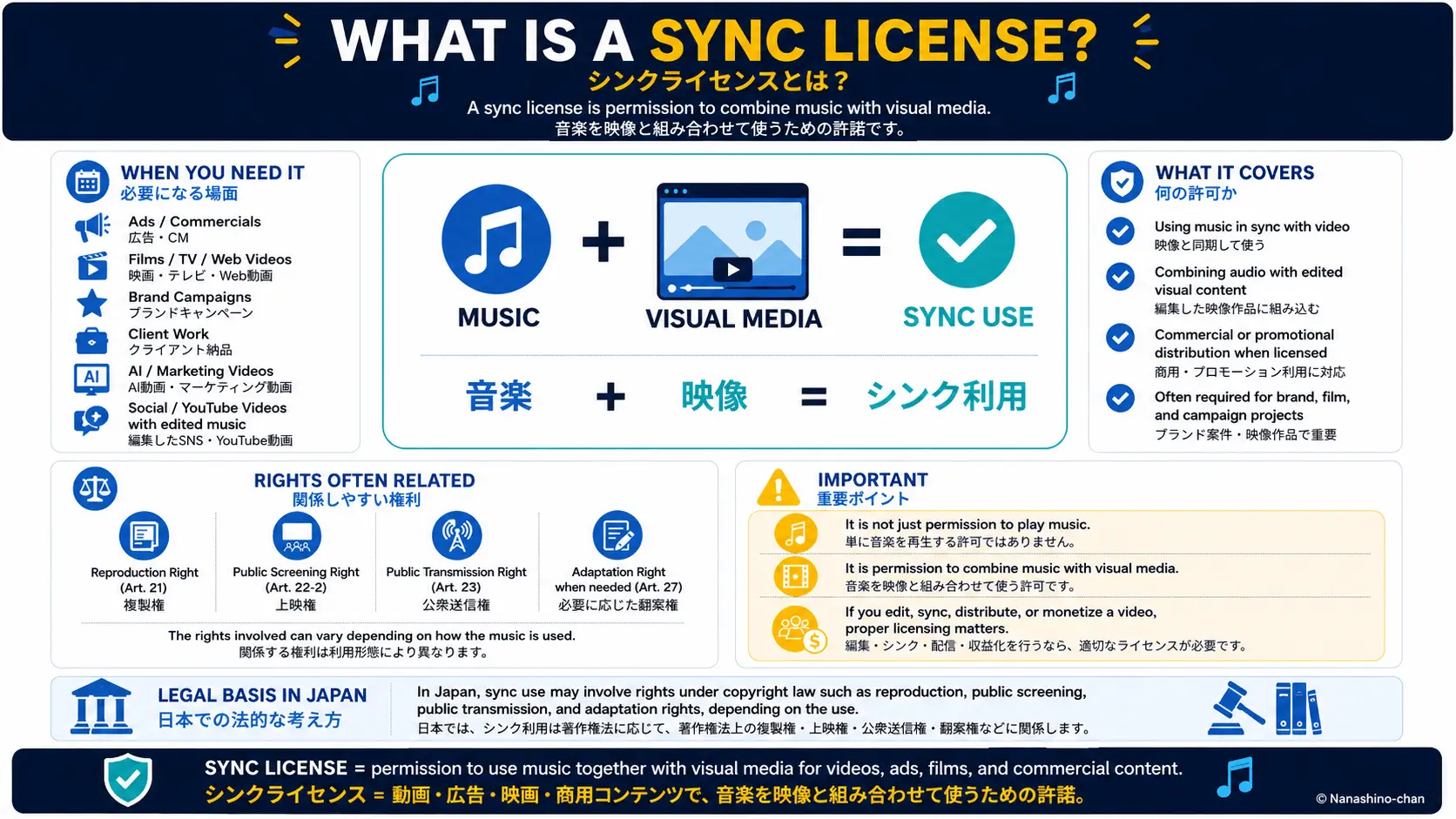
Sync licensing means getting permission to synchronize music with visual media. In simple terms, it is the license that allows music to be used together with video, advertising, brand content, films, social media campaigns, client projects, or AI-generated visuals.
If a song is placed under a YouTube video, Instagram Reel, commercial ad, product video, brand campaign, documentary, film scene, or AI video, sync licensing may become relevant.
This guide explains what a sync license is, when it may be needed, how it differs from a general commercial music license, and why creators, agencies, and brands should understand it before publishing visual content.
Quick Answer: What Does Sync Licensing Mean?
A sync license is permission to pair music with visual content. The word “sync” comes from “synchronization,” meaning the music is synchronized with moving images, video edits, scenes, captions, ads, or other visual media.
This matters because listening to a song and using that song in a video are not the same type of use. A person may be allowed to stream or buy a song, but that does not automatically mean they can place it inside a commercial video, brand campaign, paid advertisement, or client project.
- • Listening to music = access to hear the track
- • Using music in a video = a separate usage context
- • Using music in ads or brand campaigns = usually a higher-risk commercial context
- • Sync licensing = permission for music and visuals to work together
What Is a Music Synchronization License?
A music synchronization license, usually called a sync license, covers the use of music with visual media. This can include online video, advertisements, branded content, social media campaigns, films, trailers, product videos, educational videos, corporate media, and AI-generated video content.
The important point is not only whether the project is large or small. The important point is that the music becomes part of a visual work. Once a song is edited into a video, placed behind a product, synchronized to a brand message, or used in a commercial campaign, the usage becomes different from simple listening.
In traditional music licensing, sync clearance may involve multiple rights holders. A famous song may involve the master recording owner, music publisher, songwriters, labels, administrators, or other rights parties. This is why licensing well-known commercial music can become slow, expensive, and complex.
Examples of Content That May Involve Sync Licensing
Sync licensing can appear in many modern creator and business workflows. It is not limited to Hollywood films or television advertising.
YouTube Videos
Monetized videos, sponsored videos, product reviews, vlogs, Shorts, tutorials, and creator content using music with visuals.
Brand Campaigns
Commercial videos, launch campaigns, lifestyle edits, corporate storytelling, and branded social media content.
Paid Ads
Meta ads, YouTube ads, TikTok ads, paid social campaigns, product promotions, and retargeting creatives.
Client Work
Videos created by agencies, freelancers, editors, social media managers, production teams, or creative studios for clients.
Films and Documentaries
Short films, indie films, documentaries, trailers, festival submissions, and narrative visual media.
AI Videos
AI-generated scenes, avatar videos, product explainers, cinematic AI visuals, and automated video workflows.
Do You Need a Sync License?
Whether you need a sync license depends on the music source, the project type, the license terms, and how the content will be published. The table below gives a practical starting point.
| Use Case | Sync Licensing Relevance | Why It Matters |
|---|---|---|
| Personal video with no commercial purpose | Sometimes | Permission still depends on the music source and platform rules. |
| Monetized YouTube video | Often relevant | Music is synchronized with video and may affect monetization or claims. |
| Sponsored creator video | Highly relevant | Brand involvement makes usage more commercial and rights-sensitive. |
| Business social media post | Often relevant | The content is published by or for a business, brand, or commercial project. |
| Paid advertisement | Very relevant | Paid media usually requires clearer usage scope, term, platform, and territory. |
| Agency or client deliverable | Very relevant | The final video is delivered to another business or client for public use. |
| Film, documentary, trailer, or festival project | Very relevant | Music becomes part of a formal audiovisual work. |
Sync License vs Commercial Music License
A sync license and a commercial music license can overlap, but they are not always the same thing. A commercial license focuses on business or monetized use. A sync license focuses on pairing music with visual media.
For example, a company using music in an internal presentation may need commercial permission. A company placing the same music into a public product video or paid advertisement may also need synchronization rights because the music is now attached to visual content.
| License Type | Main Purpose | Common Use |
|---|---|---|
| Personal License | Individual, non-commercial use | Personal posts, small non-commercial projects, private creator use |
| Commercial License | Business, monetized, or client-facing use | YouTube channels, company content, client videos, social media publishing |
| Sync License | Music synchronized with visual media | Ads, brand campaigns, films, product videos, trailers, AI video projects |
| Custom License | Special use cases or negotiated terms | Exclusivity, unusual distribution, major campaigns, long-term or multi-territory use |
What Rights Are Involved in Sync Licensing?
Music rights can be complicated because a single song may involve more than one right. In many traditional licensing situations, there can be a recording right and a composition right.
Master Recording
The specific recorded version of a track. This may be controlled by an artist, label, distributor, or master owner.
Composition
The underlying music and songwriting. This may involve composers, publishers, administrators, or collecting societies.
Synchronization Permission
The permission to attach music to visual media such as videos, ads, films, social media edits, and campaigns.
This is why famous third-party songs can be difficult to clear. Multiple parties may need to approve the use, and the final price can depend on campaign size, media type, duration, territory, and brand context.
What Should a Sync License Include?
A useful sync license should be specific. Vague permission can create confusion later, especially if the content becomes an advertisement, client deliverable, brand asset, or long-term public video.
- • Track title and artist name
- • Project title or project type
- • Whether the music is used in video, ad, film, social media, AI video, or brand content
- • Platforms covered, such as YouTube, Instagram, TikTok, LinkedIn, websites, paid ads, or streaming platforms
- • Territory, such as worldwide or region-specific use
- • Duration or license term, such as one month, three months, one year, or perpetual use
- • Whether paid advertising, boosting, or media buying is allowed
- • Whether client work or agency deliverables are allowed
- • Whether edits, cutdowns, captions, trailers, or alternate versions are allowed
- • Whether attribution is required
- • Any restrictions, exclusions, or custom conditions
Common Misunderstandings About Sync Licensing
Many creators and businesses confuse music access with music usage rights. This is one of the main reasons music copyright problems happen after a video has already been published.
“I bought the song, so I can use it.”
Buying a song usually gives listening access. It does not automatically grant permission to place the song in a video or ad.
“Attribution makes it legal.”
Credit can be useful, but attribution alone does not replace permission when the license does not allow the use.
“Royalty-free means unrestricted.”
Royalty-free music can still include limits on advertising, client work, broadcast, paid media, platform use, or redistribution.
“Social media music is always safe for brands.”
Platform music libraries may have different rules for personal, creator, business, branded, and paid advertising use.
Sync Licensing for YouTube, Instagram, TikTok, and Social Media
Social media makes sync licensing more confusing because videos are easy to publish, but music rights still matter. A track used in a personal short video may not be cleared for business advertising, brand campaigns, boosted posts, client work, or paid social media campaigns.
For YouTube creators, music may also interact with Content ID, copyright claims, monetization, or platform-level rights management. A sync license does not mean every platform system will behave identically, but clear licensing documentation can help reduce uncertainty and support a more professional workflow.
For brands and agencies, the question is not only “Can this video be uploaded?” The stronger question is: “Do we have the correct permission for this specific project, platform, paid media use, territory, and duration?”
Sync Licensing for AI Videos
AI video workflows create new demand for background music, cinematic atmosphere, product explainers, avatar videos, social media clips, and automated content pipelines. Even when the visuals are AI-generated, the music still has its own rights.
If music is added to an AI-generated video and the final result is published, monetized, used for a client, promoted as an ad, or used by a brand, music licensing should be checked before distribution.
For AI video creators, sync licensing can help clarify whether music may be used in generated scenes, marketing videos, paid campaigns, product demos, educational videos, or client-facing content.
Traditional Sync Licensing vs Direct Original Music Licensing
Traditional sync licensing can be slow when a project uses famous third-party music. A brand, agency, or filmmaker may need to contact multiple rights holders, wait for approvals, negotiate fees, and confirm exactly which rights are included.
Direct original music licensing can be simpler when the music catalog is controlled and organized for licensing. For creators and businesses, this can reduce uncertainty and make it easier to match the right track to the right project.
| Traditional Famous Song Clearance | Direct Original Music Licensing |
|---|---|
| May involve labels, publishers, administrators, and multiple approval steps | Usually clearer when the catalog is managed directly for licensing |
| Can take longer to quote, approve, and clear | Can be faster for creators, agencies, and small-to-mid commercial projects |
| May be difficult for smaller creators or independent businesses | Can be more practical for digital video, brand content, AI videos, and creator workflows |
| Pricing may depend heavily on song fame, campaign size, and media scope | Pricing can be structured by project type, duration, and commercial usage scope |
Nanashino-chan Sync Licensing for Commercial Visual Content
Nanashino-chan provides original lo-fi music designed for creators, brands, agencies, AI video workflows, social media videos, and commercial visual storytelling.
The goal is not only to provide background music, but to make music easier to use in real content workflows: YouTube videos, brand campaigns, product visuals, paid social media, client projects, corporate videos, and AI-generated video content.
Commercial Video
Music for product videos, creator videos, social media content, brand storytelling, and business-owned media.
Brand Campaigns
Music for campaign videos, paid social, lifestyle visuals, product launches, and promotional content.
AI Video Workflows
Music for AI visuals, AI avatar videos, cinematic scenes, automated video content, and AI marketing projects.
Available Sync License Direction
- • 1 Month Sync License — suitable for short campaigns or limited campaign use
- • 3 Months Sync License — suitable for seasonal campaigns or extended promotion
- • 1 Year Sync License — suitable for longer brand campaigns and public commercial content
- • Perpetual Sync License — suitable for long-term visual usage when available terms match the project
Preview Music for Sync-Friendly Projects
Explore lo-fi music designed for calm visuals, brand videos, creator workflows, commercial campaigns, AI video content, and sync-oriented visual storytelling.
Official Platform Copyright Policies
Platform copyright systems, upload rules, music tools, monetization policies, and advertising policies may vary by platform and may change over time. A sync license helps clarify music usage rights, but creators and brands should also review the official policies of the platforms they publish on.
FAQ
What is sync licensing in music?
Sync licensing is permission to synchronize music with visual content. This can include YouTube videos, advertisements, films, brand campaigns, product videos, social media clips, client work, and AI-generated videos.
Why is it called a sync license?
It is called a sync license because the music is synchronized with visual media. The track is not only being listened to; it is being combined with images, scenes, edits, captions, products, or brand messages.
Do I need a sync license for YouTube?
It depends on the music source, license terms, monetization, sponsorship, and how the video is used. If music is placed in a YouTube video, especially a monetized, sponsored, or client-facing video, sync licensing may be relevant.
Do I need a sync license for Instagram Reels or TikTok videos?
Personal use and business use can be treated differently. If a Reel, TikTok, or short-form video is used for a brand, paid campaign, client project, product promotion, or commercial content, you should check whether the music license covers that use.
Is a sync license the same as a master license?
No. A master license relates to the specific sound recording. A sync license relates to using music with visual media. In traditional licensing, a project may need both recording and composition permissions depending on the music and rights holders.
Can I use music in an advertisement with a normal creator license?
Not always. Paid advertising and brand campaigns often require broader permission than ordinary creator use. The license should clearly mention whether ads, paid media, brand use, client work, and campaign duration are covered.
Can AI videos use sync-licensed music?
Yes, if the selected license covers the intended use. AI-generated visuals still need properly licensed music when the final video is published, monetized, used by a brand, delivered to a client, or promoted as part of a campaign.
Does a sync license prevent every Content ID claim?
A sync license documents permission, but platform systems may still vary. Clear licensing information can help reduce uncertainty and support dispute or rights clarification workflows, but no responsible license should promise that every platform system will behave perfectly.
Need Music for a Video, Ad, Brand Campaign, or AI Project?
Nanashino-chan offers original lo-fi music for creators, brands, agencies, AI video workflows, product visuals, social media campaigns, and commercial sync licensing needs.
Related Pages
- How Sync Licensing Works
- Music Licensing vs Sync Licensing
- Sync License for YouTube
- Music Licensing for Commercial Use Guide
- Music License for Marketing Campaigns
- Music License for Agencies
- Music for Brand Content
- Licensed Music for AI Commercial Videos
- Music for AI Marketing Content
- Content ID vs Copyright Strike
- Works & Use Cases
- Licensing Page