Music License for Agencies
Agencies need music for client videos, ad creatives, social media campaigns, product demos, YouTube content, brand films, AI videos, website assets, and commercial marketing workflows.
Because agency work is usually client-facing and commercial, music licensing must be clear before delivery. The safest workflow is to use music with documented rights for client projects, paid campaigns, online video, and multi-platform distribution.
Why Agencies Need Clear Music Licensing
Agency video work often moves across many hands: strategists, editors, freelancers, media buyers, clients, account managers, and brand teams. This makes music licensing more complex than a personal creator upload.
A music track may appear in a draft, a final client video, a paid ad variation, a website hero video, a social media campaign, or a localized version. If the license is unclear, the agency may face client questions, copyright claims, campaign delays, or rights verification problems after delivery.
- • Client-facing projects require stronger rights clarity
- • Paid campaigns need commercial usage permission
- • Multi-platform delivery increases licensing risk
- • Agencies should keep proof of music rights for every project
Agency Use Cases That Need Licensed Music
A music license for agencies should support practical production and delivery scenarios. The license should be suitable not only for editing, but also for final publication on client channels, ad accounts, websites, social platforms, and video platforms.
Client Videos
Music for brand films, product explainers, customer stories, launch videos, testimonials, and campaign assets.
Paid Ads
Music for YouTube ads, Meta ads, TikTok ads, LinkedIn ads, conversion campaigns, and creative testing.
Social Campaigns
Music for Reels, Shorts, TikToks, Facebook videos, LinkedIn posts, UGC-style ads, and multi-format campaign edits.
Best Type of Music License for Agencies
The best music license for agencies is a commercial license that clearly allows client-facing work. It should cover online video, social media distribution, paid advertising, brand campaigns, website use, YouTube uploads, and business marketing.
Agencies should avoid music sources where the license only supports personal creator use, single-channel publishing, or unclear commercial rights. The license must match the client’s final usage, not just the agency’s internal editing workflow.
- • Client-facing project usage
- • Commercial video and brand promotion rights
- • Paid advertising and campaign permissions
- • Social media and online video distribution
- • Website and landing page usage
- • YouTube and YouTube Shorts publishing
- • AI-generated or AI-assisted video compatibility
- • Clear Content ID and copyright policy
- • Proof of license and usage documentation
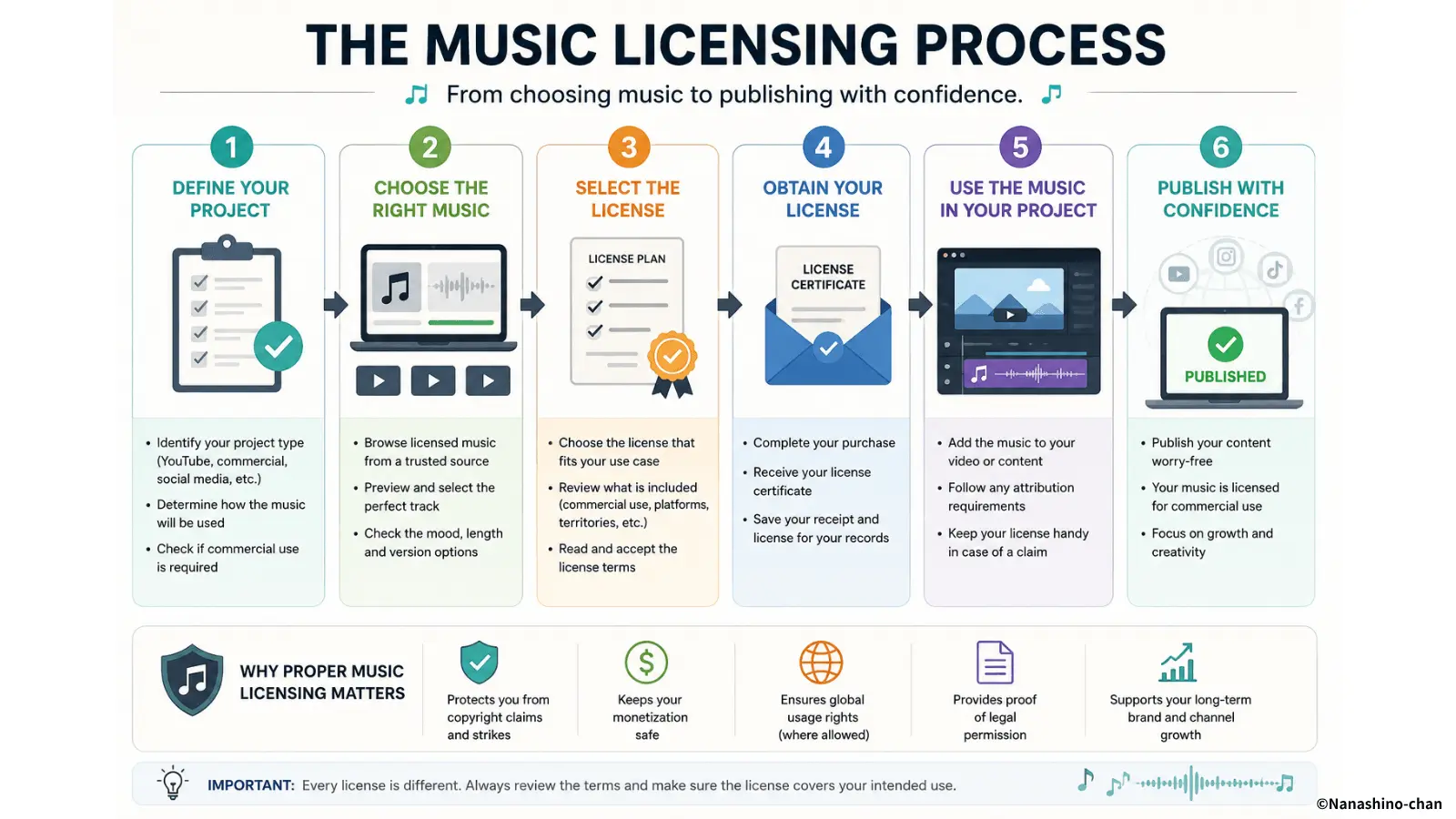
Music Licensing Workflow for Agency Client Projects
The best agency workflow is to confirm music rights before the final edit is approved. This prevents problems after export, upload, media buying, campaign launch, or client delivery.
1. Confirm the Client Use
Define whether the asset will be used on social media, YouTube, ads, websites, sales pages, events, or internal platforms.
2. Match the License
Choose music that allows the exact project scope, including commercial use, client delivery, and campaign distribution.
3. Document the Rights
Save usage terms, purchase records, license notes, project names, client names, and delivery context for future reference.
Where Agencies Publish Client Music-Based Videos
Agency deliverables often appear on more than one platform. A single video may be cut into different aspect ratios, lengths, captions, languages, and ad variations. This means the music license should be reviewed for all planned distribution channels.
- • YouTube videos and YouTube ads
- • YouTube Shorts and short-form campaign versions
- • Instagram Reels, feed videos, and story ads
- • TikTok organic content and TikTok ads
- • Facebook videos and Meta advertising
- • LinkedIn business videos and B2B campaigns
- • Client websites and landing pages
- • Product launch pages and e-commerce campaigns
- • Sales presentations and pitch decks
- • AI-generated or AI-assisted video campaigns
Common Music Licensing Risks for Agencies
Agencies often produce content under deadlines. Music may be added quickly during editing, sourced from a template, reused from an old project, or selected by a freelancer. These shortcuts can create licensing risk if the rights do not match the client’s final use.
The biggest issue is not only whether the music sounds good. The issue is whether the agency can confidently explain where the music can be used, who can publish it, and what happens if a platform claim appears.
- • Using personal-use tracks in client-facing commercial work
- • Reusing one track across multiple clients without checking license scope
- • Assuming royalty-free music automatically covers agency projects
- • Delivering client videos without proof of music rights
- • Using platform audio libraries outside their intended environment
- • Uploading campaign videos to YouTube without reviewing Content ID rules
- • Repurposing social videos to ads or websites without checking terms
- • Allowing freelancers to choose music without a licensing process
Agency Music License Checklist
Before delivering a client project that includes music, confirm that the license matches the real campaign use. This checklist helps reduce risk for agencies, freelancers, marketers, editors, and client teams.
- • Does the license allow client-facing commercial work?
- • Can the client publish the video on their own channels?
- • Are paid advertisements allowed?
- • Can the music be used on YouTube, Instagram, TikTok, Facebook, LinkedIn, and websites?
- • Are website and landing page videos covered?
- • Can the video be edited, resized, localized, shortened, or republished?
- • Can the music be reused across campaign variations?
- • Are AI-generated or AI-assisted videos allowed?
- • Are Content ID rules clearly explained?
- • Do you have proof of license, purchase, and project usage?
Why This Is Safe for Agencies
A professional licensing structure helps agencies reduce uncertainty before client delivery. Clear rights make it easier to approve edits, launch campaigns, publish across channels, work with freelancers, and answer client questions about music usage.
Nanashino-chan’s licensing-focused structure is designed for creators, agencies, and businesses that need music for client videos, social media campaigns, brand content, AI-generated videos, paid ads, and commercial marketing assets.
- • Commercial-ready licensing structure
- • Copyright-safe design for creators, agencies, and businesses
- • ISRC-based rights management
- • Transparent usage policy
Official Platform Copyright Policies
Major platforms officially state that purchasing or streaming music does not automatically grant rights for uploading, monetization, commercial use, or social media distribution.
- YouTube Copyright Guidelines
- Instagram Copyright Information
- Facebook Copyright Policy
- TikTok Copyright Policy
Copyright policies and platform rules may change over time. Always review the latest official guidelines before publishing monetized or commercial content.
FAQ
Do agencies need music licenses for client videos?
Yes. Agencies usually need music licenses when using music in client videos, ads, social media campaigns, brand content, YouTube videos, websites, product demos, or commercial marketing materials.
What type of music license is best for agencies?
A commercial music license that covers client work, online video, social media, advertising, websites, brand campaigns, and business use is usually the best fit.
Can agencies use royalty-free music for client projects?
Royalty-free music may be used for client projects only when the license clearly permits agency use, client-facing deliverables, commercial publishing, advertising, and platform distribution.
Can client videos receive copyright claims?
Yes. Client videos can receive copyright claims if the music is not properly licensed, if the usage exceeds the license scope, or if the track is registered with Content ID.
Should agencies keep proof of music licenses?
Yes. Agencies should keep proof of license, purchase records, usage terms, project notes, and client delivery documentation in case a platform, client, partner, or rights holder requests verification.
Can one music license cover multiple client projects?
That depends on the license terms. Some licenses may allow broad commercial use, while others may restrict reuse across clients, campaigns, platforms, or paid advertising.
Need Music for Agency Client Projects?
Use licensed music designed for agency videos, client campaigns, paid ads, social media content, AI videos, YouTube publishing, and commercial marketing workflows.
► View Licensing OptionsRelated Pages
- Music License for Small Business
- Music License for Marketing Campaigns
- Music License for Business Videos
- Music for Agency Videos
- Music for Client Work
- Music for Social Media Campaigns
- Music for B2B Marketing Videos
- Music for AI Marketing Content
- How to Choose a Music License for Videos
- Licensing Page