It May Cover
- The named sound recording or version
- The stated video, film, ad or content project
- Specified platforms and media
- A stated territory and license period
- Approved editing, excerpts or cut-downs
- The named brand, client or campaign
Master use license definition
A master license—often called a master use license—is permission to use a specific recorded version of a song. It covers the actual sound recording, not automatically the underlying composition.
Learn who grants the license, who the master licensee is, when video and advertising projects need permission, what an agreement should contain, and why a public-domain song can still have a protected recording.
Direct answer
A master use license is permission from the owner or authorized controller of a particular sound recording to use that recording within an agreed scope. The scope may identify the project, media, platform, territory, duration, campaign, client, editing rights and fee.
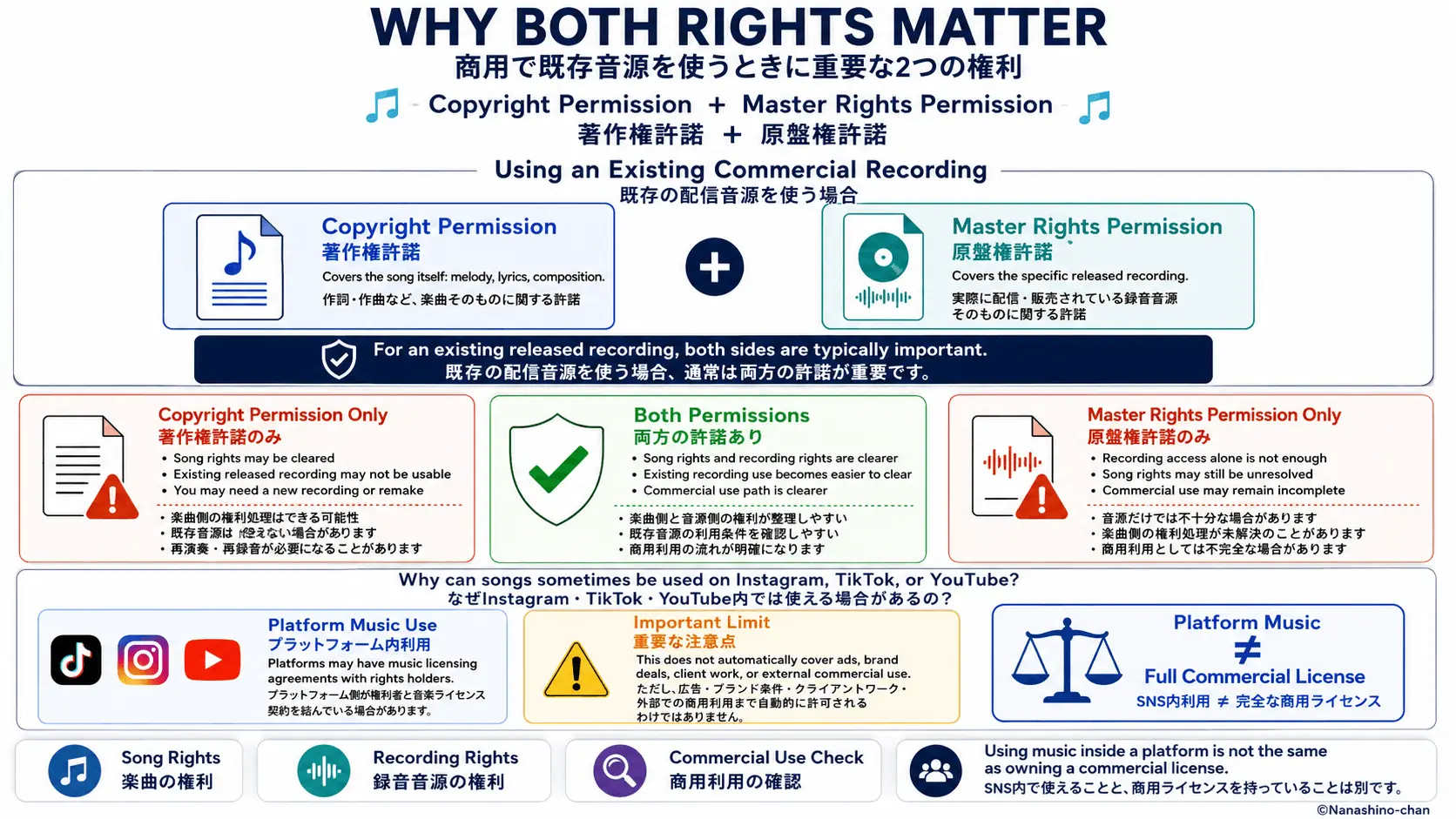
The master license answers: “May I use this exact recorded version?” It does not automatically answer: “May I use the underlying song?” or “May I synchronize the music with video?” Those permissions must be confirmed in the agreement or cleared separately.
マスターライセンスとは:特定の録音音源(原盤)を、契約で定めた動画、広告、映画、SNS投稿、ゲームなどに使用するための許諾です。 原盤の許諾だけで、メロディや歌詞など楽曲そのものの著作権、映像と組み合わせるSync利用、すべての商用利用が自動的に許可されるとは限りません。
These terms are often used for closely related ideas, but the written agreement—not the label alone—determines the actual permission.
| Term | Common meaning in music | Important note |
|---|---|---|
| Master license | Permission relating to use of a specific sound recording. | A shorter industry expression; always check the granted rights and restrictions. |
| Master use license | Permission to use the particular master recording in a stated production or context. | Commonly discussed alongside composition-side synchronization permission for audiovisual use. |
| Master recording license | Another description emphasizing that the licensed asset is the specific recording. | It does not automatically mean the underlying composition is cleared. |
| Master licence | British spelling of master license. | The spelling changes; the contract still controls the permission. |
| Master sync license | A phrase sometimes used for permission to use a master recording with visuals. | It is not a substitute for reading whether both master and composition rights are actually included. |
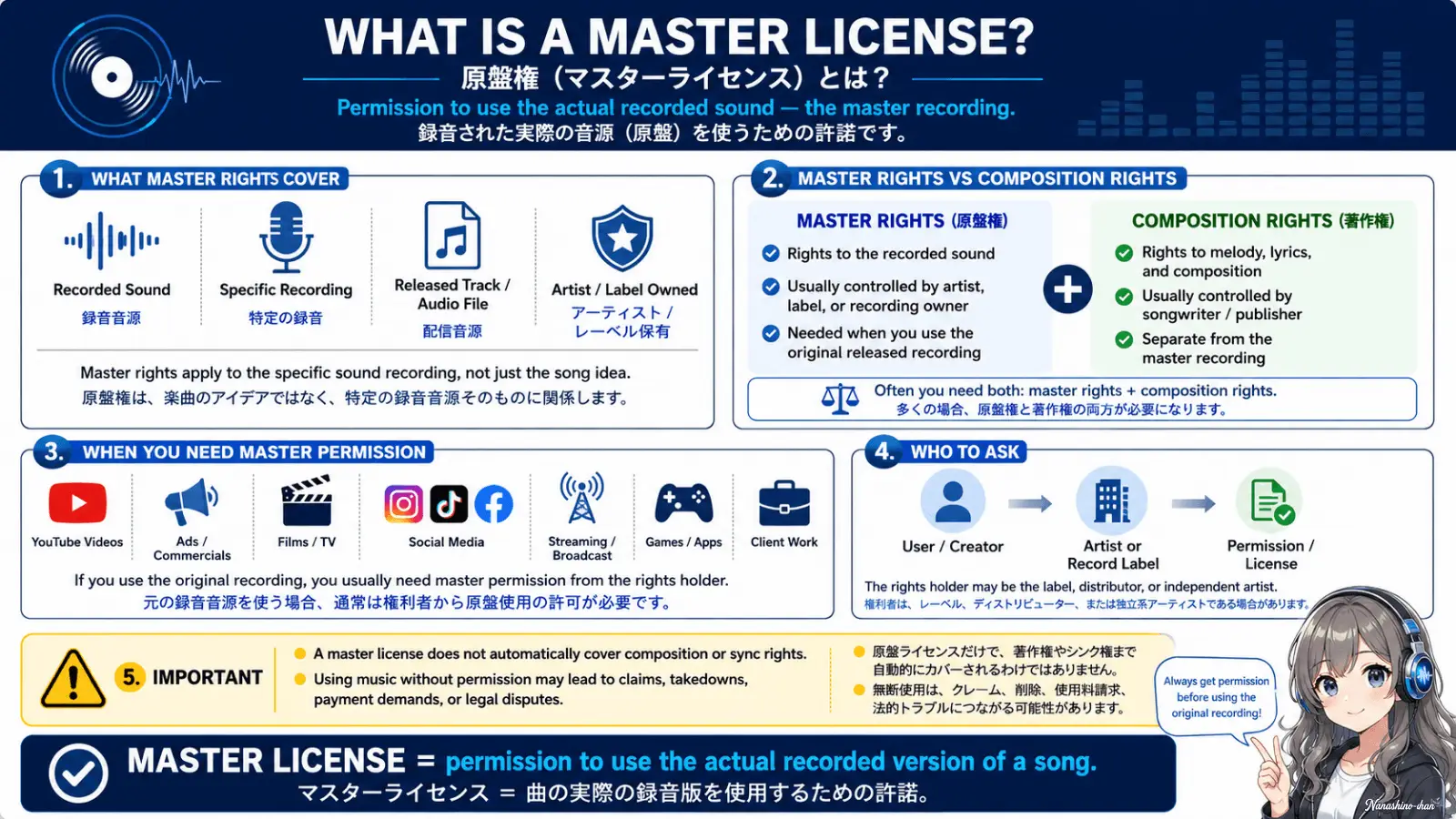
A master license can be narrow or broad. Never assume that receiving the audio file means receiving every possible usage right.
The most important distinction is between the recorded sound and the song embodied in that recording.
The specific studio recording, released audio file, live recording or other fixed performance that the listener hears.
The underlying melody, lyrics, harmony and musical work, often controlled by composers, songwriters or publishers.
| Rights layer | What it answers | Common controller | Typical document |
|---|---|---|---|
| Master recording | Can I use this exact recording? | Artist, label, producer, recording owner or authorized representative | Master use license |
| Composition | Can I use the underlying song? | Composer, songwriter, publisher or authorized administrator | Composition-side or publishing permission |
| Synchronization | Can the music be combined with visual media? | Relevant rights holders or their authorized licensing representative | Sync license or a combined agreement |
| Commercial scope | Can the use support a business, sponsor, client or ad campaign? | Specified in the applicable license terms | Commercial, sync or custom agreement |
Public-domain warning
An old composition may be in the public domain because its copyright term has expired. That does not automatically make every performance or recording of the composition free to copy or use.
A recently recorded orchestral performance, piano performance, remaster or other released sound recording may still involve master-recording, performer or related rights. Public-domain status must be checked separately for the composition and the exact recording, and protection rules can differ by country and territory.
日本語:古い楽曲の作曲・作詞に関する著作権が切れていても、その楽曲を新しく演奏・録音した音源には、実演家やレコード製作者などの著作隣接権が残っている場合があります。パブリックドメインなのは「楽曲」であり、すべてのCD・配信音源・録音物が自由に使えるという意味ではありません。
The two permissions work together in many audiovisual projects, but they answer different questions.
Recording side
Question: May the project use this exact recorded version?
Asset: The master recording or audio file.
Typical grantor: Master owner or authorized representative.
Composition side
Question: May the underlying music be synchronized with visual media?
Asset: The musical composition.
Typical grantor: Publisher, composer or authorized representative.
Yes, when one party controls or is authorized to license both rights layers and the agreement expressly includes them. Independent music can sometimes provide a shorter permission path, but the written terms must still identify the project and granted uses.
Start with one practical question: Are you using an existing, identifiable sound recording? If yes, master rights should be checked.
| Use case | Master-right question | Other issues to check |
|---|---|---|
| YouTube or online video | Is an existing released recording placed in the video? | Sync, monetization, sponsorship and Content ID documentation |
| Advertisement or branded campaign | Is the recording being used to promote a product, service or brand? | Composition, sync, paid media, territory, duration and campaign scope |
| Instagram Reel or TikTok video | Did the audio come from an identifiable recording or external edit? | Account type, organic vs paid use, platform availability and sponsor |
| Film, trailer or animation | Will the specific recording become part of the audiovisual work? | Sync, festivals, theatrical, streaming, trailers, term and territory |
| Podcast or video podcast | Will a released recording be embedded in the episode? | Download, streaming, intro/outro reuse and platform distribution |
| Game, app or reusable template | Will users receive or repeatedly access the recording? | Product integration, redistribution, interactive use and custom terms |
| Your own cover recording | You are not using the original artist’s master. | The underlying composition, arrangement, sync and commercial use may still need review |
A music license agreement normally identifies at least two sides: the party granting permission and the party receiving it.
The master owner or a representative authorized to license the sound recording. This may be an artist, label, producer, company or licensing administrator.
The creator, brand, production company, advertiser, agency, client or other named party allowed to use the recording under the agreement.
マスターライセンシーとは、原盤を使用する許諾を受ける個人または企業です。許諾を与える原盤権者や正当な代理人はライセンサーと呼ばれます。 代理店が契約してクライアントへ納品する場合は、代理店だけでなく、最終クライアント、公開アカウント、広告出稿者まで利用範囲に含まれているか確認する必要があります。
A useful agreement identifies the recording and the real project precisely enough that both parties can understand what is allowed.
Identity
Scope
Conditions
A document titled “Master License,” “Master Sync License” or “Commercial Music License” may grant different rights depending on its wording. Check the definitions, grant of rights, restrictions and project details before publishing.
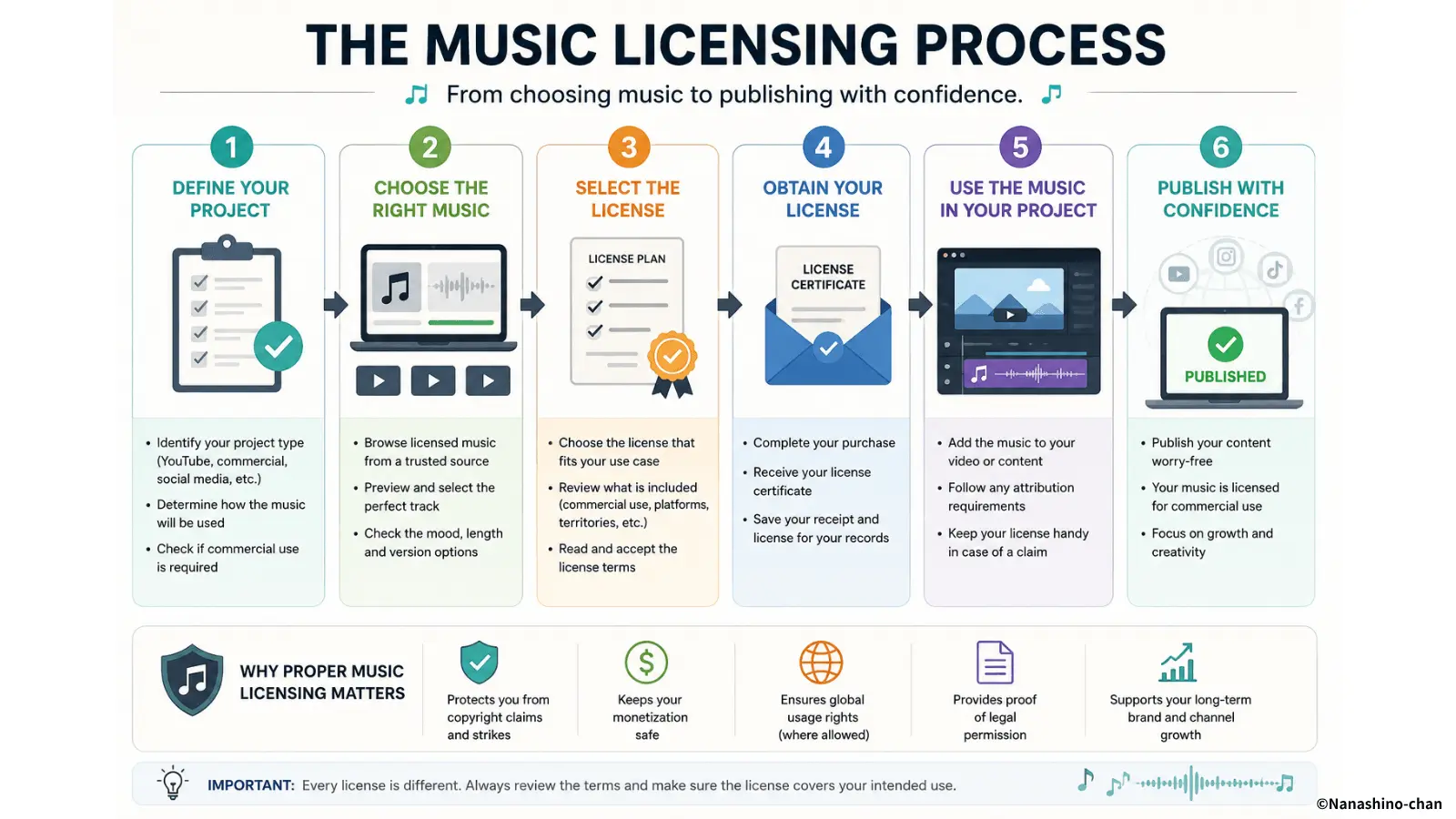
The workflow becomes easier when the recording, rights owner and intended use are identified before production is locked.
Confirm the exact version, performer, release, file source and ISRC when available.
Identify who controls the master and who controls the underlying composition.
Record the project, client, platforms, media, territory, duration and paid distribution.
Ask the authorized rights holder for terms covering the exact recording and project.
Check the grant, restrictions, fee, term, territory, credit and claim procedure.
Store the signed terms, receipt, track identity, project details and correspondence.
There is no universal price. Rights holders commonly evaluate the recording, project and distribution before offering terms.
Artist profile, track demand, label involvement and whether the requested version is available.
Organic social, paid advertising, online video, broadcast, film, cinema, games, apps or other distribution.
Territory, term, audience, campaign spend, number of versions, client and exclusivity.
Number of rights holders, approval process, sensitive categories and whether both rights layers can be cleared together.
A low-cost download or streaming subscription is not evidence that master use, sync, advertising or client-work rights are included. Ask for written permission that matches the project.
A license proves permission within its stated scope. It does not make automated music detection impossible.
An ISRC helps identify a particular sound recording. It does not replace a license and does not prove that every use is permitted. The agreement establishes permission; the identifier helps connect that permission to the recording.
Nanashino-chan is an independent original music catalog and licensing project. Direct control of the master recordings and compositions can simplify the permission path for eligible creator, commercial and sync uses.
It can reduce the need to contact an unrelated label and publisher separately. It does not make every use automatic: the selected license or project-specific agreement still determines the platforms, client, campaign, duration and restrictions.
日本語解説
マスターライセンスとは、特定の録音音源(原盤)を使用するための許諾です。たとえば、市販CD、配信楽曲、スタジオ録音、ライブ録音などの「実際に聞こえる特定の録音」を動画や広告に組み込む場合、原盤に関する許諾が問題になります。
一方、メロディ、歌詞、作曲などの楽曲そのものは別の権利です。そのため、既存の音源を映像に使用する場合、原盤の許諾だけでなく、楽曲側の権利やSync利用の許諾も必要になることがあります。
| 用語 | 意味 |
|---|---|
| マスター/原盤 | 実際に録音された特定の音源。 |
| マスターライセンス | 特定の原盤を、契約で定めた範囲で使用するための許諾。 |
| マスターライセンサー | 原盤の使用許諾を与える権利者または正当な代理人。 |
| マスターライセンシー | 原盤の使用許諾を受ける個人・企業・広告主・制作会社など。 |
| Syncライセンス | 音楽を動画、広告、映画などの映像と組み合わせて使用するための許諾。 |
日本法上、市販音源には作曲・作詞の著作権とは別に、実演家やレコード製作者などの著作隣接権が関係する場合があります。 海外利用では保護期間や権利処理が地域によって異なる可能性があるため、利用地域を含めて確認してください。
These primary sources explain the separation between musical works and sound recordings and the related rights involved in recorded music.
A master license, often called a master use license, is permission from the owner or authorized controller of a specific sound recording to use that recording within an agreed project and scope. It does not automatically clear the underlying composition or every form of distribution.
A master use license permits use of a particular recorded version of a song. For audiovisual projects, it is commonly considered alongside synchronization permission for the underlying composition.
No. A master license addresses the specific sound recording. Synchronization permission addresses combining the underlying music with visual media. A video using an existing commercial recording may require both rights layers.
A master licensee is the person or organization receiving permission to use the master recording. The licensor is the party granting permission, usually the master owner or an authorized representative.
Not automatically. Master rights cover the specific recording, while composition rights cover the underlying melody, lyrics and musical work. The agreement must state clearly if both are included.
Yes. The underlying composition may be in the public domain while a newer performance and sound recording remain protected. Public-domain composition status does not make every recording free to copy or use.
It should identify the exact recording, licensor, licensee, project, permitted media, territory, duration, commercial purpose, editing rights, campaign scope, fee, credit, Content ID process and any restrictions.
They may when a specific recording is used. Organic platform use, externally edited videos, business posts, sponsored content, boosted posts and paid ads can have different permission requirements.
特定の録音音源(原盤)を、契約で定めた動画、広告、映画、SNS投稿などに使用するための許諾です。楽曲そのものの著作権やSync利用が自動的に含まれるとは限りません。
原盤を使用する許諾を受ける個人または企業です。許諾を与える原盤権者または正当な代理人をライセンサーと呼びます。
Master and sync licensing
Tell us which track you want to use, what you are creating, who will publish it, where it will run and whether it includes paid distribution. Nanashino-chan can help identify an appropriate licensing starting point for the project.
General educational information only, not legal advice. The written license and any project-specific agreement determine the permission granted. Copyright terms, neighboring rights, platform systems and legal requirements can vary by territory and use.