01 · Detection
Copyrighted Recording Detected
A video may contain a commercial master recording, downloaded song, screen-recorded music or audio copied from another upload.
Instagram music copyright guide
Instagram can mute, restrict or remove audio when music rights, account use, location or platform detection do not align with the post. This guide explains the likely causes—and what “Original Audio” does and does not prove.
For creators, influencers, brands, agencies, social media managers and advertisers using music in Reels, Stories, sponsored posts, business content and paid campaigns.
Direct answer
Instagram may mute a video when its systems detect music for which the recording or composition is unavailable, restricted, disputed or not permitted for that account, region or type of use. A Reel can also be affected when a sound is re-uploaded by another user, when rights data changes after publishing, or when organic content is later boosted or used as an advertisement.
A mute does not automatically prove deliberate infringement, and having a license does not guarantee that automated systems will never react. The correct response is to identify the cause, verify permission and preserve documentation.
日本語まとめ:Instagramのミュート原因は、無断利用だけではありません。音源の権利地域、アカウント種別、投稿用途、広告転用、権利情報の変更、自動検出などが関係します。「オリジナル音源」と表示されていても、投稿者が著作権や原盤権を所有している証明にはなりません。
The message shown by Instagram matters. The platform may apply different actions depending on the track, recording, region, account, post format and commercial context.
01 · Detection
A video may contain a commercial master recording, downloaded song, screen-recorded music or audio copied from another upload.
02 · Territory
A recording may be available in one country but restricted in another because music rights and platform agreements can be territorial.
03 · Account
Music access and features may differ among personal, creator and business accounts, especially for promotional or commercial content.
04 · Use
A track used in an organic Reel may not be appropriate for a boosted post, paid advertisement, sponsored campaign or client deliverable.
05 · Source
The uploader may have introduced audio containing someone else’s music. The platform label does not verify ownership or permission.
06 · Change
A previously working Reel may change after rights data, ownership, distribution, availability or platform rules are updated.
No. “Original Audio” generally identifies the account that uploaded or introduced the sound into Instagram. It should not be treated as a copyright certificate, a music license or proof that the uploader created the music.
Anonymized educational example
This illustration shows how a user-uploaded sound may be labeled “Original Audio” while Instagram also identifies a possible match. A possible match is a reason to investigate; it is not, by itself, a legal finding of copyright infringement. No real account, artist or post is shown here.
Important distinction
The ability to find, hear or reuse a sound inside an app does not establish who owns it or whether every commercial use is cleared. Before a brand, agency or creator relies on user-uploaded audio, the project should be able to identify the music source and the permission path.
A video using recorded music can involve two separate layers of rights. Clearing only one layer may not be enough when a specific commercial recording is copied into a video.
The underlying melody, harmony, arrangement and lyrics, usually controlled by composers, songwriters or publishers.
The particular recorded performance or audio file, often controlled by a recording artist, producer, label or master owner.
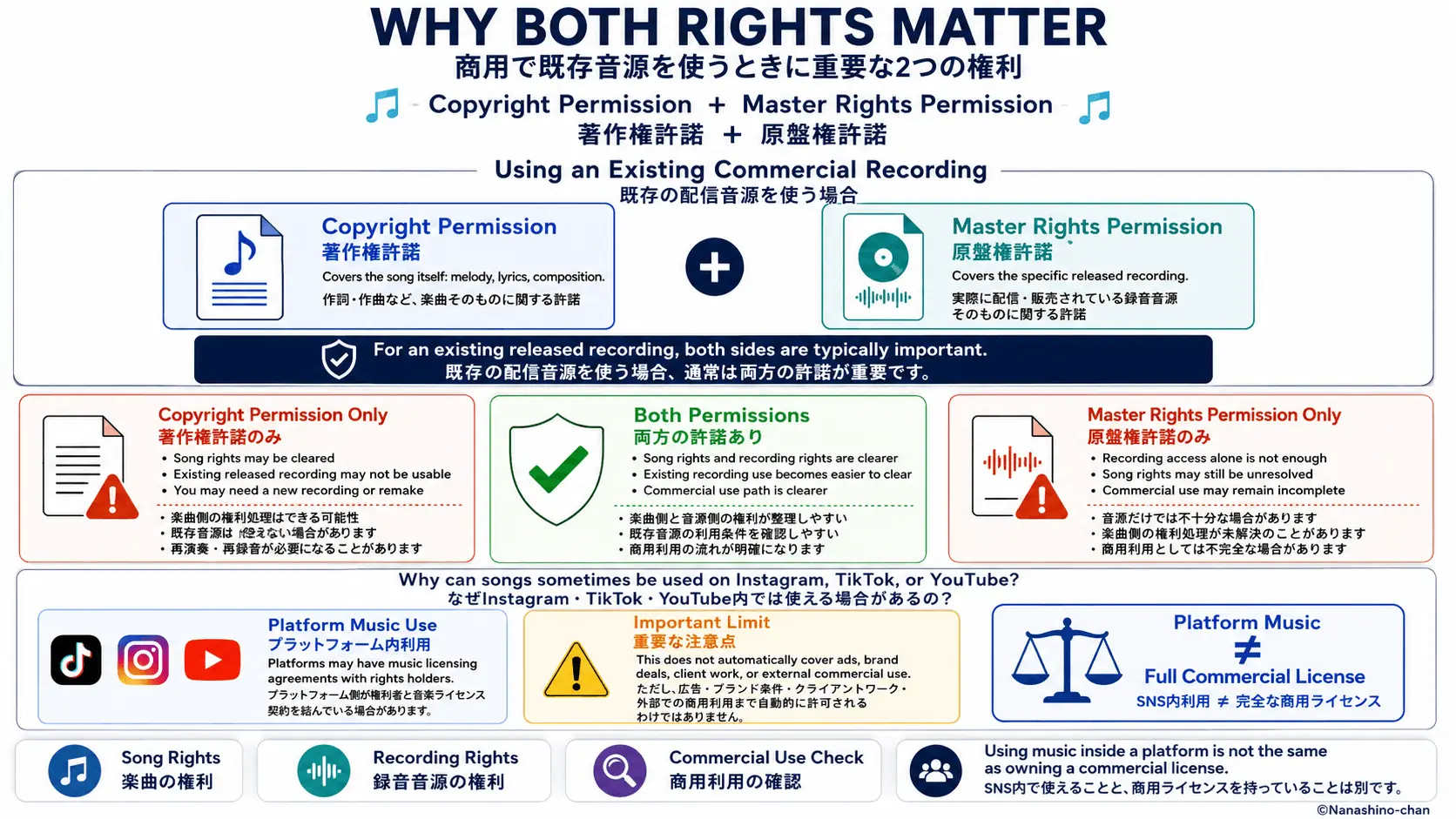
Public-domain warning
An old song may be in the public domain because the copyright in the underlying composition has expired. However, that does not automatically make every recording of the song free to use.
A newer performance or sound recording may still be protected by master recording rights, performers’ rights, or other related rights. For example, a classical composition may be in the public domain while a recently released orchestral recording of that composition remains protected.
日本語まとめ: 古い楽曲の作曲・作詞に関する著作権が切れていても、その楽曲を新しく演奏・録音した音源には、 実演家やレコード製作者などの著作隣接権が残っている場合があります。 パブリックドメインなのは「楽曲」であり、すべてのCD・配信音源・録音物を自由に使えるという意味ではありません。
Reused sound can create a chain of dependency. The original uploader, later creators and commercial partners can face different consequences.
| Party | Main exposure | Practical consequence | Recommended control |
|---|---|---|---|
| Original uploader | Introduces copied, sampled or unclear audio | Mute, removal, rights complaint, account action or legal demand | Use owned or properly licensed audio and keep permission records |
| Creator reusing the sound | Relies on the label or popularity without checking the source | Audio may disappear, availability may change, or the Reel may become unsuitable for monetization | Verify source before professional, monetized or sponsored reuse |
| Brand or advertiser | Uses the Reel for product promotion, boosting or paid media | Campaign interruption, rejected creative, replacement cost or contractual dispute | Require music warranties, license documents and campaign-specific scope |
| Agency or client | Accepts a deliverable without confirming music rights | Client escalation, takedown work, delayed launch or reputational damage | Include music clearance in the approval and delivery checklist |
Music permission should be matched to the real purpose of the content, not only to the platform name.
| Instagram use | Typical context | Main music question | Safer approach |
|---|---|---|---|
| Personal Reel | Non-commercial hobby or personal post | Is the sound available for this account and region? | Use platform tools within their rules or directly licensed non-commercial music |
| Monetized creator post | Professional creator content or portfolio activity | Does permission cover monetized or promotional use? | Use music with clear commercial creator terms |
| Sponsored post | Paid partnership, affiliate promotion or gifted campaign | Are the sponsor, product and commercial purpose covered? | Confirm brand-content and sponsored-use permission before posting |
| Business account Reel | Company, product, service, property, event or brand promotion | Does the music permit business-owned media? | Use directly licensed commercial music and retain documentation |
| Boosted post or paid ad | Ads Manager, paid distribution or campaign media | Are synchronization, advertising and campaign duration covered? | Use a campaign-appropriate sync license before boosting |
Do not appeal automatically. First establish what Instagram detected and whether your permission covers the actual use.
Capture the exact message, affected post URL, date, account, territory and any named track or claimant.
Confirm whether the sound came from Instagram’s tools, a downloaded file, a video editor, a client or another creator.
Record whether the Reel is personal, monetized, sponsored, business-owned, client work, boosted or a paid ad.
Check the track, recording, platforms, territory, commercial scope, campaign duration, client and advertising rights.
Keep the license file, receipt, terms, track information, rights-holder correspondence and project records together.
Appeal only with a valid basis. Otherwise replace the audio, edit the post or pause campaign distribution while resolving the issue.
If a sponsored post or advertisement has a launch deadline, protect the campaign first. Pause affected creative, inform the client or agency, preserve evidence and prepare a cleared replacement track. A rights dispute should not be allowed to spread across additional placements while it is being reviewed.
A repeatable pre-publication workflow is more reliable than judging music by a sound label, number of uses or creator popularity.
Platform tools, policies and music availability can change. Review current official guidance alongside the written license for the music you use.
Nanashino-chan provides original lo-fi music with direct control of the master recording and composition rights. This can create a clearer permission path for eligible creator videos, business posts, sponsored content and paid campaigns.
Instagram may mute or restrict a Reel because of music-rights availability, copyright detection, account type, region, changed licensing data, or a use that is not covered for the post or campaign. Read the exact notification before assuming the cause.
No. “Original Audio” generally identifies the source account that uploaded or introduced the sound. It is not proof that the account composed the music, owns the master recording or has permission for commercial reuse.
It usually means Instagram may have detected a possible match with an existing recording or music reference. Treat it as a signal to investigate. A possible match alone is not a legal determination that infringement occurred.
No. Confirm the real source, rights holder, exact recording, commercial scope, permitted platforms and whether sponsored or advertising use is covered. Popularity and reuse count do not replace permission.
Do not assume so. Music access and features may differ by account, region and intended use. Business, sponsored, client and paid-ad content should be checked separately and may require direct commercial or sync permission.
Yes. A valid license documents permission within its scope, but automated detection and platform behavior may still occur. Keep the license, receipt, track details and project records ready for review.
Save the notice, identify the detected recording, confirm that your actual use is within the license, prepare documentation and use the review process only when you have a valid basis. For a time-sensitive campaign, prepare a cleared replacement track.
They may be. Reused sound creates a dependency on the source audio and its rights availability. If the source is restricted, muted, removed or reclassified, connected Reels may also experience changes.
Instagram music licensing
Tell us whether the content is an organic Reel, sponsored post, business video, client deliverable, boosted post or paid campaign. Nanashino-chan can help identify an appropriate licensing starting point.
General educational information only, not legal advice. Instagram and Meta policies, music availability, automated detection and account features may change independently of a direct music license. The written license terms and any project-specific agreement determine the permission granted by Nanashino-chan.