Platform Music, Paid Ads & Sponsored Content
Can Businesses Use Platform Music in Paid Ads and Sponsored Content?
Music that appears inside Instagram, TikTok, YouTube, or another platform is not automatically cleared for every business purpose. Availability in an app may cover only specific platform-native uses.
For paid ads, sponsored content, boosted posts, influencer campaigns, client deliverables, websites, and cross-platform assets, businesses need music rights that match the actual campaign scope.
This guide explains the difference between platform audio and a dedicated commercial or sync license, what marketing teams should verify, and how to choose music that is easier to approve and document.
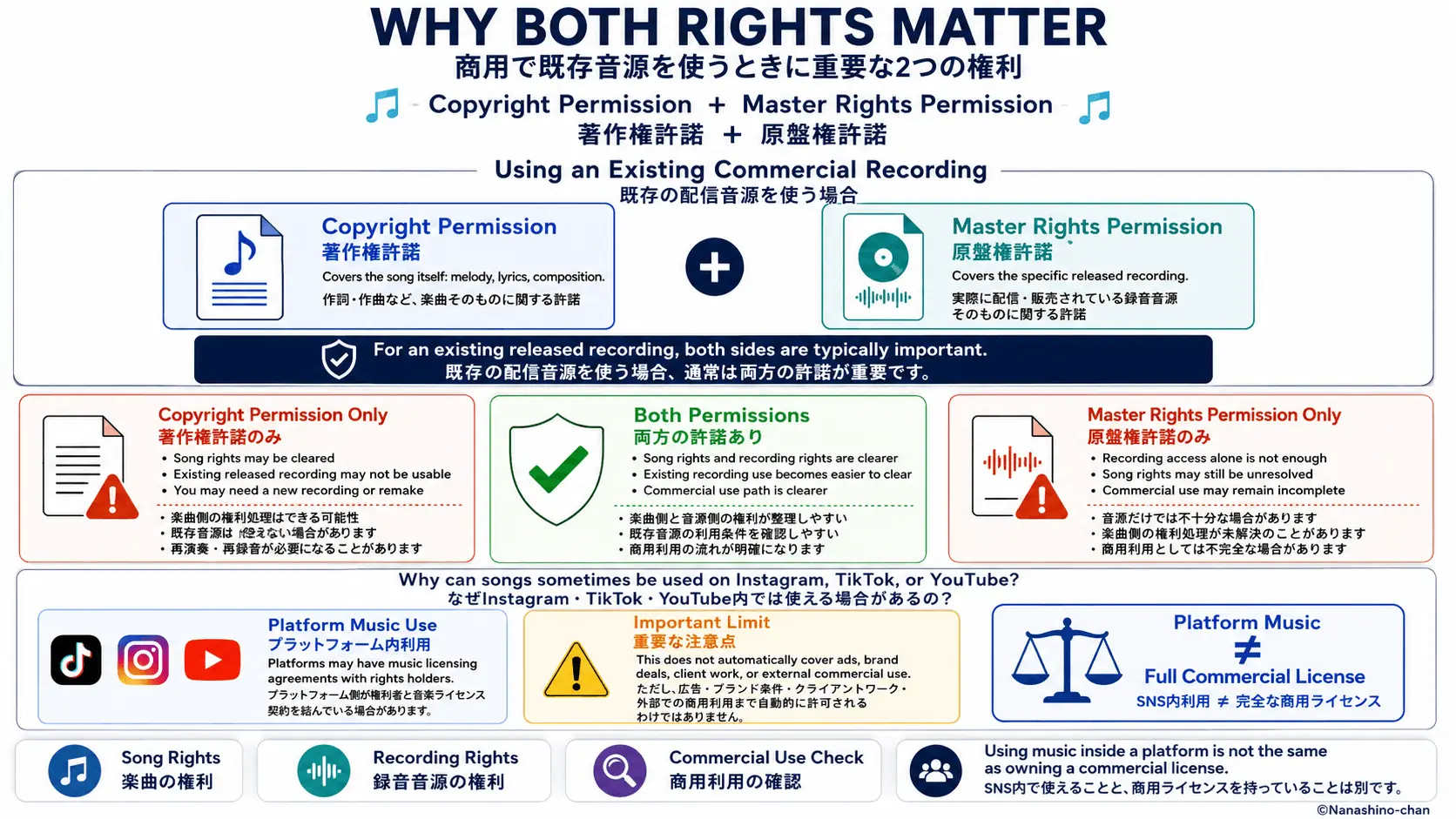
Quick Answer: Can Businesses Use Platform Music in Paid Ads?
Only when the specific platform terms or music license allow that advertising use. Music shown in a platform's general music picker is not automatically cleared for paid ads, sponsored brand content, boosted posts, or use outside that platform.
A separately licensed track can be used in paid ads and sponsored content when the agreement expressly covers commercial promotion and the complete campaign scope. Do not rely on labels such as "royalty-free," "available in-app," or "licensed music" without reading the permitted-use terms.
- ✓ Advertising or sponsored promotional use must be expressly permitted.
- ✓ Both the master recording and underlying composition must be cleared.
- ✓ Platforms, territories, campaign duration, and advertiser or client should be defined.
- ✓ Boosting, partnership ads, Spark Ads, and creator whitelisting need specific review.
- ✓ Cross-platform reuse should be included rather than assumed.
- ✓ Keep the license, invoice, track details, and campaign records together.
Can Licensed Music Be Used in Paid Ads and Sponsored Content?
Yes. Licensed music can be used in paid ads and sponsored content when the license explicitly grants the rights required for that use. The word "licensed" alone is not enough: a personal-use, creator-only, platform-only, or single-video license may exclude advertising.
An organic sponsored post is already commercial because it promotes a brand, product, or service. If the post is later boosted, converted into a partnership ad, run as a TikTok Spark Ad, or distributed through a creator's account by whitelisting, it also becomes paid media. Confirm both stages before launch.
Practical rule: if the content has a sponsor, media budget, client, sales objective, or planned cross-platform reuse, verify the license before editing and publishing the final asset.
The Common Misunderstanding: “It Was Available in the App”
The biggest misunderstanding is simple: many creators and businesses believe that if a song appears inside a platform’s music picker, it must be usable for any kind of video.
In reality, platform audio availability can depend on region, account type, music rights agreements, platform rules, whether the content is organic or paid, and whether the video is personal, creator-led, business-related, or advertising-focused.
The safer question is not “Can I select this audio inside the app?” but “Do I have permission for this specific business use?”
Platform Music vs Commercial Music License
Platform music is music made available through a social media platform’s internal tools. A commercial music license is permission from the relevant rights holder or licensing provider to use music for a defined business purpose.
These are not always the same thing. A platform may allow music to be used in certain in-app content, while a commercial license can define broader use cases such as ads, brand campaigns, client videos, website use, paid distribution, AI video workflows, and multi-platform publication.
Instagram Music: What Businesses Should Understand
Instagram offers music features for Reels, Stories, and other formats, but the source of the audio matters. Meta states that Instagram's general licensed music library is intended for personal, non-commercial use. Access can also vary by account type, region, and rights agreements.
Meta Sound Collection is the business-oriented alternative: Meta says its rights-cleared music can be used commercially, including in ads. A separately obtained license may also work when it expressly covers the intended Instagram placement, advertiser, territory, and campaign period.
General Library
Availability in Instagram's licensed music library should not be treated as general commercial clearance.
Sound Collection
Meta identifies Sound Collection as a rights-cleared option for commercial content, including ads.
External Licenses
A third-party track can be used only when its license covers the specific ad, sponsored post, or partnership-ad workflow.
TikTok Music: Commercial Music Library vs Trending Sounds
TikTok is especially important for businesses because many brand videos are built around short-form trends. However, a trending sound is not always cleared for commercial use by a business.
For content that promotes a brand, product, or service, TikTok recommends its Commercial Music Library (CML). TikTok says the CML is pre-cleared for commercial use on TikTok and covers business activities such as organic content, video ads, and branded content.
- • Businesses should not use TikTok's general music library as commercial clearance.
- • The CML is designed for commercial activity within TikTok.
- • Original sound or music outside the CML requires the necessary licenses.
- • CML permission should not be assumed to cover websites, other platforms, or unrelated client assets.
- • A dedicated license can define broader paid and multi-platform campaign use.
Organic, Sponsored, and Paid Media Are Different Uses
Organic social media posts and paid advertising are not the same licensing situation. An unpaid business Reel, a creator's sponsored post, and that same post run as an ad may require different permissions.
Treat every change in distribution as a new scope check. Adding media spend, a client, a new territory, a new platform, or advertiser access to a creator account can change what the license must cover.
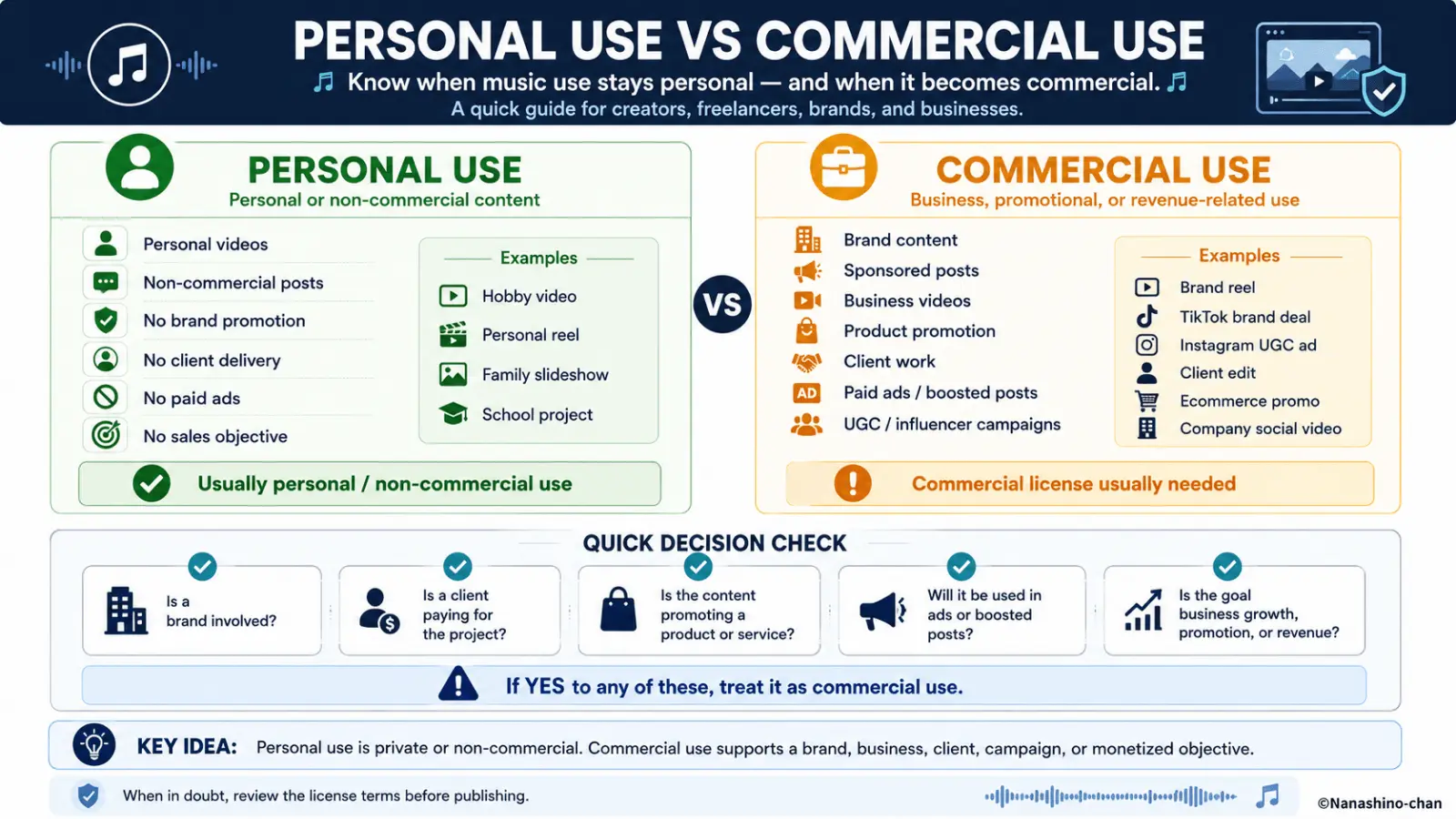
Why Platform Music Can Become Risky for Businesses
The risk is not only copyright in a narrow sense. For businesses, music problems can affect ad review, campaign delivery, client approval, monetization, platform distribution, and long-term use of video assets.
- • Audio may be muted or restricted on certain platforms.
- • A video may not be eligible for paid promotion.
- • A client may ask for proof of music permission.
- • A platform may review or reject an ad.
- • A rights holder may object to promotional use.
- • A business may not be able to reuse the asset across platforms.
- • A campaign may need to be edited, replaced, or paused.
For business use, the goal is not just to avoid takedowns. The goal is to make music rights clear enough for marketing teams, clients, agencies, and ad reviewers.
What Marketing Teams Need from a Business Music License
For a marketing director, agency, or in-house team, the value of licensing is not limited to avoiding a copyright problem. Clear terms can reduce uncertainty before production, make approvals easier, and preserve the value of campaign assets after launch.
Predictable Scope
Define the platforms, duration, territories, licensee, and permitted media before the campaign budget is committed.
Brand Safety
Verify the master and composition rights instead of relying on a song's visibility or popularity inside an app.
Faster Approval
Give marketing, agency, client, procurement, and legal reviewers one documented rights package.
Distinctive Creative
Choose music that supports the campaign mood and brand identity without depending on the same generic stock cues.
Why Both Master Rights and Copyright Permission Matter
Commercial music use can involve two important rights layers: the master recording rights and the underlying composition / copyright rights. A platform may have certain rights agreements for specific in-app uses, but that does not always mean a business has a separate license for every campaign use.
This is why businesses should be careful when taking music from one platform and using it in another context, such as a website, paid ad, client video, presentation, sales page, product demo, or AI-generated marketing asset.
Master Recording
Permission related to the actual recorded sound file used in the video.
Composition / Copyright
Permission related to the underlying musical work, melody, composition, and copyright rights.
Usage Scope
Permission should match the actual use: organic post, paid ad, client work, or campaign asset.
When Businesses Should Use a Dedicated Music License
A dedicated commercial music license is usually the better option when music is part of a business asset, not just casual platform-native content.
- • You are creating paid social ads.
- • You are publishing sponsored or branded content.
- • You may boost an organic post after publication.
- • You need partnership-ad, Spark Ad, or creator-whitelisting rights.
- • You are producing videos for a client.
- • You are making product demos or launch videos.
- • You are using the video on a website or landing page.
- • You are publishing the same video across multiple platforms.
- • You need music for AI-generated marketing videos.
- • You need proof of permission for an agency, brand, or legal review.
- • You want clearer commercial, sync, or campaign-specific usage rights.
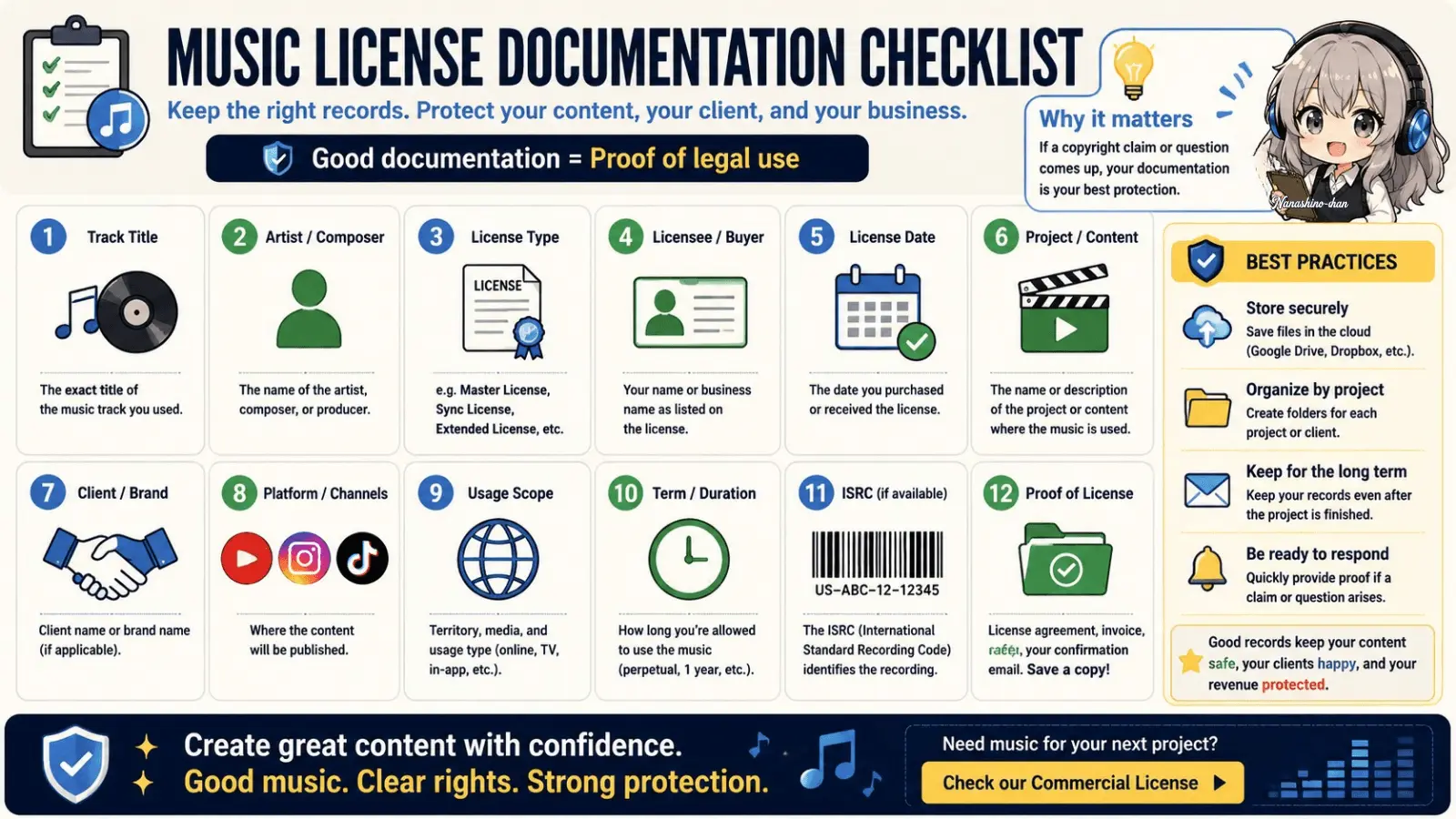
Music Rights Checklist for Business Social Media
Before using platform music in a business video, review the actual use case. The same audio may be low-risk in one context and risky in another.
- • Is this a personal post, creator post, business post, or paid ad?
- • Does the video promote a brand, product, service, event, or campaign?
- • Is the audio from a commercial music library or a general music picker?
- • Is the account personal, creator, or business?
- • Will the video be boosted or used as an ad?
- • Does the license cover sponsored or branded content?
- • Will an advertiser use a creator's handle through whitelisting, a partnership ad, or a Spark Ad?
- • Will the video be delivered to a client?
- • Will the video be reposted outside the original platform?
- • Will the video appear on a website, landing page, or sales page?
- • Are the campaign duration and territories defined?
- • Are both the master recording and composition rights covered?
- • Do you have proof of music permission?
- • Would a dedicated commercial or sync license reduce uncertainty?
How Nanashino-chan Licensing Helps
Nanashino-chan provides 2,000+ original lo-fi tracks for brands, agencies, businesses, creators, social campaigns, product videos, AI-assisted productions, and other commercial content.
The master recordings and underlying compositions are controlled directly within the Nanashino-chan project. This one-stop structure can make rights review more straightforward than clearing a commercially released recording through separate parties.
Fixed-scope commercial and sync options help teams choose the permitted use before launch. Time-limited sync terms are available for campaigns, with additional options for multi-platform distribution and advertising through creator accounts. Always review the exact product terms before purchase.
One-Stop Rights
Direct control of both master recording and composition rights for clearer commercial review.
Predictable Options
Commercial-use and time-limited sync options with defined add-ons for broader campaign needs.
Proof of License
License terms, purchase records, and track details can be retained for business, agency, and client review.
Which License Direction Fits the Use?
Official Platform Music Resources
Platform music policies can change over time. Always review the latest official information before publishing commercial, paid, client-facing, or brand-related content.
- Instagram Licensed Music Library Access
- Meta Sound Collection for Commercial Use
- Instagram Partnership Ad Format Eligibility
- Meta Music Guidelines
- TikTok Commercial Use of Music
- TikTok Commercial Music Library
- YouTube Audio Library
- YouTube Creator Music License Tracks
Official resources reviewed . This page is an educational guide and not legal advice. Always review the official platform terms and the license information shown for the specific music you want to use.
Frequently Asked Questions
Can licensed music be used in paid ads and sponsored content?
Yes, when the license explicitly covers advertising or sponsored promotional use. Confirm the platforms, territories, campaign duration, advertiser or client, paid amplification, and both the master recording and composition rights.
Can businesses use Instagram music for commercial videos?
Businesses should not assume that every song in Instagram's general licensed music library is cleared for commercial use. Meta states that this library is intended for personal, non-commercial use, while Sound Collection provides rights-cleared audio that can be used commercially, including in ads.
Can businesses use TikTok sounds for commercial content?
For content that promotes a brand, product, or service, TikTok recommends its Commercial Music Library. If a business uses original audio or music outside the CML, it must have the necessary licenses for that commercial use.
Does platform music count as a commercial music license?
Not always. Platform music access may allow certain in-app uses, but it does not automatically provide a full commercial license for paid ads, client work, website videos, AI marketing videos, product demos, or multi-platform campaigns.
Are sponsored content and boosted posts the same licensing use?
No. An organic sponsored post is commercial promotional content. A boosted post, partnership ad, Spark Ad, or whitelisted creator ad also involves paid distribution and advertiser access, so the license should expressly cover that additional use.
Can I use platform music in paid ads?
Only if the platform's specific business-music terms cover that ad placement. General or trending platform audio should not be assumed to qualify. Otherwise, use music specifically cleared for advertising or obtain a sync license that covers the campaign scope.
Can I use platform music in client work?
Client work should identify the licensee, client, project, platforms, territories, and permitted reuse. Platform availability alone may be difficult to document for delivery, while a dedicated commercial or sync license can provide a clearer record.
When should a business use a dedicated commercial music license?
A dedicated license is usually better for paid ads, sponsored content, boosted posts, brand campaigns, product videos, client work, AI marketing videos, website videos, and multi-platform distribution.
What proof should businesses keep when using music?
Keep the license terms, receipt or invoice, license certificate if provided, track title, artist name, campaign or project name, platforms, territories, campaign dates, advertiser or client, and any paid-media or whitelisting permissions.
Need Ad-Ready, Business-Licensed Lo-Fi Music?
Explore 2,000+ original lo-fi tracks with commercial and sync licensing options for paid ads, sponsored content, brand campaigns, client work, AI-assisted videos, and multi-platform social content. Master and composition rights are controlled directly for clearer review.
Related Pages
Continue with related guides about business social media music, commercial licensing, platform audio, paid ads, Content ID, proof of license, and safe music use for brands and agencies.