Proof of Music License
Proof of music license is the documentation that shows a creator, company, agency, production team, or client has permission to use a specific track in a specific project.
For commercial videos, brand content, client work, social media ads, YouTube uploads, product demos, AI-generated videos, podcasts, apps, online courses, and business campaigns, proof of license can be just as important as the music itself.
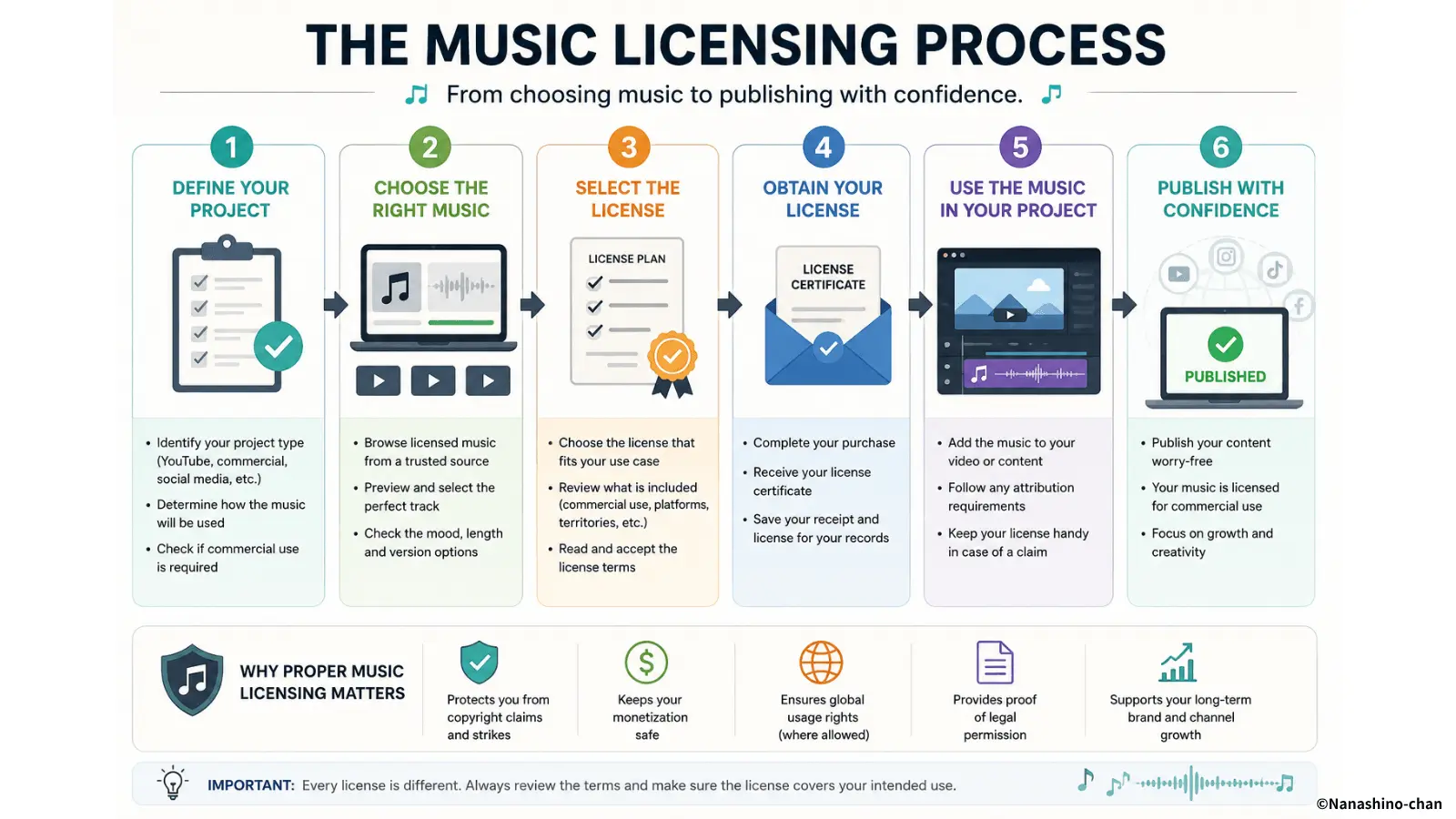
What Is Proof of Music License?
Proof of music license is a record that connects a music track, a license holder, and a permitted use case. It helps show that the user has obtained permission to use the music within a defined scope.
A strong proof of license is not only a payment receipt. It should also show what the license covers: the track, the project, the user or company, the platforms, the commercial purpose, and any important restrictions.
This matters because music usage can be questioned later by platforms, clients, legal teams, agencies, advertisers, distributors, or rights holders. Clear documentation makes it easier to show that the music was used with permission.
Why Proof of Music License Matters
Music licensing is often reviewed after a video is already published, promoted, monetized, delivered to a client, or used in a paid campaign. If documentation is missing, a simple music choice can become a business risk.
Proof of license helps businesses, creators, and agencies answer one important question: “Do we have the right to use this music in this project?”
Client Approval
Agencies and freelancers may need to show clients that the music used in a video is licensed for the project.
Platform Verification
YouTube, social platforms, or advertising platforms may ask for proof when there is a copyright claim or rights question.
Internal Records
Companies may need license records for legal review, procurement, marketing archives, campaign documentation, or future audits.
Content ID Support
License documentation can help when responding to a Content ID claim or explaining that the user has permission to use the track.
Commercial Confidence
Clear documentation reduces uncertainty when a video is used in ads, client work, product marketing, social media, or brand campaigns.
Future Reuse
When a video is reused later, the original license record helps confirm whether the same track can be used again.
What Should Be Included in Proof of Music License?
A useful proof of music license should be specific. The more clearly it identifies the track, buyer, license scope, and project use, the easier it is to verify later.
- • Track title and artist name
- • Rights holder, licensor, or seller name
- • Licensee name, company name, or buyer identity
- • Purchase date or license issue date
- • Order number, receipt, invoice, or transaction record
- • Project name or campaign name if applicable
- • Permitted use, such as video, ad, social media, podcast, app, AI video, or client work
- • Commercial or non-commercial scope
- • Platform scope, such as YouTube, Instagram, TikTok, LinkedIn, website, or paid ads
- • Duration, territory, or campaign period if the license is time-limited
- • Whether editing, looping, shortening, or synchronization with visuals is allowed
- • Any Content ID, copyright claim, or dispute instructions
- • Link to the license terms or downloadable license file
Receipt vs. License: What Is the Difference?
A receipt proves that a payment happened. A license explains what rights were granted. For commercial music use, both can be useful, but they are not the same thing.
| Document | What It Proves | Limitation |
|---|---|---|
| Payment Receipt | Shows that a purchase or payment was made. | May not clearly explain permitted use, platforms, commercial scope, or restrictions. |
| Invoice | Shows seller, buyer, amount, date, and transaction details. | May not fully describe usage rights unless license terms are included. |
| License Terms | Explains what the buyer is allowed to do with the music. | May need to be connected to a specific purchase, project, or buyer. |
| Proof of Music License | Connects track, buyer, purchase, license scope, and permitted project use. | Only valid within the scope of the license and its stated limitations. |
When Do You Need Proof of Music License?
Proof of music license is especially important when music is used in commercial, public, client-facing, monetized, paid, or brand-related content.
- • YouTube videos and YouTube Shorts
- • YouTube monetized content
- • Instagram Reels and branded social posts
- • TikTok videos and TikTok ads
- • Facebook and Meta ads
- • LinkedIn brand videos and B2B marketing videos
- • Product demo videos and SaaS videos
- • Corporate videos and company profile videos
- • Real estate videos and property tours
- • AI-generated videos and AI avatar videos
- • Sponsored content and influencer campaigns
- • Client work delivered by agencies or freelancers
- • Podcasts, intros, outros, and video podcasts
- • Online courses, training videos, and webinars
- • Apps, websites, landing pages, and product pages
- • Paid advertisements and commercial campaigns
Who Should Keep Music License Documentation?
Any person or business using music in commercial content should keep clear documentation. This is especially important when multiple people are involved in production, approval, distribution, or client delivery.
Creators
YouTubers, TikTok creators, Instagram creators, podcasters, and streamers should keep records for monetized or sponsored content.
Agencies
Creative agencies, video agencies, ad agencies, and social media teams should document music used in client work.
Brands
Brands and companies should keep license proof for ads, product videos, corporate videos, campaigns, and internal approval.
Freelancers
Video editors, motion designers, AI video creators, and social media freelancers should keep proof for each client project.
Production Teams
Production companies should store license records alongside project files, final exports, delivery notes, and client approvals.
Marketing Teams
Marketing teams should keep proof for campaigns, paid ads, landing pages, product demos, and reusable brand assets.
Proof of Music License and Content ID Claims
A music license does not always mean a platform will automatically recognize your permission. Some tracks may be registered with Content ID or other rights management systems. In that case, a platform may still detect the track.
If a claim, copyright notice, monetization issue, or client question appears, proof of license helps show that the track was licensed for the project. The proof should clearly identify the music, buyer, license date, and permitted use.
This is why keeping documentation matters before a problem appears. It is much easier to respond to a claim when the license information is already organized.
Useful records for Content ID or copyright questions
- • Track title
- • Artist or rights holder name
- • License purchase date
- • Licensee or company name
- • Order number, receipt, or invoice
- • Project title or video URL
- • Platform where the video was uploaded
- • License terms showing the use is permitted
- • Any claim dispute instructions from the licensor
Streaming or Buying a Song Is Not Proof of License
Listening to a song on a streaming service, buying a download, or finding music on a social platform usually does not grant permission to use that music in videos, ads, podcasts, client work, AI videos, apps, websites, or commercial campaigns.
For business use, the important question is not only whether you can hear or access the song. The important question is whether you have written permission to use the music in the specific project and distribution context.
Proof of Music License for AI-Generated Videos
AI-generated videos still need proper music rights when they use background music. AI tools may create scripts, visuals, avatars, edits, captions, or voiceovers, but they do not automatically clear music rights.
If an AI video is used on YouTube, Instagram, TikTok, LinkedIn, a company website, an ad campaign, an online course, a product demo, or a client project, the music should be licensed for that use.
- • AI-generated visuals do not prove music permission
- • AI avatars still need licensed background music for commercial use
- • AI YouTube channels should keep music license records
- • AI ads and AI brand videos may need commercial or sync rights
- • Agencies using AI video tools should keep documentation for clients
Proof of License for Agencies, Brands, and Client Work
For agencies and businesses, proof of music license is not only a creator issue. It is part of project management, risk control, and client communication.
When a video is delivered to a client, used in a paid campaign, embedded on a website, or reused across multiple assets, the license should be stored with the project documentation.
| Business Context | Why Proof Matters | Recommended Record |
|---|---|---|
| Client Video | The client may need to know that the video music is cleared for their use. | License terms, receipt, project name, final video URL. |
| Paid Ad Campaign | Advertising use often requires clearer scope than ordinary posting. | Campaign scope, platforms, duration, territory, license proof. |
| Brand Social Media | Social posts can become commercial assets when tied to business promotion. | Platform list, license terms, posting date, video links. |
| YouTube Upload | Content ID or copyright questions may appear after upload. | Track title, license proof, order number, video URL. |
| AI Video Production | AI visuals do not clear music rights automatically. | License proof, AI tool notes, final project usage scope. |
How Nanashino-chan Licensing Supports Proof of Use
Nanashino-chan music is positioned for creators, agencies, brands, AI video creators, product teams, and businesses that need music for commercial video use.
The licensing structure is designed to make usage scope easier to understand than relying on vague labels such as “free music,” “copyright-free,” or “royalty-free.” For business use, clarity matters.
- • Clear commercial licensing direction
- • Useful for videos, ads, client work, AI videos, brand content, and social media campaigns
- • Better documentation path than informal music use
- • Supports project records for creators, agencies, and companies
- • Helps separate listening access from actual usage permission
Official Platform Copyright Policies
Major platforms explain copyright rules separately from ordinary music listening. Purchasing, streaming, or accessing music does not automatically grant rights for uploading, monetization, advertising, business use, or social media distribution.
-
```
- YouTube Copyright Guidelines
- Instagram Copyright Information
- Facebook Copyright Policy
- TikTok Copyright Policy ```
Copyright policies and platform rules may change over time. Always review the latest official guidelines before publishing monetized or commercial content.
Proof of Music License Checklist
Before publishing, delivering, or advertising a project with licensed music, keep a simple documentation folder. This can help creators, agencies, and businesses respond faster if questions appear later.
- • Save the license terms
- • Save the receipt, order confirmation, or invoice
- • Record the track title and artist name
- • Record the project name and final video title
- • Record the platforms where the content will be published
- • Confirm whether commercial use is allowed
- • Confirm whether paid advertising is allowed
- • Confirm whether client work is allowed
- • Confirm whether editing, trimming, looping, or synchronization is allowed
- • Confirm whether the music may trigger Content ID or similar systems
- • Keep links to final uploads or campaign pages
- • Keep internal notes if the video is reused across multiple assets
FAQ
What is proof of music license?
Proof of music license is documentation showing that a creator, company, agency, client, or production team has permission to use a specific piece of music in a specific project or usage context.
Is a receipt enough to prove music rights?
A receipt helps prove that a purchase happened, but it may not be enough by itself. Strong proof should include both the purchase record and the license terms that explain what the buyer is allowed to do with the music.
Why do clients ask for proof of music license?
Clients may ask for proof because they need to know that the music used in their video, ad, campaign, or brand content is legally usable within the intended scope.
Can proof of license help with Content ID claims?
Yes. Proof of license can help when responding to Content ID claims, copyright questions, platform notices, client reviews, or rights verification requests.
Does streaming music count as proof of license?
No. Streaming music or buying music for personal listening generally does not grant permission to use that music in videos, ads, client work, AI videos, podcasts, apps, websites, or commercial campaigns.
Do AI-generated videos need proof of music license?
Yes, if the AI-generated video uses background music in a commercial, monetized, public, client-facing, or brand-related context. AI-generated visuals do not automatically clear music rights.
Should agencies keep music license documentation?
Yes. Agencies, freelancers, production companies, and marketing teams should keep license documentation for every client project that uses licensed music.
What should I save after licensing music?
Save the license terms, receipt, invoice, order confirmation, track title, artist name, project name, final video URL, platform list, and any Content ID or copyright claim instructions.
Need Music With Clear License Documentation?
Use licensed music for videos, ads, client work, YouTube, social media, AI videos, podcasts, apps, online courses, brand content, and commercial campaigns with a clearer path to proof of use.
► View Licensing OptionsRelated Pages
- Music License Documentation Checklist
- Music License for Agencies
- Music License for Business Videos
- Music License for Client Videos
- Music License for Marketing Campaigns
- Music Rights for Video Creators
- How to Choose a Music License for Videos
- How to Avoid Content ID Claims
- What Is Sync Licensing?
- Music Licensing for Commercial Use Guide
- Licensing Page
- Contact