What Happens If You Use Copyrighted Music?
If you use copyrighted music without the right permission, your video or post may receive a Content ID claim, lose monetization, be muted, be blocked, have ads placed on it, or in more serious cases receive a copyright strike.
The exact result depends on the platform, rights holder, license terms, account type, and whether the content is personal, monetized, sponsored, commercial, or made for a client.
This guide explains what can happen on YouTube and social media, why famous songs are risky for business use, and how licensed music helps creators reduce copyright uncertainty.
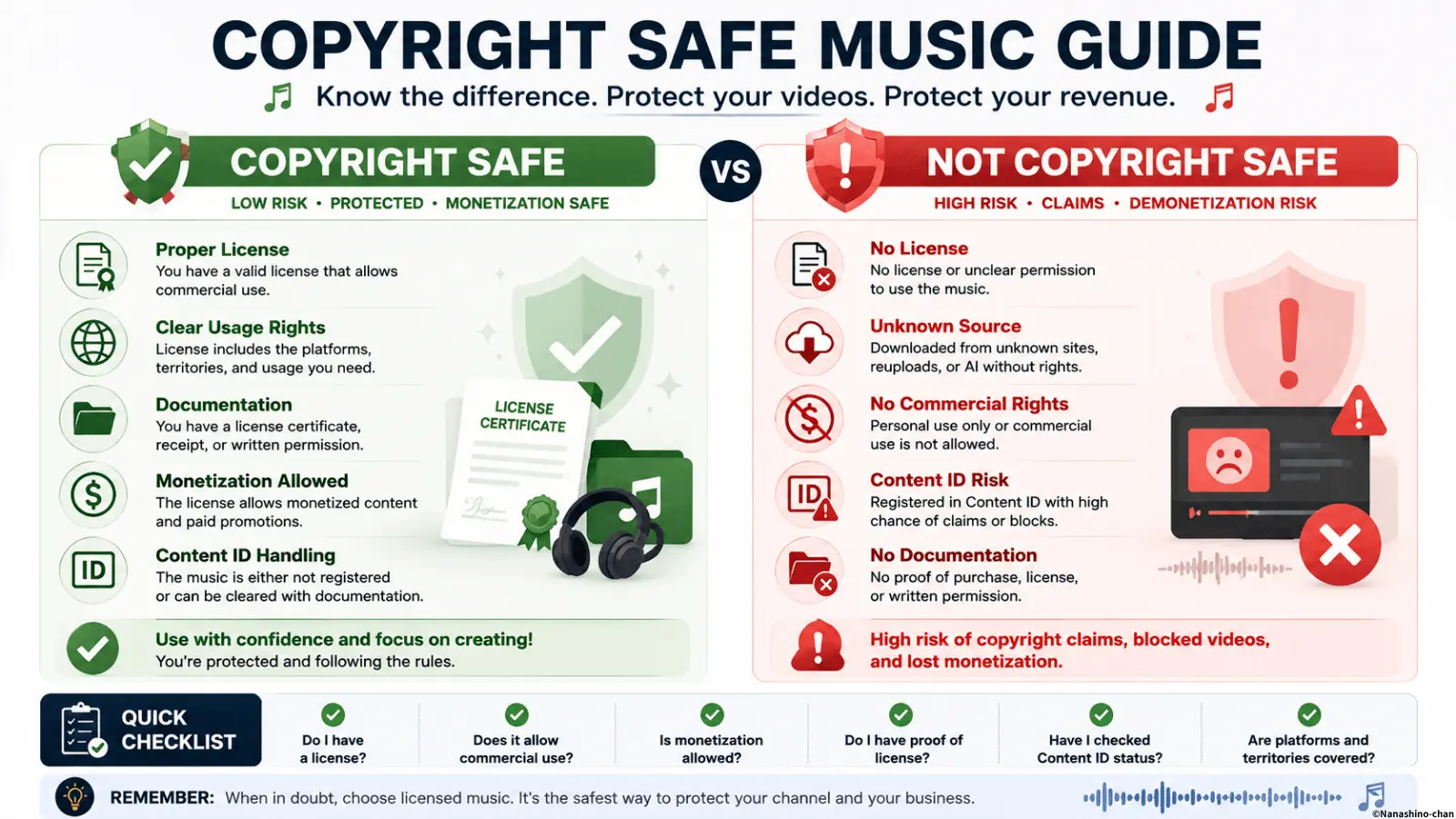
Direct Answer: What Can Happen If You Use Copyrighted Music?
When copyrighted music is used without proper permission, the rights holder or platform system may apply different actions. Some are minor, while others can seriously affect monetization, visibility, brand campaigns, or channel status.
- • A Content ID claim may appear
- • Your video may stay online but earn revenue for the rights holder
- • Ads may be placed on your video
- • Your video may be blocked in some countries or regions
- • Your audio may be muted or removed
- • The video may become unavailable on certain platforms
- • A copyright removal request may lead to a copyright strike
- • Brand, client, or ad campaigns may be delayed or rejected
Possible Outcomes by Platform Situation
The result can vary depending on whether you are uploading a YouTube video, publishing a social media post, running a paid ad, or delivering a client project.
| Situation | Possible Result | Why It Matters |
|---|---|---|
| YouTube video with copyrighted music | Content ID claim, ads, blocked regions, revenue redirection | Can affect monetization and channel workflow. |
| YouTube copyright removal request | Copyright strike | More serious than a standard Content ID claim. |
| Instagram or Facebook post | Muted audio, restricted post, removal, or blocked distribution | Can reduce reach and damage campaign performance. |
| TikTok video with famous music | Audio restrictions, business-use limitations, or removal | Personal use and brand use can be treated differently. |
| Paid ad or brand campaign | Ad rejection, takedown, legal review, or rights holder issue | Commercial use usually requires clearer licensing. |
| Client video or agency deliverable | Client approval problem, re-editing cost, or licensing dispute | Proof of music rights may be required. |
Content ID Claim vs Copyright Strike
A Content ID claim and a copyright strike are different. Many creators panic when they see a claim, but the outcome depends on the rights holder’s policy and whether the issue is an automated match or a formal removal request.
| Term | What It Means | Typical Impact |
|---|---|---|
| Content ID claim | An automated copyright match on YouTube | May affect ads, revenue, visibility, or tracking. |
| Copyright strike | A more serious action usually tied to a copyright removal request | Can affect channel standing. |
| Muted audio | A platform limits or removes the audio portion | Can damage the viewing experience. |
| Blocked video | The video becomes unavailable in some or all regions | Can reduce reach or stop a campaign. |
For a deeper explanation, see: Content ID vs Copyright Strike.
Can Copyrighted Music Affect Monetization?
Yes. Copyrighted music can affect monetization when a rights holder claims the audio, places ads on the video, redirects revenue, blocks the video, or limits where it can be viewed.
For casual uploads, this may be inconvenient. For monetized creators, businesses, agencies, and brand campaigns, it can directly affect revenue, client delivery, campaign timing, and professional credibility.
- • You may lose revenue from that video
- • The rights holder may monetize the video instead
- • The video may not qualify for your planned campaign use
- • A sponsor may reject the video
- • A client may request a replacement track
- • Re-editing and re-uploading may cost time
What Happens on Instagram, TikTok, Facebook, and Other Social Platforms?
Social platforms also have music rules and copyright systems. A song that appears in personal social media content may not be safe for business accounts, paid ads, branded content, or commercial campaigns.
Famous songs and major-label tracks are especially risky for commercial use because both the sound recording and the underlying composition may require permission.
- • Posts may be muted
- • Videos may be blocked or removed
- • Ads may be rejected
- • Business accounts may have limited music access
- • Brand campaigns may require separate clearance
- • Rights holders or collection societies may pursue usage fees
For famous songs and business use, see: Can You Use Famous Songs on Social Media?.
Why Creators Often Get Confused
Music copyright is confusing because access is not the same as permission. A track may be easy to hear, download, stream, or repost, but still not be cleared for your intended use.
“I bought the song.”
Buying music for listening does not usually grant upload, monetization, advertising, or commercial video rights.
“I gave credit.”
Credit may be required by some licenses, but attribution alone usually does not replace permission.
“It was on social media.”
Music appearing on social media does not automatically mean it can be reused in YouTube videos, ads, or commercial projects.
“It said royalty-free.”
Royalty-free music can still include restrictions, attribution requirements, Content ID policies, or exclusions for ads and client work.
When Copyrighted Music Is Especially Risky
Copyrighted music becomes more risky when your content has business value, public visibility, paid promotion, client obligations, or long-term revenue potential.
- • Monetized YouTube videos
- • YouTube Shorts for business growth
- • Sponsored creator videos
- • Product reviews with affiliate links
- • Brand campaigns
- • Paid social media ads
- • Company Instagram Reels or TikTok posts
- • Client editing projects
- • Agency deliverables
- • AI-generated videos for marketing
- • Website videos and landing pages
What Should You Do If You Already Used Copyrighted Music?
If you already used copyrighted music, the best next step depends on whether the video has a claim, whether you have permission, and whether the project is personal, monetized, or commercial.
1. Review the Claim
Check the claimed track, claimant, policy, affected section, and whether monetization or visibility changed.
2. Check Your Rights
Confirm whether you actually have a license, permission, attribution text, or usage proof.
3. Choose a Fix
You may need to replace the audio, mute the section, remove the video, license the music, or use a different track.
Do not dispute a claim unless you understand the reason and have a valid basis or proof of permission.
Safer Music Workflow for Creators
A safer workflow does not mean promising that copyright systems will never create a claim. It means choosing music with clearer rights and keeping documentation before publishing.
- • Use music from identifiable sources
- • Check whether YouTube use is allowed
- • Check whether monetization is allowed
- • Check whether commercial use is allowed
- • Check Content ID or claim handling policies
- • Keep proof of license
- • Save track title, artist name, and usage terms
- • Avoid streaming tracks, famous songs, and unclear social audio for business content
- • Use commercial licensing for ads, client work, and brand campaigns
Licensed Music vs Copyrighted Music Without Permission
Most music is copyrighted. The question is whether you have permission to use it in your specific project. Licensed music can still be copyrighted, but the license defines what you are allowed to do.
That means “copyrighted” and “licensed” are not opposites. A professional commercial license gives you documented permission for a specific usage scope.
| Music Type | Problem | Better Approach |
|---|---|---|
| Famous song without permission | High copyright and commercial-use risk | Get proper clearance or use licensed music. |
| Streaming track | Listening access does not grant upload rights | Use a track with video usage permission. |
| Unclear free download | Ownership and license scope may be uncertain | Use music with clear terms and proof. |
| Commercial licensed music | May still need Content ID instructions | Keep license proof and follow claim release process if needed. |
Commercial-Ready Lo-Fi Music for Creators
Nanashino-chan provides original lo-fi music with commercial licensing options for YouTube creators, monetized videos, Shorts, podcasts, sponsored content, brand campaigns, AI videos, product videos, and client projects.
The goal is to help creators and businesses use music with clearer rights, better documentation, and a workflow designed for modern video publishing.
YouTube Creators
Music for monetized videos, Shorts, tutorials, podcasts, and creator businesses.
Brands & Agencies
Music for sponsored content, product videos, brand campaigns, ads, and client work.
Commercial Licensing
Licensing helps clarify usage rights for videos, campaigns, and business content.
ISRC, Track Identification, and Rights Clarity
ISRC stands for International Standard Recording Code. It helps identify a specific sound recording. ISRC does not replace licensing, but it supports clearer track identification and rights management.
Nanashino-chan’s officially distributed music is managed as identifiable recordings. Many releases are associated with formal recording metadata such as ISRC-based identification.
- ✔ Identifiable recordings
- ✔ Clearer artist and track identity
- ✔ Commercial licensing available
- ✔ Useful for YouTube creators, brands, agencies, and monetized videos
Track identification supports rights clarity, but it does not replace licensing. Always use the appropriate license for videos, ads, sponsored content, client work, or commercial campaigns.
Preview Music Before You License
Listen to original lo-fi tracks before using them in YouTube videos, Shorts, sponsored content, AI videos, ads, brand campaigns, or client projects.
Browse the catalog → All Tracks
Official Platform Copyright Policies
Copyright policies and platform rules may change over time. Always review the latest official guidelines before publishing monetized, sponsored, or commercial content.
- YouTube Copyright Guidelines
- YouTube Content ID Overview
- YouTube Content ID Claims
- YouTube Copyright Strikes
- Instagram Copyright Information
- Facebook Copyright Policy
- TikTok Copyright Policy
This page is an educational guide and not legal advice. For high-value campaigns, disputes, or complex rights questions, consult qualified legal counsel or the relevant rights holder.
FAQ
What happens if you use copyrighted music on YouTube?
If you use copyrighted music on YouTube without the right permission, you may receive a Content ID claim, lose monetization, have ads placed on the video, face regional blocking, or in more serious cases receive a copyright strike.
Will copyrighted music always trigger a Content ID claim?
Not always. Detection depends on the platform, the rights holder, Content ID registration, and how the music is used. However, famous songs and commercial releases are often detectable.
Is a Content ID claim the same as a copyright strike?
No. A Content ID claim is usually different from a copyright strike. A strike is generally connected to a copyright removal request, while a Content ID claim comes from YouTube's automated matching system.
Can copyrighted music affect YouTube monetization?
Yes. Copyrighted music may affect monetization if a claim redirects ad revenue, places ads on the video, restricts availability, or prevents the creator from earning revenue from that upload.
Can I use copyrighted music if I give credit?
Credit alone usually does not replace permission. Some licenses require attribution, but attribution does not automatically grant the right to use copyrighted music.
How can creators avoid problems with copyrighted music?
Creators can reduce risk by using music with clear licensing terms, avoiding unclear audio sources, checking Content ID policies, keeping proof of license, and choosing commercial licensing for monetized, sponsored, or client-facing content.
Need Music You Can Use More Safely?
Use original lo-fi music with commercial licensing options for YouTube creators, monetized videos, Shorts, sponsored content, brand campaigns, AI videos, ads, and client projects.
Related Pages
- How to Use Music Legally on YouTube
- Can You Use Famous Songs on Social Media?
- Content ID vs Copyright Strike
- YouTube Content ID Guide
- How to Avoid Content ID Claims
- How to Avoid Copyright Problems on YouTube
- Copyright-Safe Music for YouTube
- Music License for YouTube Creators
- Commercial Use Music Guide
- Licensing Page