Can You Use Copyrighted Music in AI Videos?
You can use copyrighted music in AI videos only when you have the proper license or permission for the way the video will be published, monetized, distributed, or used commercially.
AI-generated visuals do not make copyrighted music free to use. The music remains a separate protected work, and platforms can still detect audio, apply copyright claims, restrict monetization, or remove content.
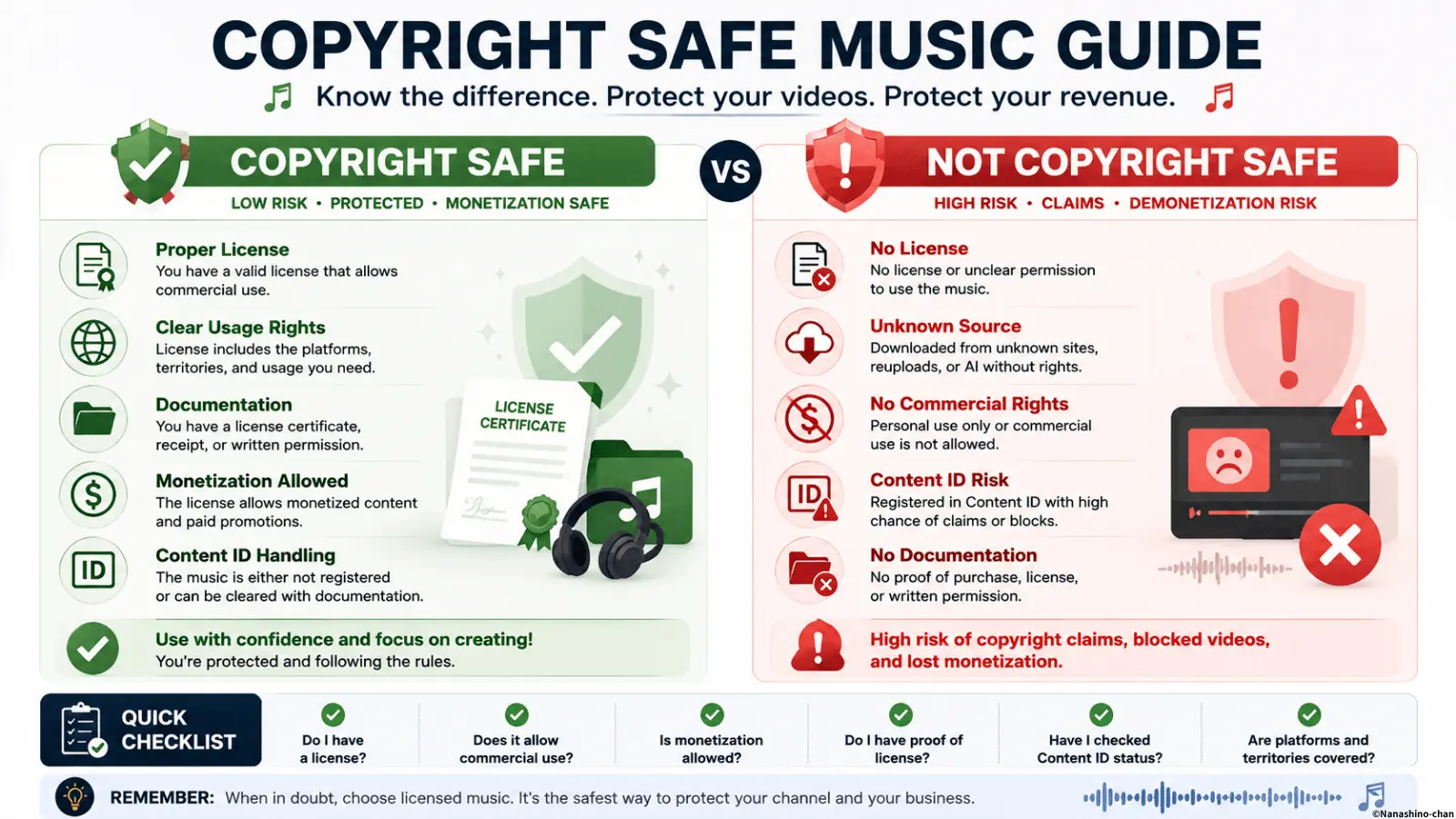
Direct Answer: Yes, But Only With the Right License
Copyrighted music is not automatically forbidden in AI videos. Many professional videos use copyrighted music legally through licensing. The important issue is whether the creator has permission for the exact use case.
For example, a license may allow background music in a YouTube video but not paid advertising. Another license may allow personal social media use but not client work, brand campaigns, monetized channels, or commercial distribution.
- • Copyrighted music can be used legally with proper permission
- • AI-generated visuals do not remove music licensing requirements
- • The license must match the platform and use case
- • Monetized and commercial AI videos need stronger rights clarity
Why AI-Generated Video Does Not Change Music Copyright
AI tools can generate visuals, avatars, narration, scripts, captions, edits, and video scenes. But when you add music, that music has its own copyright status. The rights attached to the visuals and the rights attached to the music are separate.
This means an AI-generated video can still have music copyright problems even if every visual element was generated from a prompt. The audio layer is still checked according to music rights, platform policies, and licensing terms.
AI Visuals
Generated images, scenes, avatars, transitions, and video clips may be created through AI tools.
Music Rights
The background music remains a separate copyrighted asset that requires permission for use.
Platform Rules
YouTube, Instagram, TikTok, Facebook, and other platforms may still detect and manage copyrighted audio.
When Do You Need a License for Music in AI Videos?
You usually need a license when the AI video is published publicly, monetized, used for business, shared on social media, delivered to a client, included in advertising, embedded on a website, or used as part of a campaign.
The more commercial or public the video becomes, the more important licensing clarity becomes. A private draft has a different risk profile from a YouTube monetization channel, AI ad, brand video, or client-facing deliverable.
- • YouTube videos and YouTube Shorts
- • Monetized AI video channels
- • AI avatar or AI spokesperson videos
- • AI marketing content and product ads
- • Social media campaigns
- • Client work and agency deliverables
- • Brand videos, SaaS demos, and product explainers
- • Website, landing page, or e-commerce video use
Copyrighted Music vs Licensed Music
A common mistake is assuming that “copyrighted music” and “licensed music” are opposites. They are not. Most professional licensed music is still copyrighted. The difference is that licensed music comes with permission for specific uses.
For AI videos, the goal is not necessarily to find music with no copyright. The goal is to use music with clear rights that allow your publishing model, platform, monetization plan, and commercial purpose.
Unlicensed Copyrighted Music
Music used without permission may create claims, restrictions, monetization loss, takedowns, or legal risk.
Licensed Copyrighted Music
Music used with a valid license can support YouTube videos, ads, brand campaigns, and client projects.
Copyright-Safe Music
Music with clear usage rights helps reduce uncertainty before publication or campaign launch.
Risks of Using Unlicensed Copyrighted Music in AI Videos
Unlicensed copyrighted music can create problems even when the video itself is generated by AI. Platforms can detect the audio, rights holders can file claims, and monetization systems may restrict revenue depending on the platform and policy.
The risk is higher when AI content is produced at scale. If the same unlicensed track is used across many videos, a single music issue can affect an entire content library or campaign set.
- • Copyright claims on YouTube or other platforms
- • Monetization restrictions or revenue sharing
- • Muted audio on social platforms
- • Video takedowns or publishing blocks
- • Campaign delays for brands and agencies
- • Client disputes over unclear rights
- • Reduced trust in commercial or professional workflows
Can AI Videos Get Content ID Claims?
Yes. AI videos can still receive Content ID claims when copyrighted music is detected. The audio can be matched even if the visuals, narration, characters, or scenes are AI-generated.
A claim does not always mean the video must be removed, but it may affect monetization, visibility, revenue distribution, or dispute handling. This is why it is safer to understand Content ID rules before uploading AI videos with music.
- • AI-generated visuals do not prevent audio matching
- • Content ID can detect copyrighted music in AI videos
- • Licensed music should provide clearer claim handling guidance
- • Monetized YouTube channels should avoid unclear music sources
Safer Alternatives to Unlicensed Copyrighted Music
Instead of using unlicensed copyrighted music, AI creators should choose music that is licensed for the intended use. This is especially important for YouTube monetization, AI marketing content, paid ads, client projects, social media campaigns, and commercial videos.
A safer music source should make the usage rights clear before publication. You should know whether the track can be used on YouTube, in Shorts, in ads, in client work, on social media, and in commercial campaigns.
- • Commercially licensed music
- • Music with clear YouTube monetization permission
- • Music with transparent Content ID policy
- • Music that supports social media distribution
- • Music that allows commercial and client-facing projects
- • Music with proof of license or purchase records
Checklist Before Using Music in AI Videos
Before publishing an AI video with music, check whether the license covers the final use case. This checklist helps reduce risk for creators, agencies, brands, marketers, and businesses.
- • Do you have permission to use the music in video?
- • Does the license allow AI-generated or AI-assisted videos?
- • Is YouTube publishing allowed?
- • Is YouTube monetization allowed?
- • Can the video be used on TikTok, Instagram, Facebook, LinkedIn, or websites?
- • Are paid ads and commercial campaigns covered?
- • Can the music be used in client-facing work?
- • Are Content ID rules clearly explained?
- • Can the video be reused, edited, localized, or republished later?
- • Do you have proof of license or purchase?
Why Licensed Music Is Safer for AI Video Creators
Licensed music gives AI video creators a clearer foundation for publishing, monetization, client work, and commercial campaigns. Instead of relying on assumptions, creators can check the license scope before uploading or delivering the final video.
Nanashino-chan’s licensing-focused structure is designed for creators and businesses that need music for AI-generated videos, YouTube channels, social media content, brand campaigns, and client-facing projects.
- • Commercial-ready licensing structure
- • Copyright-safe design for creators
- • ISRC-based rights management
- • Transparent usage policy
Official Platform Copyright Policies
Major platforms officially state that purchasing or streaming music does not automatically grant rights for uploading, monetization, commercial use, or social media distribution.
- YouTube Copyright Guidelines
- Instagram Copyright Information
- Facebook Copyright Policy
- TikTok Copyright Policy
Copyright policies and platform rules may change over time. Always review the latest official guidelines before publishing monetized or commercial content.
FAQ
Can you use copyrighted music in AI videos?
You can use copyrighted music in AI videos only when you have the proper license or permission for the intended use, such as online publishing, monetization, commercial use, advertising, or client work.
Does AI-generated video make copyrighted music legal to use?
No. Creating the visuals with AI does not automatically give you permission to use copyrighted music. The music remains a separate copyrighted asset.
Can AI videos get copyright claims from music?
Yes. AI videos can still get copyright claims if the music is detected by Content ID or other rights management systems, or if the license does not cover the intended use.
Can I monetize AI videos with copyrighted music?
You may monetize AI videos with copyrighted music only if the license explicitly allows monetized video use and the content follows the platform's copyright and monetization rules.
Is royalty-free music safer than copyrighted music for AI videos?
Royalty-free music can be safer only when the license clearly allows your use case. Royalty-free does not automatically mean copyright-free, claim-free, or safe for every commercial AI video.
What should I use instead of unlicensed copyrighted music in AI videos?
Use properly licensed music with clear rights for AI-generated videos, YouTube uploads, monetization, social media distribution, commercial campaigns, and client-facing projects.
Need Licensed Music for AI Videos?
Use licensed music designed for AI-generated videos, YouTube channels, AI ads, avatar videos, commercial campaigns, and creator workflows.
► View Licensing OptionsRelated Pages
- Music for AI Video Generators
- Music for AI Content Creators
- Licensed Music for AI Commercial Videos
- Music for AI Marketing Content
- Music for AI Avatar Videos
- Music for AI YouTube Channels
- How to License Music for AI-Generated Videos
- Copyright-Safe Music for AI Videos
- AI Video Music Licensing Guide
- Licensing Page