Commercial license|sync license|sync rights|paid ads|brand campaigns
Commercial License vs Sync License
A commercial music license and a sync license are not always the same. The right license depends on whether the music is used in organic business content, client work, paid ads, brand campaigns, or synchronized audiovisual media.
Use this guide to understand commercial music licensing, sync rights, synchronization licenses, business video use, paid social ads, client projects, and brand campaign music licensing.
Direct Answer: Which License Do You Need?
If your use is a normal organic commercial video, a Commercial Creator License may be the starting point. If your use involves paid advertising, brand campaigns, sponsored campaigns, client campaign assets, product launches, or broader audiovisual promotion, a Sync License or custom license is usually the safer starting point.
Commercial License
For commercial online use
A commercial music license may cover certain business videos, creator videos, product demos, website videos, monetized online videos, and organic brand content, depending on the license terms.
Sync License
For music synchronized with visuals
A sync license covers music synchronized with visual media, especially when the video is used for paid ads, brand campaigns, product launches, sponsored content, client campaign deliverables, or broader promotional use.
Why This Difference Matters
Many creators and businesses use the phrase “commercial license” broadly. But music licensing depends on the actual use: where the video appears, whether it is paid media, who the client is, how long the campaign runs, and whether music is synchronized with campaign visuals.
A video used organically on a brand profile is not the same as a paid social ad. A product demo on a website is not the same as a multi-platform campaign. A freelance client edit is not the same as a large brand launch campaign.
日本語:商用ライセンスとSync Licenseは似ていますが、同じではありません。 通常の企業動画やオーガニック投稿と、広告・キャンペーン・クライアント案件・映像同期利用では、必要な許諾範囲が変わる場合があります。
Commercial License vs Sync License Comparison
Use this table as a practical starting point when choosing between a commercial music license and a sync license.
| Question | Commercial License | Sync License |
|---|---|---|
| Basic purpose | Allows certain commercial uses of music, such as business videos, monetized online videos, website videos, and organic brand content, depending on scope. | Allows music to be synchronized with visual media, especially campaign videos, paid ads, sponsored content, product launch videos, and broader audiovisual use. |
| Typical use | Organic YouTube videos, product demos, business explainers, website videos, creator videos, brand posts, and non-ad commercial content. | TikTok ads, Instagram ads, YouTube ads, LinkedIn ads, brand campaigns, product launches, sponsored videos, client campaigns, and audiovisual campaigns. |
| Paid advertising | Usually not the best fit unless the license explicitly allows paid ad use. | Usually the better starting point for paid social ads, boosted posts, and campaign distribution. |
| Client work | May fit organic client videos if the final client use is covered. | Often needed for client campaigns, paid ads, sponsored campaigns, or broader promotional deliverables. |
| Campaign duration | Often not built around campaign flight dates unless specified. | Often tied to a usage period such as 1 month, 3 months, or custom campaign duration. |
| Risk if misunderstood | Using a basic commercial license for paid media may exceed the intended scope. | Using sync licensing clarifies campaign-style audiovisual use within the stated scope. |
What Are Sync Rights?
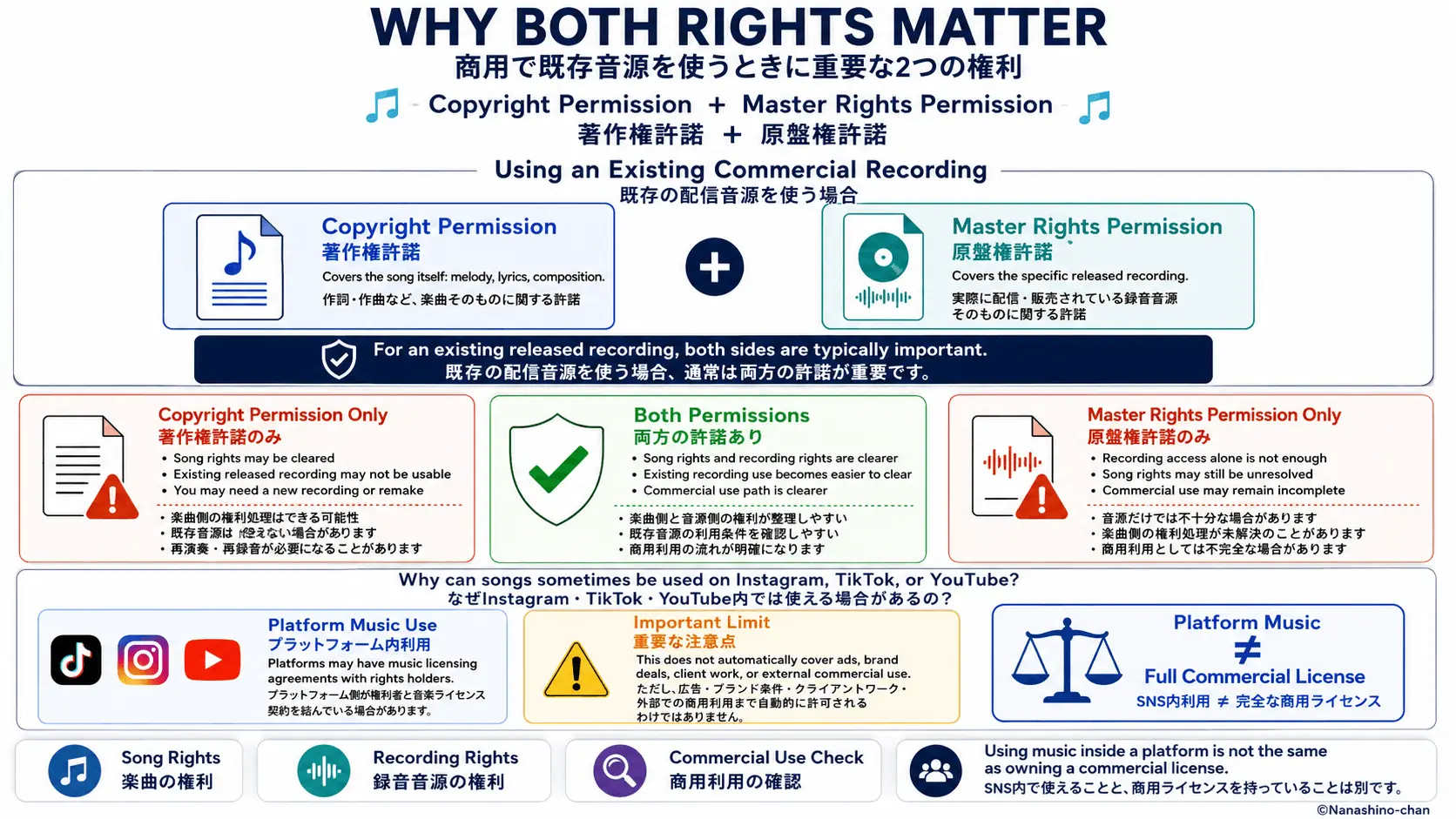
Sync rights, or synchronization rights, refer to permission to synchronize music with visual media. This is why sync licensing becomes important when music is combined with video, ads, campaign assets, films, product launch videos, apps, games, or other audiovisual works.
Sync rights
Music + visual media
Sync rights matter when a track is placed under moving images, edited to a video, used in a brand film, or combined with campaign visuals.
Master rights
The specific recording
If you use an existing recording, permission may need to cover the sound recording itself, not only the underlying musical composition.
Composition rights
The underlying music
A complete music use analysis may also consider the musical composition, especially when licensing music for commercial audiovisual projects.
Why Both Rights Matter in Music Licensing
When using existing recorded music in a video, brand campaign, client project, or paid ad, the license should clarify the relevant rights for the actual use. Platform availability or casual streaming access should not be treated as full campaign permission.
This is especially important for sync rights because the music becomes part of an audiovisual work.
 Open full-size infographic →
Choose by Use Case
The easiest way to choose between a commercial license and a sync license is to start with the final use.
Organic creator video
Commercial License may fit
Monetized YouTube videos, creator videos, educational videos, portfolio videos, and organic social content may start from a commercial license if the use is covered.
Business video
Commercial License may fit
Product demos, website videos, company introduction videos, SaaS explainers, and organic business videos may start from a commercial license.
Client work
Commercial, Sync, or Custom
Client projects depend on the final client use. Organic client videos may differ from paid client ads or campaign deliverables.
Paid social ads
Sync License usually fits better
TikTok ads, Instagram ads, Facebook ads, YouTube ads, LinkedIn ads, boosted posts, and UGC ads usually need ad-appropriate sync licensing.
Brand campaign
Sync or Custom License
Product launches, sponsored campaigns, influencer campaigns, campaign videos, and multi-platform promotion usually need sync or custom review.
Broadcast / app / game / exclusive use
Custom License Inquiry
TV, cinema, games, apps, events, broadcast, exclusive use, and large-scale campaigns should be reviewed as custom licensing cases.
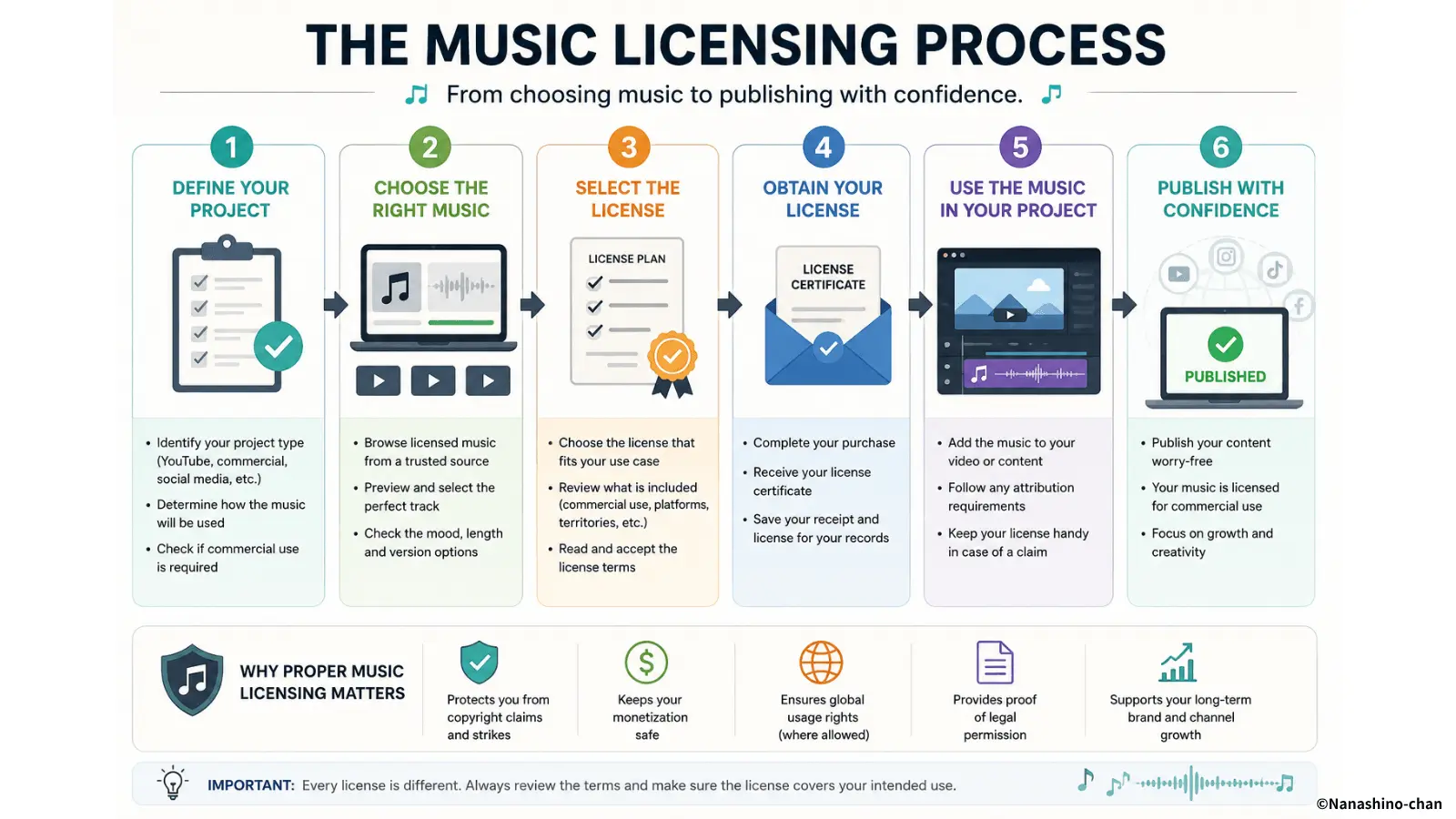
Music Licensing Process: From Track Choice to Usage Scope
A good licensing workflow starts with the creative need, then checks the commercial scope. Choose the track by mood, then choose the license by actual use.
If the video will be used for paid media, campaign promotion, sponsored content, or broad audiovisual distribution, do not treat a simple commercial license as automatically enough.
 Open full-size infographic →
Platform Audio Is Not a Commercial or Sync License
A track may appear inside Instagram, TikTok, YouTube Shorts, or another platform music interface, but that does not automatically mean it is cleared for brand campaigns, paid ads, client work, commercial websites, product launches, or broader audiovisual use.
Platform-library or credit-based usage may be suitable for non-commercial or small-scale projects, but it should not be treated as a substitute for a commercial license, sync license, paid advertising license, client-work license, or brand campaign license.
日本語:SNS上で選べる音源として表示されていることと、商用ライセンスやSync Licenseが取得できていることは同じではありません。 企業動画、広告、キャンペーン、クライアント案件では、用途に合った許諾確認が必要です。
Nanashino-chan License Options
Nanashino-chan offers license options for personal, commercial, and sync use cases. The correct license depends on the actual use, platform, duration, paid distribution, and campaign scope.
Personal Use License
$19
For personal, non-commercial use only. Not for business videos, paid ads, client work, brand campaigns, monetized content, or commercial video use.
Open GumroadCommercial Creator License
$500
For organic commercial videos, business videos, product demos, monetized videos, website videos, and non-ad online content within license scope.
Open Gumroad1-Month Sync License
$500
For suitable short-term paid ads, brand campaigns, campaign videos, sponsored promotion, client advertising, and sync use during a limited period.
Open Gumroad3-Month Sync License
$1,200
For suitable longer campaign periods, paid social distribution, multi-week brand campaigns, extended promotional visibility, and broader campaign use.
Open GumroadCommercial License vs Sync License Checklist
Before choosing a license, answer these questions. They help clarify whether your use is commercial, sync, paid media, client work, or custom.
- Will the music be used with video? If yes, sync rights may matter.
- Is the video for a business, brand, client, product, or service? If yes, treat it as commercial use.
- Will the video be posted organically only? A commercial license may be the starting point.
- Will the video be used as a paid ad or boosted post? Start from a sync license or custom review.
- Is the video part of a brand campaign or product launch? Sync or custom licensing may be needed.
- Is an agency or freelancer delivering the video to a client? Confirm the final client usage scope.
- How long will the campaign run? Campaign duration may affect license choice.
- Will there be multiple versions or platforms? Multi-platform use may require broader scope.
- Do you need documentation? Save license terms, receipt, track title, artist name, project name, dates, and usage notes.
Important: A License Does Not Guarantee Platform Behavior
A commercial license or sync license clarifies permission from the rights holder within the stated scope. It does not guarantee how TikTok, Instagram, YouTube, Facebook, LinkedIn, advertising review systems, regional catalogs, account settings, automated audio systems, Content ID systems, or future platform policies will behave.
The safer workflow is to choose the correct license, keep documentation, confirm platform rules, and request custom review when the campaign or distribution is broader than standard online use.
日本語:ライセンスは権利者からの許諾範囲を明確にするものですが、 各プラットフォームの自動判定、広告審査、地域差、アカウント設定、将来の仕様変更まで保証するものではありません。
Related Guides
Continue with these pages depending on your actual use case: brand videos, client work, paid social ads, brand campaigns, platform music, or proof of licensing.
FAQ
What is the difference between a commercial license and a sync license?
A commercial license may cover certain business, monetized, or organic commercial uses. A sync license specifically covers music synchronized with visual media such as videos, ads, brand campaigns, sponsored content, and other audiovisual works. The correct license depends on the final usage scope.
When do I need a sync license?
You may need a sync license when music is combined with video for paid ads, brand campaigns, sponsored videos, product launch videos, client campaign assets, films, apps, games, or broader commercial audiovisual distribution.
What are sync rights?
Sync rights are permissions related to synchronizing music with visual media. They matter when music is used in videos, ads, films, campaigns, online commercials, product videos, apps, games, or other audiovisual content.
Is a commercial license enough for YouTube videos?
A commercial license may be enough for some monetized YouTube or organic online videos if the license scope covers that use. Paid advertising, sponsored campaigns, client campaign assets, or broader distribution may require a sync license or custom permission.
Do paid social ads need a sync license?
Paid social ads often require a sync license or custom permission because the music is synchronized with advertising video and distributed through paid media platforms such as TikTok, Instagram, Facebook, YouTube, or LinkedIn.
Can platform music replace a commercial or sync license?
Platform-library or credit-based usage should not be treated as a substitute for a commercial license, sync license, paid advertising license, client-work license, or brand campaign license.
Which Nanashino-chan licenses are available?
Nanashino-chan offers a Personal Use License for $19, a Commercial Creator License for $500, a 1-Month Sync License for $500, and a 3-Month Sync License for $1,200 for suitable use cases, subject to license scope.
Choose the License Based on the Actual Use
Start with the final use: organic commercial video, business content, client work, paid social ads, brand campaign, product launch, or broader audiovisual distribution. Then choose the license that matches that scope.
Disclaimer
This page provides general music licensing information about commercial licenses, sync licenses, sync rights, paid ads, brand campaigns, client work, business videos, and commercial audiovisual use. It is not legal advice and does not guarantee platform behavior, monetization approval, advertising approval, reach, claim outcomes, or campaign performance.
A license clarifies permitted use from the rights holder within the stated scope, but platforms may apply their own rules, account settings, regional restrictions, automated systems, advertising review systems, audio catalog behavior, and future policy changes.
免責事項
このページは、商用ライセンス、Sync License、sync rights、広告、ブランドキャンペーン、 クライアント案件、企業動画、商用映像利用に関する一般的な情報を提供するものです。 法的助言ではなく、各プラットフォームでの表示、収益化、広告審査、リーチ、Content IDの挙動、キャンペーン成果を保証するものではありません。