Proof of license|license documentation|business videos|client work|paid ads
Proof of Music License for Business
Businesses, brands, agencies, freelancers, and marketing teams should keep clear proof of music license when using music in commercial videos, client work, paid ads, brand campaigns, product videos, and sync-licensed projects.
Proof of music license is not only a receipt. It should connect the music track, license terms, project, client, platform, campaign period, and actual commercial use.
Direct Answer: What Counts as Proof of Music License?
Proof of music license is a set of records showing that a business has permission to use a specific music track in a specific commercial context. A receipt is helpful, but the strongest record usually includes both purchase proof and license scope.
Purchase proof
Shows that a license was obtained
This may include a Gumroad receipt, order confirmation, invoice, transaction record, purchase email, or other record showing that the license was purchased.
Usage scope
Shows what the license permits
This may include license terms, permitted platforms, duration, client use, paid advertising permission, campaign use, restrictions, and custom written permission.
Why Businesses Need Music License Documentation
Business videos often move across teams, platforms, clients, campaigns, and time periods. A video may begin as an internal edit, become an organic social post, then later be reused as a paid ad, client deliverable, website video, or campaign asset.
Without clear documentation, teams may not remember which track was licensed, who purchased the license, what the license allowed, which client it covered, whether paid advertising was included, or whether the use period has expired.
日本語:企業動画やクライアント案件では、あとから「どの曲を、どの範囲で、誰のために、いつまで使えるのか」を確認する場面があります。 そのため、購入履歴だけでなく、ライセンス条件・曲名・使用先・クライアント名・媒体・期間を記録しておくことが重要です。
Music License Documentation Checklist
A useful proof-of-license record should connect the music track to the actual project. This helps businesses, agencies, freelancers, editors, marketing teams, and clients understand what was licensed and why.
Keep documentation before publishing, delivering, boosting, or launching a campaign.
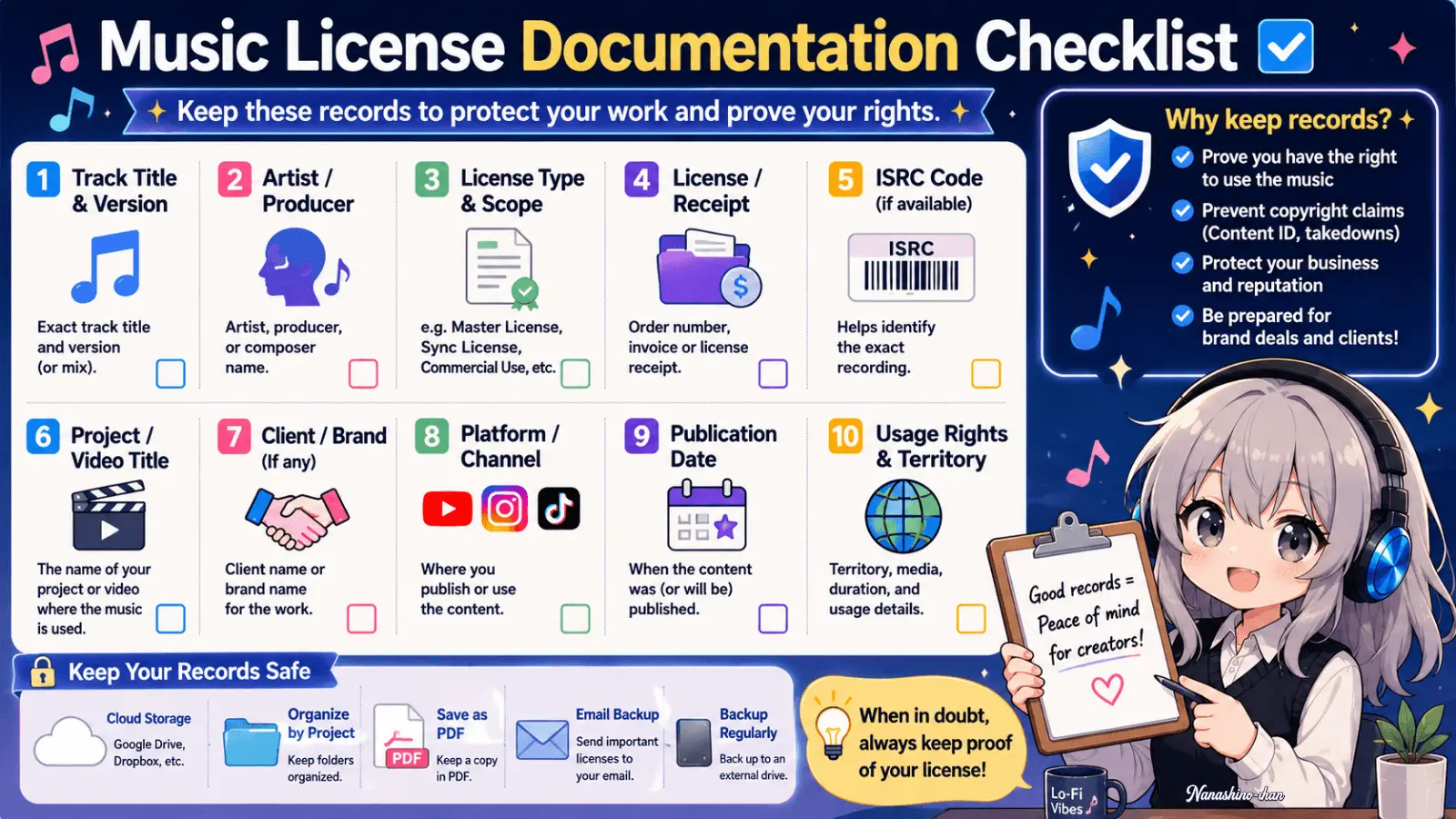 Open full-size infographic →
What Businesses Should Keep as Proof
For business use, proof of music license should be organized like project documentation, not like a casual download receipt.
Purchase
Receipt or order confirmation
Save the Gumroad receipt, invoice, transaction ID, purchase email, payment date, buyer account, and any confirmation page connected to the license.
Terms
License terms and usage scope
Save a copy of the license terms showing what the license allows: personal, commercial, sync, ads, platforms, duration, restrictions, and permitted use.
Music
Track title and artist name
Record the exact track title, artist name, music URL, version, release name, and any other track identifiers available for the music.
Project
Project and client information
Record the project name, client name, brand name, product name, campaign name, internal project code, and final video title.
Distribution
Platforms and media use
Record where the video will appear: YouTube, Instagram, TikTok, Facebook, LinkedIn, website, landing page, ads, internal channels, or campaign pages.
Dates
Usage period and campaign dates
Record publication date, delivery date, campaign start date, campaign end date, license period, renewal date, and any expiration notes.
Proof Needed by Use Case
The proof you need depends on the project type. A simple organic business video may need fewer records than a paid campaign or client deliverable, but businesses should still keep the core documents.
| Use Case | Documents to Keep | Why It Matters |
|---|---|---|
| Organic business video | Receipt, license terms, track title, artist name, project name, platform list, publish date. | Helps confirm that the business had permission for non-ad commercial online use. |
| Website or product demo video | Receipt, terms, track details, website URL, product name, project notes, publication date. | Website videos may stay live for a long time, so documentation should be easy to find later. |
| Client work or agency deliverable | Receipt, terms, client name, brand name, project name, final video title, platforms, delivery date, usage notes. | Client assets may be reused, reposted, archived, boosted, or transferred between teams. |
| Paid social ads | Sync license, receipt, terms, campaign name, client name, ad platforms, campaign dates, ad versions, usage notes. | Paid media usually has broader commercial and campaign scope than organic posting. |
| Brand campaign | Sync or custom license, receipt, terms, campaign name, platform list, duration, assets, territories, client approval notes. | Campaign use often involves multiple assets, dates, teams, and distribution channels. |
| Custom or unusual use | Written permission, custom agreement, project-specific terms, usage restrictions, signed correspondence, invoice, and scope notes. | Broadcast, apps, games, events, exclusivity, or unusual distribution should be clearly documented. |
Who Should Keep the Proof?
In business music licensing, the proof should be accessible to the person or team responsible for the final use. In some projects, more than one party should keep a copy.
Business / brand
The final user
The brand or business using the video should keep proof because the content may stay online, be reused in campaigns, or be reviewed later.
Agency
The production manager
Agencies should keep license records with project files so account managers, producers, media buyers, editors, and clients can verify usage scope.
Freelancer
The creator or editor
Freelancers should keep proof for their own records and provide relevant license information to the client when the project is delivered.
How Music Licensing Fits the Business Workflow
License documentation should be created before final delivery, publishing, boosting, or campaign launch. It should be stored with the project files, not scattered across email, payment history, and chat messages.
A clean workflow reduces confusion when a client asks, a platform issue appears, a campaign expands, or a team member needs to confirm what usage was permitted.
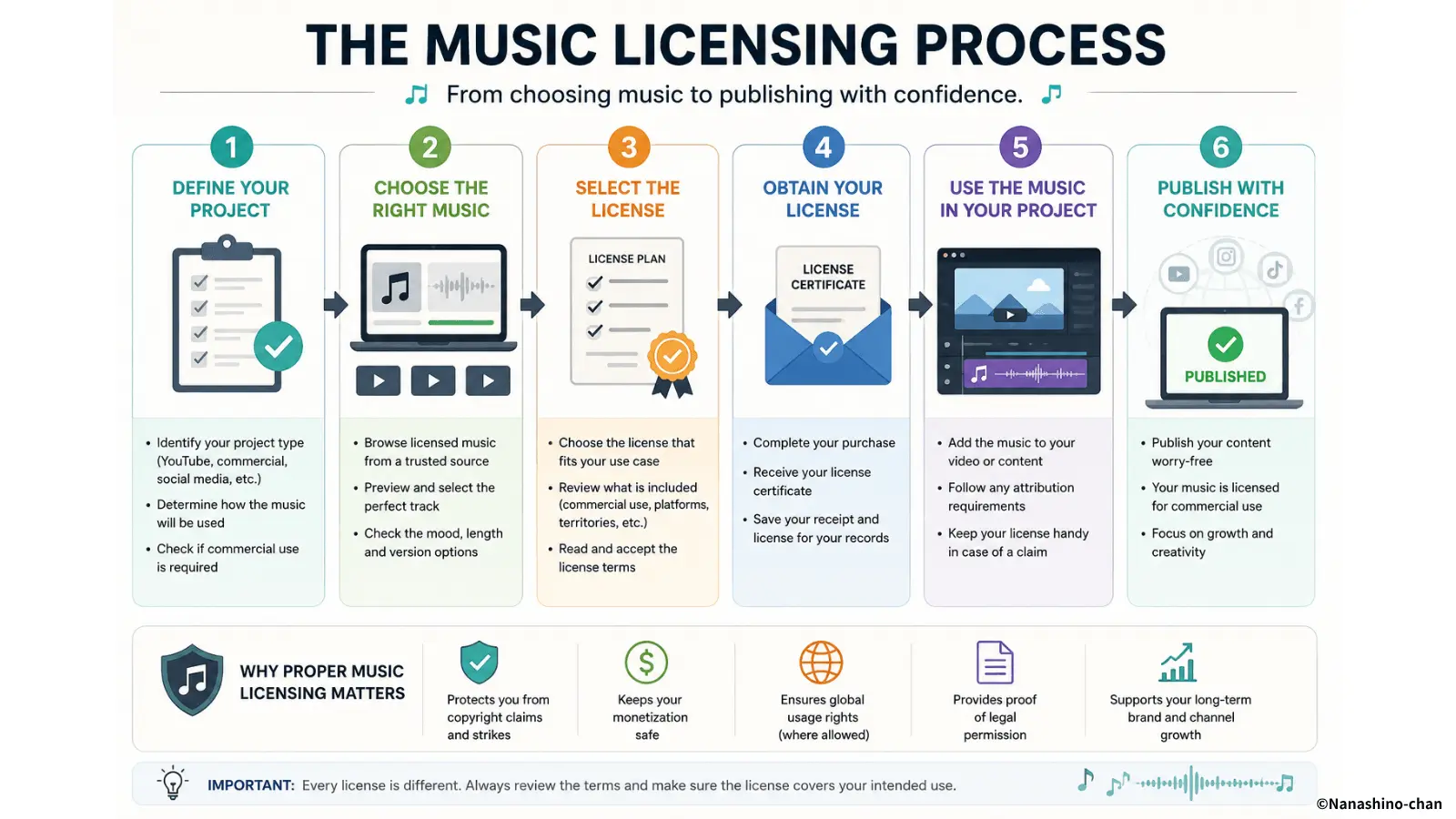 Open full-size infographic →
Proof of License Workflow
Use this workflow before delivering or publishing a business video with music.
Identify the final use
Confirm whether the video is personal, organic commercial, client work, paid advertising, sponsored content, brand campaign, or custom usage.
Choose the correct license
Match the license to the actual use: commercial license for suitable organic business use, sync license for paid ads or campaigns, custom review for unusual use.
Save purchase proof
Save the receipt, order confirmation, invoice, Gumroad purchase record, buyer name, purchase date, and license product name.
Save license terms
Keep the license text, permitted use, restrictions, platform notes, duration, paid media scope, and any custom permission notes.
Attach project details
Add track title, artist name, project name, client name, brand name, platforms, campaign dates, ad versions, and delivery date.
Store with project files
Keep license documentation in the same folder or knowledge base as the video, creative brief, exports, approvals, and campaign records.
Common Documentation Mistakes
Many businesses do license music, but fail to keep records in a way that can be found later.
Mistake 1
Only saving the audio file
An audio file alone does not show who licensed the music, what terms applied, or what project the music was allowed for.
Mistake 2
Only saving a receipt
A receipt shows purchase activity, but it may not explain commercial scope, paid ad use, client use, duration, or restrictions.
Mistake 3
Not naming the project
Without the project name, client, campaign, or platform details, it may be difficult to connect the license to the actual video.
Mistake 4
Assuming platform music is proof
Platform audio availability is not the same as a business license document for ads, client work, campaigns, or off-platform use.
Mistake 5
Using one license for new scope
A license used for organic posting may not automatically cover a later paid ad, new campaign, new client, or expanded platform plan.
Mistake 6
Scattering records across tools
If records are split across email, chat, invoices, drives, and editor folders, the team may not be able to find proof when needed.
Platform Audio Is Not License Documentation
A track may appear inside Instagram, TikTok, YouTube Shorts, or another platform music interface, but that does not automatically create a reusable license record for business documentation.
Platform-library or credit-based usage should not be treated as a substitute for commercial license documentation, sync license documentation, paid advertising permission, client-work proof, or brand campaign license records.
日本語:SNS上で音源が選べることと、企業・広告・クライアント案件で使うためのライセンス証明を保管していることは同じではありません。 ビジネス利用では、曲名、ライセンス条件、購入記録、使用範囲、媒体、期間、クライアント名を整理して残すことが重要です。
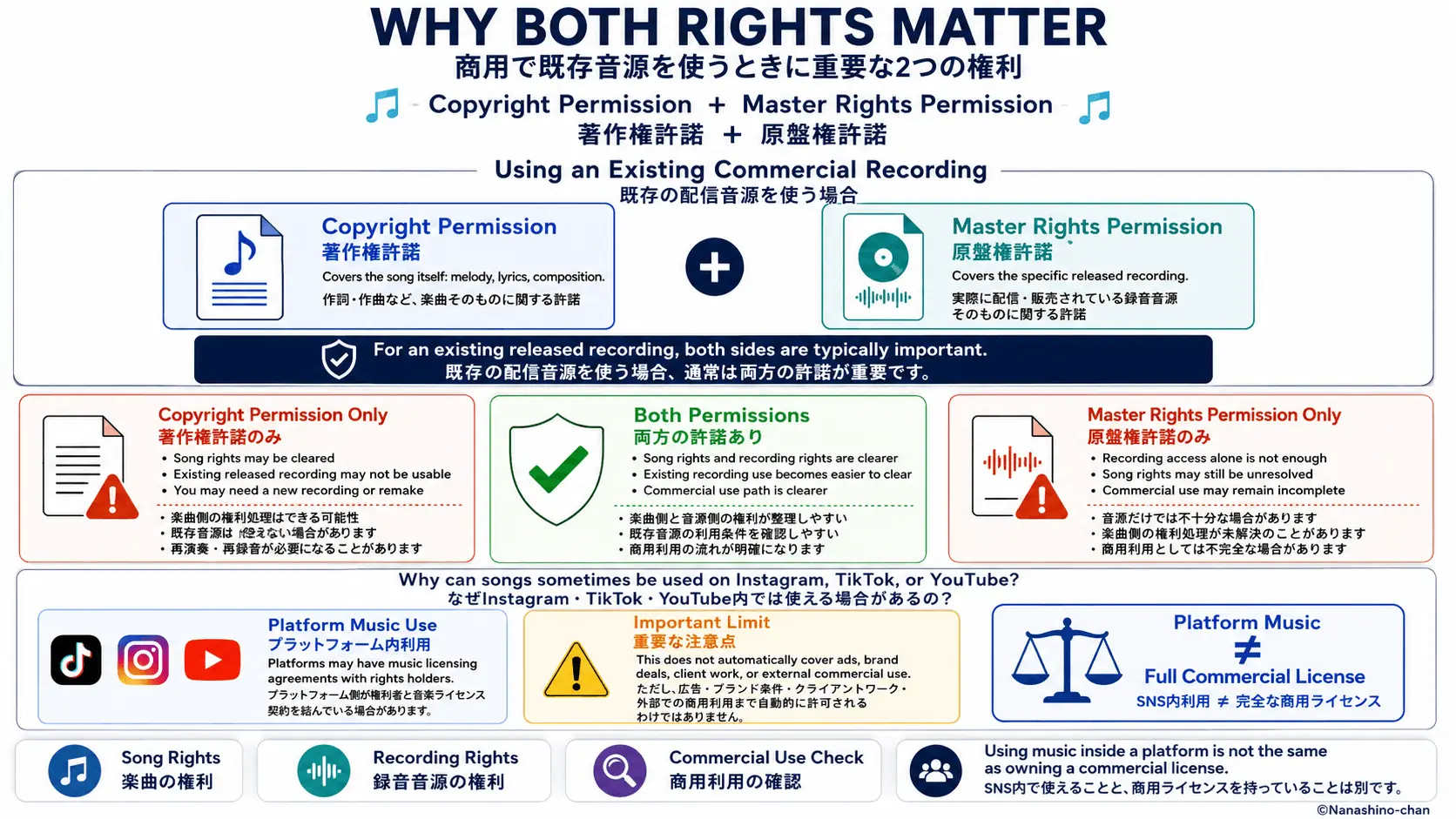 Open full-size infographic →
Recommended Nanashino-chan Tracks for Documented Business Use
If your business needs licensed music with clearer documentation, start with flexible tracks suitable for brand posts, product demos, website videos, paid ads, client work, and commercial campaigns.
Lifestyle / brand
Smooth Groove
A warm and versatile track for lifestyle brands, café visuals, premium social content, business posts, and relaxed product promotion.
Product / SaaS
Smooth Transitions
A clean and practical track for product demos, SaaS videos, app walkthroughs, business explainers, and LinkedIn videos.
Corporate / calm
Stillness Vibes
A calm track for corporate videos, real estate visuals, technology content, soft business storytelling, and quiet client projects.
Luxury / fashion
Diamond Dreams
A polished glam lo-fi option for luxury visuals, fashion mood, premium product scenes, beauty videos, and elegant brand campaigns.
Urban / modern
Urban Twilight
A stylish urban track for city visuals, tech-forward products, modern brand edits, night scenes, and cinematic short-form ads.
Interior / hospitality
Closing Time Jazz
A cozy evening track for café content, interior visuals, hospitality brands, restaurant videos, and warm product scenes.
Wellness / calm product
Ambient Flow
A soft ambient-style track for wellness posts, skincare visuals, calm product ads, and reflective brand storytelling.
Warm campaign mood
Evening Chillhop Glow
A warm evening track for seasonal posts, cozy brand ads, soft launch videos, and short promotional edits.
Nanashino-chan License Options and Documentation
Nanashino-chan license purchases can help businesses keep clearer records for music use. The correct license depends on whether the project is personal, organic commercial, paid advertising, client-based, campaign-based, or custom.
Personal Use License
$19
For personal, non-commercial use only. Not for business videos, paid ads, client work, brand campaigns, monetized content, or commercial video use.
Open GumroadCommercial Creator License
$500
For organic commercial videos, business videos, product demos, website videos, monetized videos, and non-ad online content within license scope.
Open Gumroad1-Month Sync License
$500
For suitable short-term paid social ads, boosted posts, campaign videos, sponsored promotion, client advertising, and sync use during a limited period.
Open Gumroad3-Month Sync License
$1,200
For suitable longer paid social campaigns, extended ad testing, multi-week brand campaigns, wider promotional visibility, and broader campaign use.
Open GumroadProof of Music License Checklist
Use this checklist when preparing a business video, client project, paid social ad, brand campaign, product video, or commercial content package.
- License receipt: Save the Gumroad receipt, invoice, order confirmation, or transaction record.
- License terms: Save a copy of the exact license terms that applied at purchase.
- License product: Record whether it was Personal, Commercial Creator, 1-Month Sync, 3-Month Sync, or custom.
- Track title: Record the exact song title and version used in the video.
- Artist name: Record Nanashino-chan as the artist / rights holder contact point for the licensed track.
- Project name: Add the video title, campaign name, product name, or internal project code.
- Client or brand name: Record the final business, client, advertiser, or brand using the video.
- Platforms: List YouTube, Instagram, TikTok, Facebook, LinkedIn, website, landing page, ads, or internal use.
- Usage type: Identify whether the use is organic, monetized, paid ad, sponsored, client work, campaign, or custom.
- Dates: Record purchase date, delivery date, publication date, campaign start date, and campaign end date.
- Ad versions: Record whether multiple edits, aspect ratios, A/B tests, or localized versions use the track.
- Storage location: Keep the license documents with the final video files and campaign records.
Important: Documentation Does Not Guarantee Platform Behavior
Proof of music license helps clarify permission and usage scope. It can be useful for internal records, client communication, project delivery, and resolving questions about music permission.
However, documentation does not guarantee how TikTok, Instagram, Facebook, YouTube, LinkedIn, advertising review systems, regional catalogs, account settings, automated audio systems, Content ID systems, or future platform policies will behave.
日本語:ライセンス証明や購入記録は、使用許諾の範囲を確認するために重要ですが、 各プラットフォームの自動判定、広告審査、Content ID、地域差、将来の仕様変更まで保証するものではありません。
Related Guides
Continue with these pages if you need to compare commercial and sync licenses, license music for business videos, manage client work, run paid ads, or avoid relying only on platform audio.
FAQ
What is proof of music license for business use?
Proof of music license is documentation showing that a business, brand, agency, freelancer, or client has permission to use a specific music track in a defined project, platform, campaign, or commercial video use.
What music license documents should a business keep?
Businesses should keep the purchase receipt, license terms, track title, artist name, purchase date, project name, client name, platforms, usage period, campaign dates, and any written permission or correspondence related to the music use.
Do agencies need proof of music license for client work?
Yes. Agencies and freelancers should keep license documentation for client deliverables because the final video may be reused, boosted, published on multiple platforms, archived, or reviewed later by the client.
Is a receipt enough proof of music license?
A receipt is useful, but it is usually better to keep both the receipt and the license terms. The receipt shows the purchase, while the license terms explain what usage is allowed.
What proof should businesses keep for paid ads?
For paid ads, businesses should keep the sync license or custom permission, receipt, license terms, track details, brand or client name, campaign name, platforms, campaign dates, ad duration, and usage notes.
Does proof of music license guarantee no Content ID claim?
No. License documentation helps clarify permission and may help resolve questions, but it does not guarantee platform behavior, Content ID outcomes, ad approval, monetization approval, reach, or future platform policy changes.
Which Nanashino-chan licenses provide documentation?
Nanashino-chan license purchases through Gumroad provide purchase records and license-related materials for suitable use cases, including Personal Use, Commercial Creator, 1-Month Sync, and 3-Month Sync licenses, subject to license scope.
Keep Proof Before Publishing, Delivering, or Advertising
If your business, agency, client, or campaign uses music in commercial video, keep documentation that connects the track, license, project, client, platform, campaign dates, and usage scope.
Disclaimer
This page provides general music licensing and documentation information for businesses, brands, agencies, freelancers, client work, paid social ads, brand campaigns, sync licenses, commercial licenses, and commercial video projects. It is not legal advice and does not guarantee platform behavior, monetization approval, advertising approval, reach, claim outcomes, or campaign performance.
A license clarifies permitted use from the rights holder within the stated scope, but platforms may apply their own rules, account settings, regional restrictions, automated systems, advertising review systems, audio catalog behavior, and future policy changes.
免責事項
このページは、企業、ブランド、代理店、フリーランス、クライアント案件、SNS広告、 ブランドキャンペーン、Sync License、商用ライセンス、商用動画における音楽ライセンス証明と記録管理に関する一般的な情報を提供するものです。 法的助言ではなく、各プラットフォームでの表示、収益化、広告審査、リーチ、Content IDの挙動、キャンペーン成果を保証するものではありません。