Monetized content
YouTube Videos & Creator Channels
Monetized videos, Shorts, explainers, branded channels and creator businesses may require commercial permission even when no paid ad is running.
Commercial music licensing|business video|brand content|client work|advertising
License original lo-fi music for business videos, monetized content, brand social media, product demos, client work, sponsored content, AI-assisted video and advertising.
A commercial music license documents what a business, creator, agency or production team is permitted to do with a track. The correct scope depends on the final user, platform, media type, paid distribution, territory and duration—not simply where the music was found.
Direct answer
A commercial music license is written permission to use music in content connected to business, monetization, marketing, promotion, sponsorship, advertising or client delivery. It defines the permitted project, users, platforms, duration and other relevant limits.
It is different from buying a song for personal listening, streaming it through a music service, or selecting audio that happens to be available inside a social platform. Access to a recording does not automatically provide the rights needed to combine it with commercial visual content.
日本語要約:企業・ブランド・収益化動画・クライアント案件・広告などで音楽を使用する場合は、 視聴や購入とは別に、実際の用途をカバーする商用利用許諾が必要です。広告配信や大規模キャンペーンでは、 通常の商用ライセンスではなくSync Licenseまたは個別契約が必要になる場合があります。
“Commercial” is broader than a traditional television advertisement. If the content supports revenue, a business relationship, a client deliverable or promotion, the music use should be reviewed.
Monetized content
Monetized videos, Shorts, explainers, branded channels and creator businesses may require commercial permission even when no paid ad is running.
Business social
Organic posts published by a brand or business can still be commercial content because they support awareness, reputation, products or services.
Client delivery
The license should cover the final client and intended distribution—not only the editor or agency that prepares the files.
Product marketing
Product demos, software walkthroughs, launch videos, onboarding clips and sales-enablement assets support a commercial objective.
Promotion
Paid partnerships, sponsored posts, UGC deliverables and affiliate promotions require music permission that matches the brand relationship and distribution.
Paid media
Paid social, pre-roll ads, display campaigns and promotional distribution commonly need sync or campaign-specific licensing.
Important distinction
A song may be available on a streaming service or inside a social media music library, but that availability should not be assumed to cover every business, advertising, client or cross-platform use. Platform terms can vary by account type, territory, music catalog, ad product and intended use.
The name of a license matters less than its written scope. Use this comparison as a starting point, then confirm the actual terms before publishing.
| License Type | Typical Uses | Not the Right Starting Point For | Nanashino-chan Option |
|---|---|---|---|
| Personal Use | Individual, non-commercial projects within the stated terms. | Business-owned content, client work, brand campaigns, paid promotion or advertising. | $19 Personal Use License |
| Commercial License | Specified monetized videos, business content, product videos, brand social content and client-facing work. | Uses outside the stated scope, including some paid campaigns, broadcast, exclusivity or resale. | $500 Commercial Creator License |
| Sync License | Music synchronized with ads, promotional video, sponsored campaigns and defined paid-media periods. | Unspecified perpetual, exclusive, broadcast, game or large multi-territory use unless expressly covered. | $500 / 1 month or $1,200 / 3 months |
| Custom License | Broadcast, apps, games, events, enterprise packages, large campaigns, exclusivity, buyout requests or unusual distribution. | Projects that can be handled clearly by an existing standard option. | Project-specific review and quotation |
This table is a practical guide, not a substitute for reading the selected license terms. Final permission depends on the specific track, project, buyer, platforms, territory, duration and media plan.
Using an existing recording in video commonly requires permission relating to both the musical composition and the specific master recording. If these rights are controlled by different parties, clearance can require multiple approvals.
Nanashino-chan controls the master recording and composition rights for the original catalog, allowing project permission to be reviewed through one rights-controlled source.
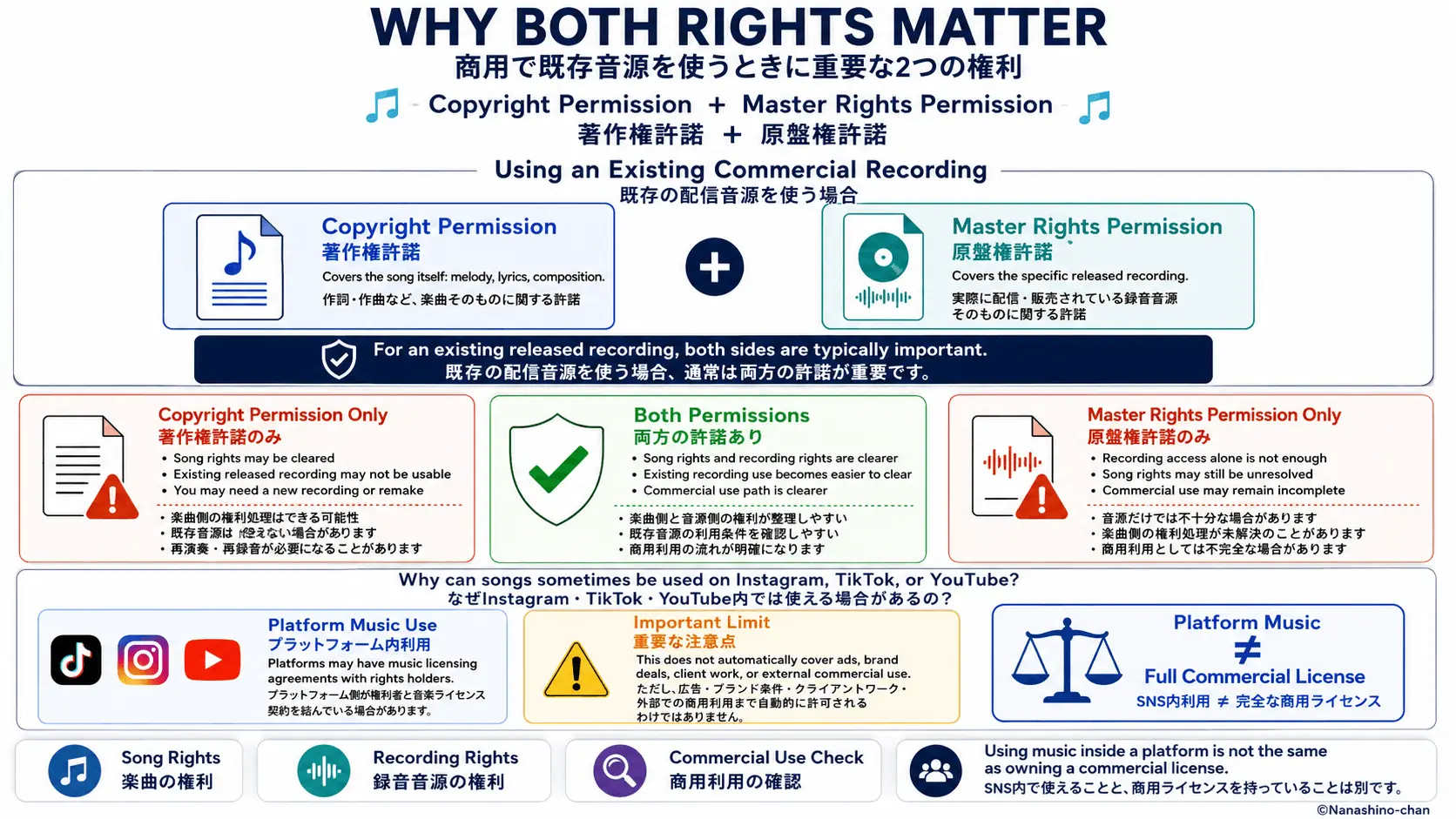 Open full-size rights infographic →
Choose by actual use—not only by budget. If the project involves paid media, a client campaign, multiple deliverables or an unusual distribution plan, confirm the scope before purchase.
Main commercial option
$500
For eligible business videos, monetized content, brand-owned media, product videos and client-facing commercial work within the stated terms.
Campaign use
$500
For eligible ads, YouTube and social campaigns that synchronize music with promotional visual content for a defined one-month period.
Extended campaign
$1,200
For eligible ads and promotional campaigns requiring a longer three-month usage period across defined platforms and media.
Contact Nanashino-chan before publishing if the project involves broadcast, games, apps, theatrical use, physical products, resale, sublicensing, exclusivity, full buyout, large-scale media buying, multiple unrelated clients or a scope not clearly covered above.
A short project brief helps match the license to the real distribution plan and reduces uncertainty later.
Who
Identify who is purchasing, who owns the finished content, and whether a separate brand, agency or client will publish it.
What
Describe the video, campaign, product, service, sponsor or client relationship and how the music supports it.
Where
List YouTube, Instagram, TikTok, LinkedIn, websites, apps, broadcast channels and the intended geographic markets.
How
Confirm whether the content remains organic or will be boosted, placed as an ad, sponsored or distributed through paid media.
How long
State the active campaign dates and whether the video will remain publicly accessible after the campaign ends.
How many
Confirm the number of recordings, edits, languages, aspect ratios, ad variants, client brands and final deliverables.
Start with the final use, select music that fits the creative direction, confirm the appropriate rights scope, keep the documentation and publish within the agreed terms.
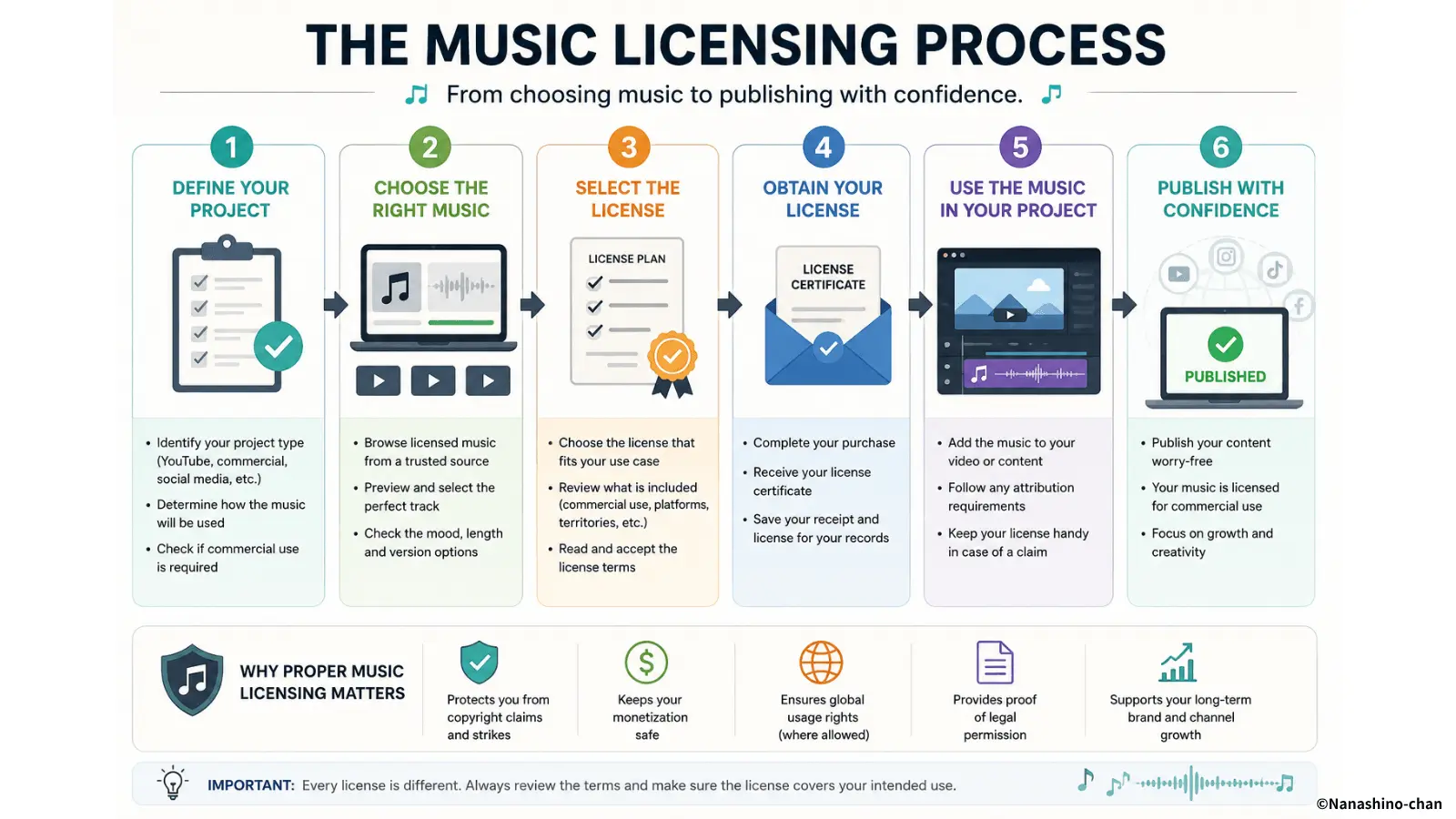 Open full-size licensing process →
Identify the project, client, content type, platforms, paid distribution, territory and duration.
Preview original tracks and choose a mood that supports the brand, pacing, audience and visual direction.
Use commercial, sync or custom permission based on the actual final distribution—not the editing stage alone.
Save the receipt, terms, track details, project information and any custom written approval with the production records.
Good documentation helps a creator, business, agency or client explain why the music is permitted if a platform, distributor, legal team or stakeholder asks later.
License records
Production records
Nanashino-chan is an independent original music catalog and licensing project focused on modern digital-content workflows. Direct control of the master recording and composition rights can simplify the permission path for eligible uses.
A large catalog supports different moods, brands, formats and recurring content needs.
A growing discovery signal showing that listeners have actively searched for the music they heard.
Master and composition rights are controlled through the project for the original catalog.
Music suited to brands, agencies, creators, animation, AI-assisted video and international online content.
Public references include a Harper’s BAZAAR Hong Kong Reel related to a Cartier event, participation in a creator event at Google Tokyo, and participation in the U-KNOCK 2026 in Japan Summit. These public-use and participation references provide context only and do not imply endorsement, partnership or sponsorship.
A commercial music license is written permission to use music in content connected to business, monetization, promotion, client work, advertising or another commercial purpose. The exact permission depends on the terms and intended use.
You may need one when the post promotes a business, product, service, sponsor or client, or when the account or content is monetized. Paid ads and boosted posts may require sync or campaign-specific permission.
No. Buying, downloading or streaming a song generally provides listening access, not permission to synchronize the recording with commercial video, advertising or client content.
A commercial license may cover specified business and monetized content. A sync license addresses synchronizing music with visual media and is commonly used for paid ads, campaigns and promotional audiovisual content. Always follow the written terms.
Yes, when the selected license expressly covers the final client, project, platforms and commercial purpose. Paid campaigns, multiple clients, broadcast, exclusivity or unusual distribution may require sync or custom terms.
No responsible license can guarantee every automated platform outcome. A valid license documents permission from the rights holder within its scope and can support review if a platform question or claim occurs.
Keep the receipt, license terms, track title, artist name, project and client names, permitted platforms, territory, duration, campaign dates and any written correspondence about custom permission.
Yes, subject to the selected license and final use. AI-assisted product videos, social content, explainers and marketing videos may use an appropriate commercial, sync or custom license.
Commercial music licensing
Tell us what you are creating, who will publish it, where it will run and whether it includes paid distribution. Nanashino-chan can help identify the appropriate starting point for the project.
General information only. The selected license terms and any written project-specific agreement determine the permitted use. Platform policies, automated detection systems and account requirements may change independently of the license.