Free of Charge
No payment is required to access or download the file. This says nothing by itself about copying, editing, video use, monetization or advertising.
Free Music & Social Video Rights Guide
Free music can be usable, restricted, mislabelled or completely unauthorized. The word free tells you the price—not whether the recording and composition are cleared for your video.
This guide separates official platform libraries, artist giveaways, Creative Commons music, free-library tracks, trials, user-uploaded Original Audio and public-domain compositions so you can assess the real permission behind each source.
Direct answer
Free music is safe for a social media video only when the person offering it has authority to license all relevant rights, and the written permission covers your actual use. Organic posting, monetized creator content, sponsored posts, client work, boosted posts and paid advertising can require different permissions.
A paid license is not an automatic guarantee against every platform claim, either. The practical goal is to use a verifiable source, match the license to the project and keep evidence.
無料で入手できることと、SNS動画で自由に使用できることは別です。提供者が作曲と音源の権利を正当に管理しているか、動画との組み合わせ、収益化、PR案件、広告配信、クライアント納品、他SNSへの転載まで許可されているかを確認してください。
Start with the terminology
Similar labels are often used as if they mean the same thing. They do not. Read the license behind the label rather than relying on a thumbnail, caption or search result.
No payment is required to access or download the file. This says nothing by itself about copying, editing, video use, monetization or advertising.
Usually a licensing or payment model—not an absence of copyright. The license can still restrict media, audience, term, client work or paid promotion.
An imprecise marketing phrase. Ask whether the work is truly public domain, offered under CC0, or simply licensed without an upfront fee.
A family of standardized licenses with different conditions. Attribution, NonCommercial, ShareAlike and NoDerivatives terms can materially change what you may publish.
The underlying work may no longer be protected, but a modern performance or recording can remain protected. Verify both layers separately.
Music made available through a platform tool may be cleared only for particular accounts, placements, territories or uses inside that platform.
Source-by-source classification
These are starting risk indicators, not legal verdicts. “Lower when verified” still requires reading the applicable terms; “high if unknown” can become usable only after rights and permission are confirmed.
| Free music source | Starting assessment | What to verify | Typical failure point |
|---|---|---|---|
| Official platform music library | Lower when verified | Account eligibility, placement, platform, territory, ads and cross-posting. | Assuming in-app permission also covers exported videos, paid campaigns or another platform. |
| Artist or creator giveaway | Conditional | Identity, ownership, video rights, commercial use, attribution and duration. | A social caption says “free” but no stable license defines permitted use. |
| Creative Commons music | Depends on license | BY, NC, ND or SA conditions; licensor authority; attribution and license version. | Using NC material commercially or ND music in a video without separate permission. |
| Free music library or website | Conditional | Per-track terms, content type, social ads, clients, edits, Content ID and proof. | Relying on the site's “free music” label instead of the individual track license. |
| Subscription free trial | Time-sensitive | Whether published projects remain licensed after cancellation and how projects are registered. | Downloading during the trial but publishing later without the required active subscription or registration. |
| User-uploaded “Original Audio” | High if source unknown | Original uploader, sampled material, recording owner, composition owner and permission chain. | The upload is a rip or edit of a commercial recording that the uploader cannot license. |
| Public-domain composition with a modern recording | Uncertain until both layers verified | Status of the musical work and separate status or license of the exact recording. | Correctly identifying an old song as public domain but copying a protected new performance. |
Official platform libraries
Official libraries can reduce uncertainty because the platform publishes the relevant rules. They are not universal licenses. Confirm the exact track, account, placement and distribution plan.
YouTube says Audio Library music and sound effects are copyright-safe on YouTube. Some Creative Commons tracks require attribution, and eligible YouTube Partner Program videos can be monetized. YouTube also warns that it is not responsible for “royalty-free” music from other channels or libraries and cannot advise on off-platform issues.
Meta describes Sound Collection audio as royalty-free and available for uses including commercial content such as ads. Use the music through the applicable Meta workflow and check current eligibility and placement rules before publishing or boosting.
TikTok presents its Commercial Music Library as pre-cleared music for organic content and ad creation. Brands and commercial creators should use the current library tools and verify that the selected track is available for the planned market and placement.
Creative Commons
Creative Commons licenses are standardized, but each license grants a different scope. The official Creative Commons license overview should be read together with the page where the rights holder applied the license to the exact track.
| License | Commercial use | Adaptation | Key condition for social video |
|---|---|---|---|
| CC BY | Permitted | Permitted | Provide the required attribution and license information. |
| CC BY-SA | Permitted | Permitted | Attribution applies, and adapted material must use the required same or compatible license. |
| CC BY-ND | May be permitted for unadapted distribution | Sharing adaptations is not permitted | Creative Commons treats synchronizing music with moving images as an adaptation. |
| CC BY-NC | Not permitted | Permitted for noncommercial use | Do not assume a creator account, sponsored post or business video is noncommercial. |
| CC BY-NC-SA | Not permitted | Permitted under ShareAlike | Both NonCommercial and ShareAlike conditions apply. |
| CC BY-NC-ND | Not permitted | Sharing adaptations is not permitted | This is generally a poor fit for synchronized social video without separate permission. |
| CC0 | Generally unrestricted by copyright | Generally permitted | Confirm that the person applying CC0 had authority and check other rights that may affect the content. |
Direct giveaways and free libraries
An artist may legitimately offer a track for zero cost. A library may also provide free tracks under clear terms. The risk comes from missing authority, vague language or a license that does not match the project.
High-risk example
A social platform may label audio as “Original Audio” because it entered the system through a user's upload. The label does not prove that the uploader composed the music, owns the master recording, cleared the sample or can sublicense it to other users.
If the audio appears to contain another artist's commercial recording, do not rely on the uploader's profile, follower count or “use audio” button. Identify the exact recording and obtain permission from the appropriate rights holders—or choose a verifiable alternative.
Muting, blocking, takedown, lost ad spend, demonetization, a copyright claim or a request to replace the music.
Risk increases when the post promotes a business, includes affiliate revenue, is sponsored, is boosted or becomes a paid advertisement.
Agencies and clients may need a clean permission chain. Unverifiable music can delay delivery and weaken trust even before a formal dispute occurs.
For the Instagram-specific detection and muting process, see Why Instagram Mutes Videos.
Two rights layers
A musical composition and a sound recording are separate works. The U.S. Copyright Office's musician guidance explains this distinction. In Japan, JASRAC explains music copyright and separate recording permissions, while the Agency for Cultural Affairs explains neighboring rights for performers and record producers.
Layer 1
The melody, lyrics and underlying musical work. An old composition may have entered the public domain in a particular territory.
Layer 2
The specific recorded performance. A recently recorded orchestra, cover or remaster may remain protected even when the composition is old.
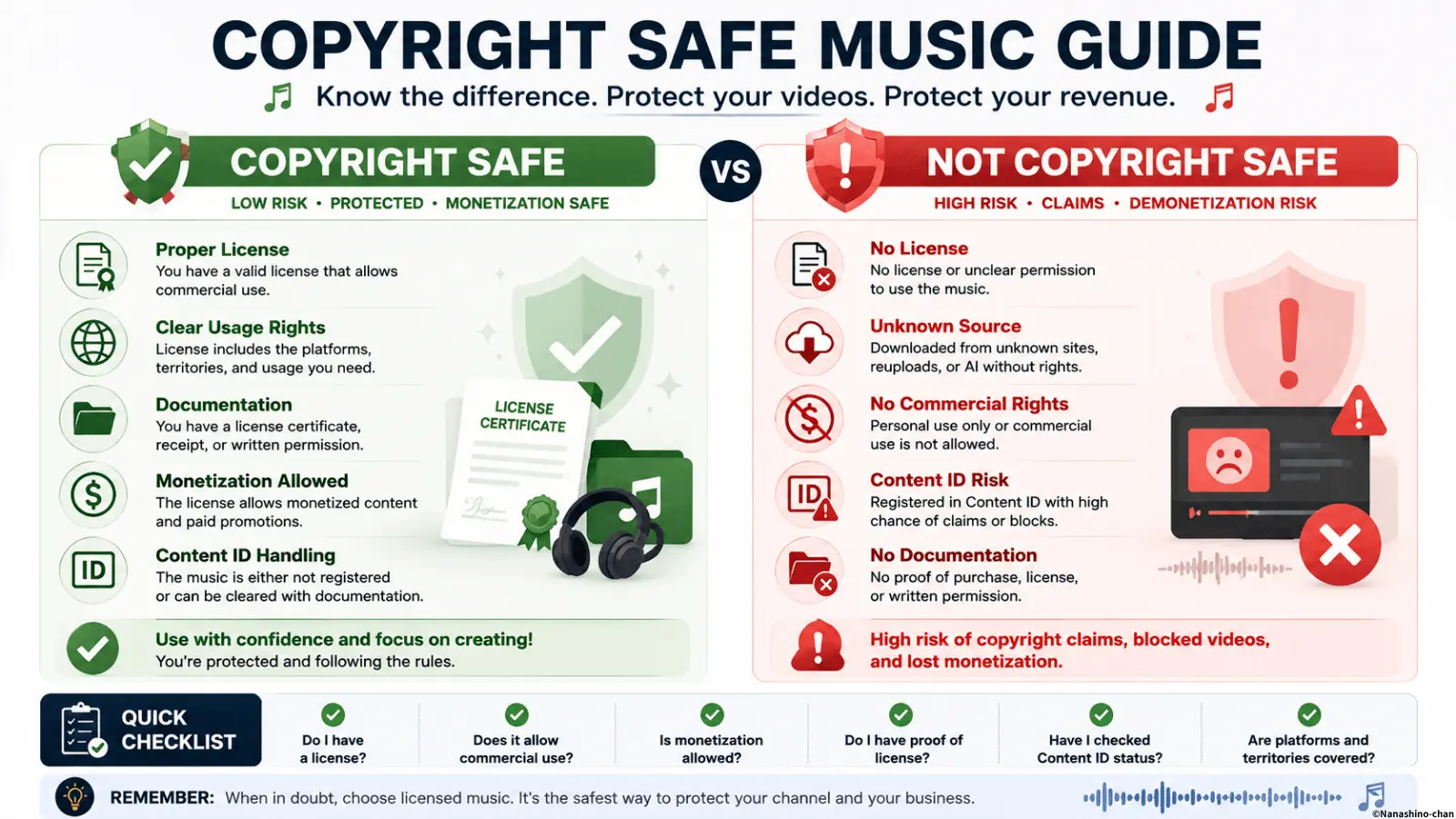
Commercial context
Decide how the video functions before choosing music. “Posted on social media” is not a complete description of the use.
| Video use | Questions to ask | Why it changes the license check |
|---|---|---|
| Personal, non-monetized post | Is personal video use allowed? Is attribution required? | A personal permission may be enough, but it does not extend to later brand or ad use. |
| Monetized creator content | Does the license allow monetization and creator revenue? | “Noncommercial” or personal-only terms may conflict with revenue-generating content. |
| Sponsored or affiliate post | Are paid partnerships, affiliate links and promotional content allowed? | The post creates commercial value even when the audience does not pay to watch it. |
| Business account post | Does the track cover brand promotion and the relevant business account? | Consumer music features and commercial music tools may have different catalogs. |
| Boosted post or paid ad | Are paid media, ad placements, campaign term, territory and spend covered? | Organic social permission often does not include paid distribution. |
| Client or agency delivery | Can the license cover a client, transfer the deliverable and survive project handoff? | A creator's personal license may not authorize the client's publication or paid campaign. |
Pre-publish checklist
If a provider cannot answer the questions that apply to your project, pause publication. A different track is usually cheaper than repairing a campaign after launch.
Evidence matters
Free music is especially difficult to defend when the only evidence was a temporary description or deleted post. Build a compact record for every track and project.

If a claim or mute appears
Record the platform notice, matched segment, claimant, post URL and deadline.
Confirm that your license covers the exact recording, account, platform and use.
Ask the licensor to verify the track and provide the correct claim-release process.
Dispute only when you have a valid basis and evidence—or replace the music if rights are uncertain.
A practical decision rule
You can identify who supplied the track and why that party has licensing authority.
The written permission covers video, platform, account, commercial purpose and paid media as needed.
You can satisfy attribution, registration, term, territory, editing and other conditions.
You retain the license, source record and project details in a form others can review.
When you need a clearer permission chain
Nanashino-chan offers a catalog of 2,000+ original lo-fi tracks with the composition and master rights controlled directly. License options are organized around personal use, commercial creator content and synchronization projects, helping creators, brands and agencies start with an identifiable rights source and written scope.
No catalog or license can promise that an automated platform system will never produce a notice. Clear ownership, suitable terms, documentation and a support route make the situation easier to prevent and resolve.
Primary sources
Platform features and legal rules can change. Use these official pages to verify current conditions for the track, account, platform and territory involved.
Frequently asked questions
Sometimes. Safety depends on who controls the music, what the license permits, where the video will be posted, whether the use is commercial, and whether you can prove the permission. A zero price alone does not grant usage rights.
No. Free download describes price or access. Permission to synchronize music with video, monetize content, run ads, publish for a client or reuse the video on another platform must come from the applicable license or rights holder.
Check the individual license and the destination platform before reuse. YouTube states what it knows to be copyright-safe on YouTube and says it cannot provide guidance about legal issues that may occur off-platform.
It depends on the license. Attribution conditions may apply, NonCommercial licenses restrict commercial use, and Creative Commons explains that synchronizing music with moving images is an adaptation, making NoDerivatives licenses unsuitable for sharing that adapted video without separate permission.
No. Original Audio is a platform label, not proof that the uploader owns every right in the recording and composition. Identify the source and permission before using it commercially or in advertising.
Not automatically. The musical composition and the sound recording are separate rights layers. An old composition may be in the public domain while a modern performance and recording remain protected.
No. Royalty-free usually describes a licensing or payment model. The music can still be copyrighted and restricted by media, term, territory, audience, advertising or client-use conditions.
No. A valid license is important evidence, but automated matching systems can still produce a notice or claim. Keep the license, receipt, track details and publishing records so the issue can be reviewed.
Keep the source URL, track title, artist, rights holder, license name and version, terms in effect on the download date, required attribution, receipt or download record, and the projects where the track was used.
無料という価格表示だけでは判断できません。提供者が権利を持っているか、動画への利用、収益化、広告、案件、複数SNSへの転載が許可されているかを個別に確認し、許諾条件を保存してください。
Continue learning
Clear source. Clear scope. Saved proof.
Tell us what you are creating, who will publish it, which platforms it will appear on and whether it includes monetization, sponsorship, client delivery or paid distribution. We can help identify an appropriate licensing starting point.
General educational information only, not legal advice. The written license, platform terms and project-specific facts determine the permission granted. Copyright, neighboring rights and public-domain status can vary by territory.