Music for Influencer Marketing
Influencer marketing campaigns need music that fits sponsored posts, brand collaborations, creator partnerships, Instagram Reels, TikTok videos, YouTube Shorts, UGC ads, product reviews, AI videos, and paid social content.
But influencer content is not always the same as personal creator content. When a post promotes a brand, product, service, app, campaign, sponsor, or client, the music license should clearly cover the actual commercial use.
Quick Answer: What Music License Do Influencer Campaigns Need?
Influencer marketing campaigns often need music that covers both commercial use and sync use.
That is because sponsored posts and creator campaigns usually promote a brand, product, service, app, campaign, sponsor, or client, and the music is often combined with video, captions, product shots, creator footage, or edited visual content.
- Commercial license may be needed because the content supports a brand, product, service, app, sponsor, campaign, or client.
- Sync license may be needed because music is combined with video, captions, creator footage, product shots, AI visuals, or social media edits.
- Client-use permission may be needed when the influencer, UGC creator, editor, or agency delivers the video to a brand.
- Paid advertising coverage may be needed when the content is used in Meta Ads, TikTok Ads, YouTube Ads, Spark Ads, whitelisted ads, boosted posts, or paid social campaigns.
- Documentation matters because brands, agencies, platforms, and media buyers may ask for proof of music rights.
日本語:インフルエンサーマーケティングでは、個人投稿向けの音源だけでは不十分な場合があります。スポンサー投稿、ブランド案件、広告配信、企業アカウント、クライアント納品に使えるライセンスかどうかが重要です。
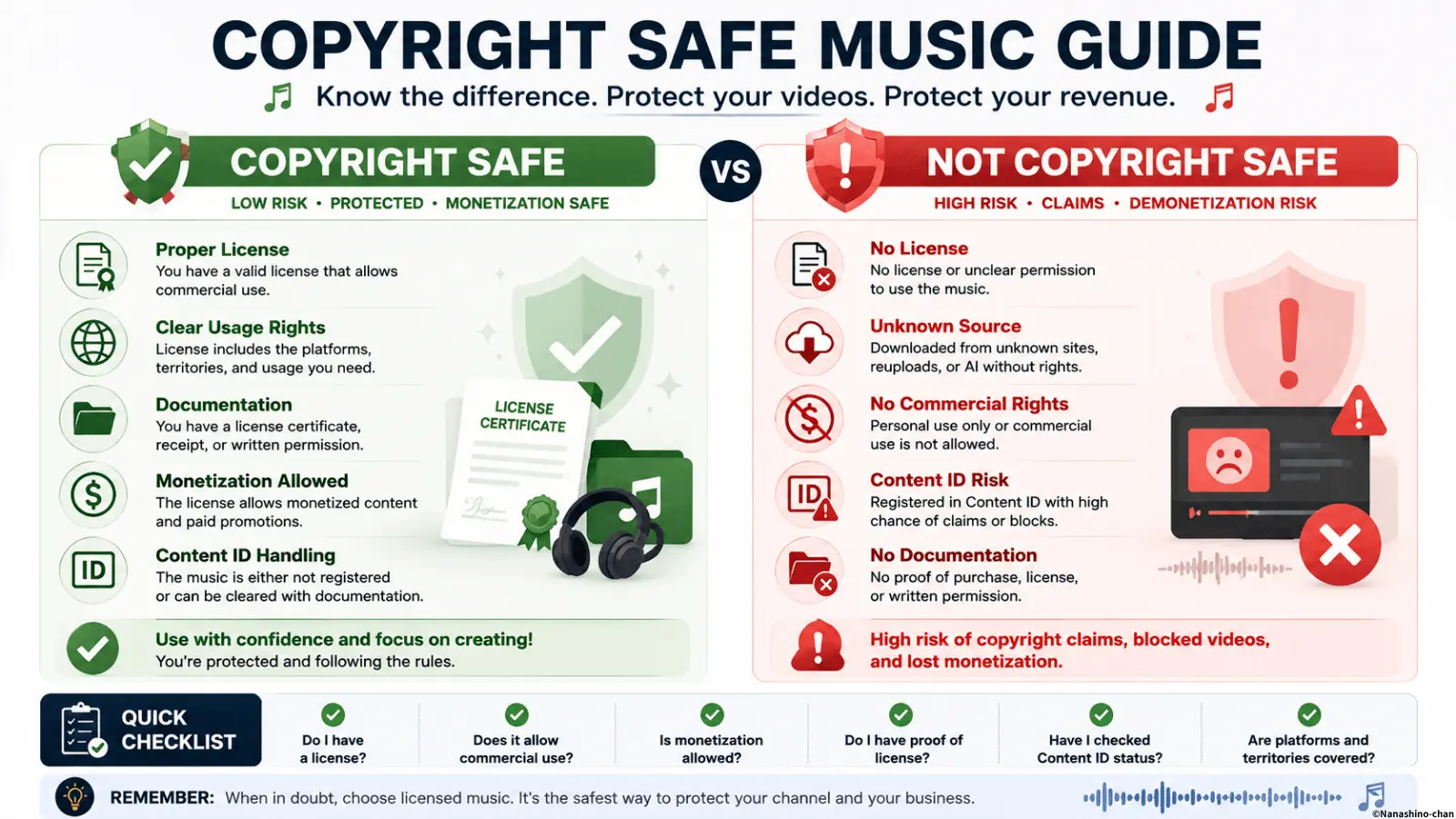
What Is Influencer Marketing Content?
Influencer marketing content is creator-led content that promotes, reviews, introduces, demonstrates, or endorses a brand, product, service, app, campaign, event, or client.
It can look organic and casual, but it is usually commercial when it is part of a sponsored post, brand collaboration, affiliate campaign, paid partnership, or client campaign.
Examples include:
- Sponsored Instagram Reels
- Sponsored TikTok videos
- YouTube Shorts brand integrations
- Product reviews and tutorials
- Unboxing and lifestyle videos
- Affiliate marketing videos
- Creator testimonials
- Brand collaboration posts
- Whitelisted creator ads
- Spark Ads and paid creator campaigns
- UGC ads and paid social assets
- Influencer content repurposed by a brand
- Agency-managed creator campaigns
- AI-assisted creator videos and product explainers
Because these videos often combine creator footage, captions, music, product shots, brand messaging, and distribution across multiple platforms, both commercial licensing and sync licensing should be reviewed.
Organic Creator Posts vs Sponsored Influencer Campaigns
A major licensing mistake is assuming that music allowed in a normal creator post is automatically allowed in a sponsored campaign.
An organic creator post and a sponsored influencer campaign can look similar, but the rights situation may be very different.
| Influencer Use Case | Typical Risk Level | License to Review |
|---|---|---|
| Personal creator post | Lower, depending on platform and music source | Creator license or in-app platform rules. |
| Sponsored Instagram Reel | High | Commercial use, sync use, brand campaign scope. |
| Sponsored TikTok video | High | Commercial use, sync use, TikTok platform rules, client or sponsor scope. |
| Affiliate product video | Medium to high | Commercial use, monetization, platform rules, disclosure context. |
| Whitelisted creator ad | High | Paid advertising coverage, creator identity use, commercial use, sync use. |
| Brand-reused influencer content | High | Client/brand use, repurposing rights, paid social, multi-platform use. |
| Multi-platform influencer campaign | Very high | Platform coverage, campaign duration, paid distribution, documentation. |
For influencer campaigns, the safest workflow is to confirm music rights before the content is published, delivered, boosted, or repurposed by the brand.
Why Music Matters in Influencer Marketing
Influencer marketing depends on attention, trust, pacing, emotional fit, and creator authenticity. Music can help a sponsored post feel more natural, more watchable, and more aligned with the creator’s style.
For influencer marketing, lo-fi music can work well because it supports voiceovers, product demos, testimonials, tutorials, lifestyle edits, and soft hooks without overpowering the creator’s message.
Music can help with:
- Opening hooks and pacing
- Creator voiceover support
- Product demonstration flow
- Unboxing rhythm
- Affiliate offer explanation
- Lifestyle atmosphere
- Before-and-after transitions
- Brand trust and tone
- Reducing silence in edited clips
- Making sponsored content feel less generic
However, because influencer marketing is commercial, music should be chosen for both creative fit and licensing fit.
Music Licensing Checklist for Influencer Campaigns
Before using music in an influencer campaign, confirm how the content will be published, delivered, boosted, reused, and distributed.
A sponsored post can start as one creator upload, then later become a whitelisted ad, Spark Ad, Meta Ad, YouTube Shorts campaign, landing page video, or multi-platform brand asset.
- ✔ Is the content a personal creator post or a sponsored campaign?
- ✔ Will the post promote a brand, product, app, service, sponsor, or client?
- ✔ Will the content be posted only by the influencer, or also by the brand?
- ✔ Will the brand reuse the content in ads, landing pages, websites, email campaigns, or social media?
- ✔ Will the content be used in whitelisted ads, Spark Ads, Meta Ads, TikTok Ads, YouTube Ads, or paid social campaigns?
- ✔ Will the content be repurposed into multiple cuts, aspect ratios, captions, translations, or campaign variations?
- ✔ Does the music license cover commercial use?
- ✔ Does the music license cover sync use?
- ✔ Does the music license cover client delivery or brand reuse?
- ✔ Does the music license cover paid advertising?
- ✔ Can the influencer, brand, or agency provide proof of license if needed?
If any of these points are unclear, review the music license before publishing, delivering, boosting, or repurposing the influencer content.
Sponsored Posts, Whitelisted Ads, Affiliate Content, and Brand Reuse
Influencer marketing content can move through several stages. A creator may publish the post organically, then a brand may reuse it as an ad, social proof asset, product page video, or multi-platform campaign creative.
Music licensing should be reviewed before the content moves from creator post to brand campaign asset.
Sponsored Posts
Sponsored posts are usually commercial because they promote a brand, product, service, app, campaign, or sponsor. Even if the post feels natural, the music supports a commercial message.
For sponsored posts, commercial licensing and sync licensing should be reviewed.
Whitelisted Creator Ads
Whitelisted ads may run from a creator identity while being promoted by a brand or agency. This makes the content feel native, but it is still advertising when used for paid promotion.
For music licensing, the key issue is not only who appears to post the content. The key issue is whether the content is used for brand advertising, paid promotion, campaign distribution, or client delivery.
Affiliate Content
Affiliate content can also be commercial because the creator may earn revenue from links, discount codes, product referrals, or sales generated by the content.
If music is used in affiliate videos, product reviews, tutorials, or comparison content, commercial use should be considered.
Brand Reuse and Repurposing
Brands often repurpose influencer content into multiple hooks, captions, thumbnails, vertical edits, square edits, website embeds, retargeting ads, landing page clips, and paid campaign variations.
The music license should be clear enough to cover the brand’s intended usage, not only the influencer’s first upload.
Who Needs Licensed Music for Influencer Marketing?
Licensed music for influencer marketing is useful for creators, brands, agencies, editors, and media buyers who create or manage commercial creator content.
Influencers and Creators
Creators making sponsored posts, product reviews, tutorials, affiliate videos, brand collaborations, and paid partnership content.
Brands and Startups
Businesses using influencer content for product launches, app installs, ecommerce campaigns, SaaS marketing, and paid social growth.
Influencer Agencies
Agencies managing creator campaigns, brand partnerships, UGC deliverables, campaign briefs, influencer contracts, and usage rights.
UGC Teams
UGC creators and production teams making testimonial videos, creator ads, product demos, unboxings, and campaign assets.
Freelance Editors
Editors creating sponsored social clips, brand collaboration videos, TikTok edits, Instagram Reels, Shorts, ads, and client deliverables.
Media Buyers
Performance marketers testing influencer creatives, scaling paid social campaigns, managing Spark Ads, Meta Ads, and ad variations.
Creator, Brand, Agency, and Editor Workflow
Influencer campaign content often passes through several roles: creator, editor, agency, brand, media buyer, and platform. Each role may assume someone else handled the music rights.
A clearer workflow helps avoid confusion.
For Influencers
Before publishing or delivering sponsored content, influencers should confirm whether the music can be used for brand collaborations, paid ads, external edits, whitelisted campaigns, and brand reuse.
For Brands
Brands should confirm that the music license covers the full campaign, not just the influencer’s initial post. This is important if the video will be boosted, repurposed, embedded on a website, or used across multiple platforms.
For Agencies
Agencies should document track information, license records, creator agreements, client usage scope, platform destinations, paid media plans, and campaign duration.
For Freelance Editors
Editors should not assume that in-app audio, trending sounds, or a personal music account covers client delivery. If the video is delivered for brand use, commercial and sync terms should be checked before export.
For Media Buyers
Media buyers should confirm whether influencer content can run as paid ads, be resized into multiple placements, remain active over time, and be distributed across Instagram, TikTok, YouTube Shorts, Facebook, LinkedIn, or landing pages.
Why Famous Songs and Trending Audio Can Be Risky for Influencer Campaigns
Famous songs and trending sounds can make influencer content feel familiar, but they can be risky when the content is used for sponsored posts, brand collaborations, paid ads, whitelisted campaigns, client delivery, or multi-platform distribution.
A single popular song can involve multiple rights holders, including record labels, master owners, publishers, songwriters, composers, distributors, and collecting societies. If a brand uses the original recording in an influencer campaign, the project may involve master rights, composition rights, sync rights, and commercial rights.
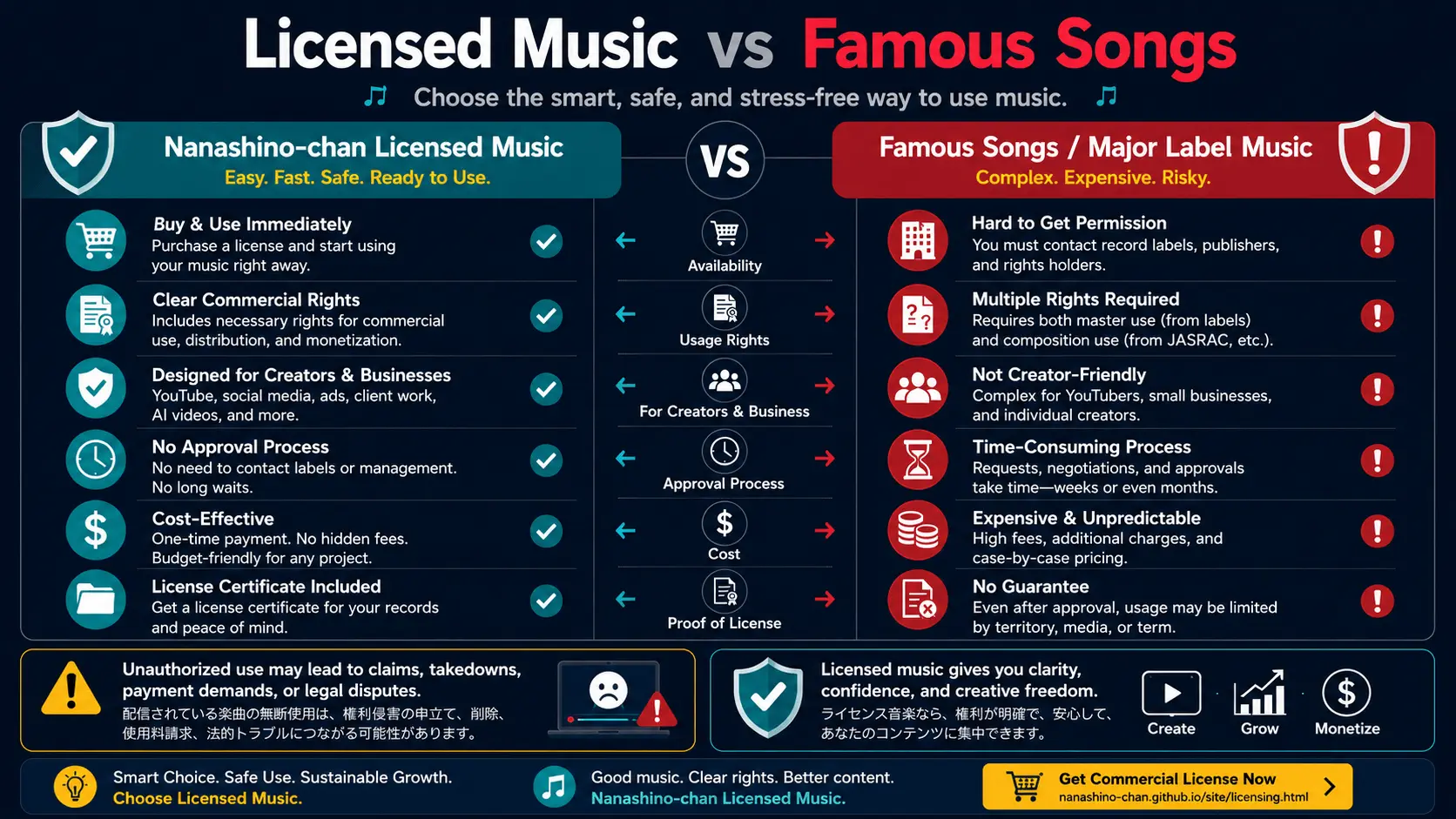
Unauthorized use of famous songs in promotional videos has led to real lawsuits and substantial damages. For example, Beastie Boys sued Monster Energy over the use of their songs in a promotional video, and a jury awarded $1.7 million.
This does not mean every unauthorized use will lead to the same result. However, it shows why famous songs can carry serious legal and financial risk when used in advertising, promotion, branded content, or business videos without permission.
日本語:インフルエンサー案件で有名曲・トレンド音源を使うリスク
インフルエンサー案件では、有名曲やトレンド音源を使いたくなる場合があります。しかし、スポンサー投稿、ブランド案件、広告素材、クライアント納品、有料配信、whitelist広告では、権利処理が複雑になりやすいです。
有名曲を使う場合、原盤権者、出版社、作曲者、作詞者、管理団体など複数の権利者が関係する可能性があります。SNS内で聞ける音源であっても、広告や商用利用に自由に使えるとは限りません。
そのため、インフルエンサーキャンペーンでは、商用利用・Sync利用・クライアント納品・広告配信に対応したライセンス音楽を使う方が、権利処理の不確実性を減らしやすくなります。
A Clearer Music Licensing Workflow for Influencer Marketing
Nanashino-chan licensed music is designed for creators, brands, agencies, AI video makers, advertisers, podcasters, editors, and client projects that need clearer music usage terms.
For influencer marketing, the goal is not just to use a popular sound. The goal is to use music that fits creator-style content while reducing uncertainty around commercial use, sync use, paid social, whitelisted ads, client delivery, and brand reuse.
Built for Sponsored Posts
Useful for sponsored videos, product reviews, affiliate content, brand collaborations, creator campaigns, and client campaign assets.
Clearer Commercial Use
Designed for influencer content that supports brands, products, clients, campaigns, sponsors, and paid social workflows.
Creator-Style Fit
Lo-fi music can support voiceovers, product demos, soft hooks, lifestyle edits, tutorials, testimonials, and natural social pacing.
This is not just “music for social media.” It is a practical way to reduce uncertainty, avoid unclear licensing claims, and use music with clearer creator, commercial, sync, and client-use terms.
Used in Real Brand & Creator Projects
Nanashino-chan music has also been used in real brand and creator projects.
Nanashino-chanの楽曲は、実際のブランド・クリエイタープロジェクトでも使用されています。
Documentation for Influencer Campaign Music
Influencer campaign content may move from creator account to brand account, agency folder, ad account, paid campaign dashboard, landing page, and multi-platform distribution. That makes documentation important.
Good records can help if a brand asks for proof, a platform detects music, an ad is reviewed, a campaign is repurposed, or a client requests additional usage later.
Recommended records include:
- Track title and artist name
- License, receipt, purchase record, or permission record
- Influencer campaign name or content title
- Brand, client, agency, or sponsor name if relevant
- Creator account and brand account if relevant
- Publication date and campaign launch date
- Platform destinations, such as Instagram, TikTok, YouTube Shorts, Facebook, LinkedIn, websites, landing pages, or paid ad platforms
- Usage scope, including organic posting, paid ads, whitelisting, Spark Ads, editing, repurposing, and client delivery
- ISRC or recording identifier if available
A license does not guarantee a specific platform outcome, but clear documentation can reduce uncertainty and support review if needed.
Related guides:
日本語まとめ:インフルエンサーマーケティングに必要な音楽ライセンス
インフルエンサーマーケティングでは、個人投稿向けの音源だけでは不十分な場合があります。スポンサー投稿、ブランド案件、商品紹介、広告素材、クライアント納品、有料配信では、音楽の使用範囲を明確にする必要があります。
インフルエンサー投稿は見た目が自然なクリエイター投稿でも、ブランドが商品・サービス・アプリ・キャンペーンの宣伝に使う場合は商用利用に該当する可能性があります。また、音楽を動画と組み合わせるため、Sync利用も関係することがあります。
特に、Instagram Reels、TikTok、YouTube Shorts、UGC広告、whitelist広告、Spark Ads、代理店納品、フリーランス編集、複数プラットフォーム配信では、音楽のライセンス範囲を確認することが重要です。
Nanashino-chanのライセンス音楽は、インフルエンサー、UGCクリエイター、企業、広告制作、SNSキャンペーン、AI動画、クライアントワークに向けて、より明確で使いやすいライセンス選択肢として設計されています。
Preview Music for Influencer Marketing Campaigns
Explore lo-fi music designed for influencer marketing campaigns, sponsored posts, Instagram Reels, TikTok videos, YouTube Shorts, UGC ads, product reviews, affiliate videos, AI videos, creator campaigns, client deliverables, and commercial social media workflows.
Before choosing music, consider whether the content will be used as an organic creator post, sponsored post, whitelisted creator ad, Spark Ad, Meta Ad, TikTok Ad, brand campaign asset, client deliverable, AI video, or multi-platform paid social campaign.
Official Platform Copyright Policies
Influencer marketing campaigns, sponsored creator videos, whitelisted ads, Spark Ads, UGC ads, and multi-platform paid social campaigns are also affected by platform rules. Instagram, TikTok, YouTube, Facebook, and other platforms may apply their own copyright systems, music availability rules, business account restrictions, advertising policies, monetization rules, regional limits, and claim workflows.
Before publishing or delivering influencer marketing content, review the official platform copyright policies:
- Instagram Copyright Help
- TikTok Copyright Policy
- YouTube Copyright Help
- YouTube Content ID Information
- Facebook Copyright Help
A music license helps clarify permission from the relevant rights holder, but platform behavior may still depend on each platform’s automated systems, advertising policies, music-library rules, regional availability, account type, monetization rules, and rights-management settings.
FAQ
Do influencer marketing campaigns need licensed music?
Yes, they may. Influencer marketing campaigns often need licensed music when music is used in sponsored posts, brand collaborations, UGC ads, creator campaigns, paid social ads, client deliverables, or commercial social media content.
Can influencers use Instagram or TikTok music in sponsored posts?
Do not assume that music available inside Instagram or TikTok is cleared for sponsored posts, paid ads, business accounts, brand campaigns, external edits, client delivery, or multi-platform use. Platform audio availability and commercial licensing are not always the same.
What music license do influencer campaigns need?
Influencer campaigns often require commercial and sync licensing because music is combined with video and used to promote a brand, product, service, app, campaign, sponsor, or client.
Are sponsored influencer posts commercial use?
Yes. Sponsored influencer posts are generally commercial use because they support a brand, product, service, campaign, sponsor, or client. Even if the content looks casual, it can still be commercial when used in a brand collaboration.
Can influencer campaign music be used in paid ads?
Only if the license covers paid advertising. A sound that works for an organic influencer post may not automatically cover whitelisted ads, Spark Ads, Meta Ads, TikTok Ads, YouTube Ads, boosted posts, or multi-platform paid social campaigns.
Can creators use trending sounds in influencer campaigns?
Trending sounds may be useful for organic creator content, but they may not be cleared for sponsored videos, paid ads, whitelisted ads, client delivery, external edits, or brand reuse. For influencer campaigns, direct licensing is usually clearer.
Can a brand reuse influencer content with music?
Only if the music license covers that use. Brands should confirm whether the license allows commercial use, paid advertising, editing, repurposing, client use, brand account posting, and multi-platform distribution.
Can influencer content with music be used as whitelisted ads?
Only if the license covers paid advertising and creator campaign use. Whitelisted ads may look like creator posts, but they are still advertising assets when a brand or agency uses them for paid promotion.
Can licensed music still trigger platform detection?
Yes. Licensed music may still be detected by automated systems. Influencers, brands, and agencies should keep license records, track details, campaign information, platform destinations, publication dates, and usage scope.
Is lo-fi music good for influencer marketing?
Lo-fi music can work well for influencer marketing because it supports creator voiceovers, product reviews, tutorials, testimonials, lifestyle clips, affiliate videos, and soft hooks without overpowering the message.
日本語:インフルエンサーマーケティングに音楽ライセンスは必要ですか?
必要になる可能性があります。スポンサー投稿、ブランド案件、商品紹介、広告素材、クライアント納品、AI動画などでは、商用利用・Sync利用・広告利用・納品後の利用範囲を確認する必要があります。
日本語:InstagramやTikTokの音源をスポンサー投稿に使えますか?
InstagramやTikTok内で利用できる音源でも、スポンサー投稿、有料広告、企業アカウント、外部編集、クライアント納品、複数プラットフォーム配信に自由に使えるとは限りません。商用利用では別途ライセンス確認が重要です。
Need Licensed Music for Influencer Marketing?
If your project involves influencer marketing campaigns, sponsored posts, brand collaborations, Instagram Reels, TikTok videos, YouTube Shorts, UGC ads, whitelisted creator ads, Spark Ads, affiliate videos, AI videos, client work, or commercial social content, choose music with licensing terms that match the actual use.
Nanashino-chan music is designed for influencers, UGC creators, brands, agencies, advertisers, marketers, freelance editors, AI video makers, and commercial content workflows that need clearer music licensing options.
► View Music Licensing Options
For unclear use cases, influencer campaigns, sponsored posts, paid social campaigns, client work, AI videos, multi-platform use, or custom licensing:
Contact Nanashino-chan
Related Pages
Continue with these guides if you want deeper information about influencer marketing, UGC ads, TikTok brand deals, commercial music licensing, sync rights, Content ID, AI videos, and creator-safe workflows.
Licensed music for UGC videos, brand deals, and creator content Music for Instagram UGC Ads
Licensed music for UGC ads, Reels, and paid social Music for TikTok Brand Deals
Music licensing for sponsored TikTok videos and creator campaigns Music for Content Marketers
Licensed music for brand content, campaigns, and social videos Music for Freelance Video Editors
Music licensing for client videos and commercial edits Music for Podcast Intro and Outro
Licensed lo-fi music for podcasts and video podcasts Music Licensing for Commercial Use
Commercial licensing for creators, brands, and agencies Music License for Business Videos
Music licensing for company videos and brand content What Are Sync Rights?
Understand music rights for videos, ads, and social content What Is Sync Licensing?
Understand music use with video and visual media How Sync Licensing Works
Sync licensing workflow for videos, ads, and AI content How Music Rights Work
Master rights, sync rights, copyright, and commercial use Music Copyright FAQ
Common questions about music copyright and licensing YouTube Content ID Guide
Claims, music detection, rights management, and creator protection How to Avoid Content ID Claims
Checklist before uploading music-based videos Licensed Music for AI Commercial Videos
Commercial music licensing for AI video projects Music for AI Video Generators
Licensed music for AI-generated video workflows Works
Real brand and creator use cases Licensing Page
Commercial, sync, brand, and custom music licensing
Disclaimer
This page is provided for general information about influencer marketing, sponsored posts, music licensing, copyright, sync rights, commercial use, paid ads, whitelisted ads, UGC videos, AI videos, and creator music workflows. It is not legal advice.
Music usage may be affected by copyright law, platform rules, Instagram policies, TikTok policies, YouTube policies, advertising policies, Content ID or other audio detection systems, account type, region, monetization status, metadata, distribution settings, license scope, rights ownership, campaign settings, client contracts, influencer agreements, and policy changes outside the control of Nanashino-chan.
A license helps clarify permitted use from the relevant rights holder, but it does not guarantee specific outcomes such as ad approval, monetization approval, reach, campaign performance, claim behavior, audio availability, client approval, sponsor approval, or platform acceptance.
Users are responsible for ensuring that their content complies with the terms, policies, contracts, disclosure requirements, and laws applicable to each platform, campaign, client, sponsor, and jurisdiction.
免責事項
このページは、インフルエンサーマーケティング、スポンサー投稿、音楽ライセンス、著作権、Sync権、商用利用、有料広告、whitelist広告、UGC動画、AI動画、クリエイター向け音楽利用に関する一般的な説明を目的としたものであり、法的助言ではありません。
音楽の利用可否や表示・検出・広告審査・収益化の挙動は、著作権法、各プラットフォームの仕様、Instagramポリシー、TikTokポリシー、YouTubeポリシー、広告ポリシー、Content IDなどの自動検出システム、アカウント種別、地域、メタデータ、配信設定、ライセンス範囲、権利者の管理状況、キャンペーン設定、クライアント契約、インフルエンサー契約、ポリシー変更等により影響を受ける場合があります。
ライセンスは権利者からの利用許諾を明確にするものですが、広告審査の承認、収益化承認、リーチ、広告成果、Content IDの挙動、音源利用可否、クライアント承認、スポンサー承認、各プラットフォーム上での利用可否を保証するものではありません。
利用者は、各プラットフォームの利用規約・広告ポリシー・契約条件・表示義務・適用法令を確認し、適切に遵守する責任を負います。