Music ownership|commercial licensing|business rights|brand risk|music management
Music Ownership vs Licensing for Business
Should your company buy and manage music rights—or license the music it needs for a defined project?
The right answer depends on exclusivity, long-term strategy, budget, internal resources and actual distribution.
Ownership can create a valuable brand asset, but it can also transfer production, documentation,
enforcement and platform-management responsibilities to the company. Licensing can reduce that burden
while providing written permission for clearly defined commercial uses.
2 RightsThe composition and master recording can be separate and both may need to be addressed.
Ongoing WorkOwnership can involve metadata, registrations, storage, monitoring, claims and enforcement.
Defined ScopeLicensing can authorize a project without transferring the underlying music rights.
2,000+Original Nanashino-chan tracks for commercial, sync and custom licensing.
Direct answer
Is It Better to Own or License Music for Business?
A business should consider owning music when it must become a distinctive, long-term and potentially exclusive
brand asset. A business should consider licensing music when it needs legal permission for defined videos,
platforms or campaigns without taking responsibility for producing, registering, distributing and managing the music.
Ownership is not automatically safer, and licensing is not automatically more limited. The practical value of either
option depends on the contract, chain of title, rights included, permitted uses, exclusivity, duration and territory.
What Does “Owning Music” Actually Mean?
“We own the song” can be dangerously vague. Music commonly involves separate rights, contributors and contracts.
Before treating music as a company-owned asset, confirm exactly what has been transferred.
Underlying work
Composition rights
The composition covers the melody, harmony, lyrics and musical work. A songwriter or publisher may control these rights even when another party owns the recording.
Songwriter and composer agreements
Publisher interests and splits
Samples, interpolations and adaptations
Territory, duration and retained rights
Recorded performance
Master recording rights
The master right covers a specific recorded version. Producers, performers, studios, labels or production partners may have contractual interests.
Producer and performer releases
Session-musician permissions
Master delivery and source files
Distribution and platform obligations
Assignment, exclusive license and non-exclusive license are different
A full assignment transfers specified rights. An exclusive license grants exclusivity within its written scope
without necessarily transferring ownership. A non-exclusive license allows the rights holder to license the same
music to others. The contract—not the invoice label—determines the actual position.
Key Risks When a Company Owns and Manages Music
Buying rights can increase control, but it also makes the music part of the company's operational and reputational
responsibility. Evaluate these risks before commissioning, acquiring or registering original music.
1
Creative mismatch and brand backlash
Weak production, an unsuitable mood or culturally insensitive choices can conflict with the brand and attract public criticism.
2
Similarity or infringement allegations
A supposedly original work may be challenged for similarity, sampling or copied elements, especially when AI tools, stock loops or unclear sources were used.
3
Unauthorized use and brand dilution
Third parties may reuse or falsely claim the music. Association with low-quality, controversial or competing content may require monitoring and enforcement.
4
Administrative cost and workload
Files, contracts, registrations, credits, metadata, ISRC records, platform accounts and usage history require maintenance beyond the production fee.
5
Takedown and continuity risk
Removing or replacing a track can disrupt old videos, landing pages, campaigns and partner deliverables, creating confusion and loss of trust.
6
False registration and Content ID disputes
A third party may register conflicting rights or metadata. The company then needs evidence and a process to challenge incorrect claims.
7
Incomplete chain of title
Missing contributor agreements, unclear splits, unlicensed samples or a vendor without transfer authority can undermine ownership.
8
Vendor and employee dependency
If the only person who understands the files, registrations or platform accounts leaves, essential administration knowledge may be lost.
9
Enforcement and policy decisions
The business must decide when to permit reuse, issue notices, challenge claims, approve partners or tolerate fan and creator use.
AI music review
AI-Generated Music Is Not Automatically Risk-Free
An AI tool may allow commercial output under its terms, but that does not necessarily provide exclusivity,
a complete chain of title, protection from similarity allegations or acceptance by every platform.
Tool terms may change or differ by subscription level.
Outputs may be non-exclusive or similar to other outputs.
Human authorship and protectability may vary by jurisdiction.
Training-data and source-transparency questions may remain.
Record the tool, plan, date, prompts and human contributions.
Review warranties, indemnities and commercial-use limits.
Run creative and similarity review before a major release.
Seek legal advice for valuable or sensitive brand assets.
This table compares typical operational characteristics. A specific acquisition or license can differ, so the written agreement always controls.
Decision factor
Owning music rights
Licensing music
Primary purpose
Create or acquire a long-term company asset.
Secure permission for defined commercial uses.
Upfront cost
Often includes composition, production, revisions, buyout or assignment fees and legal review.
Usually based on use, duration, platforms, territory, audience and campaign scope.
Exclusivity
Possible if expressly transferred and all relevant rights are cleared.
Usually non-exclusive unless exclusivity is negotiated in writing.
Creative choice
Often one commissioned asset or a small custom set.
Can provide access to a broad catalog and multiple moods.
Rights administration
The company may manage contracts, metadata, registrations, distribution and claims.
The rights holder retains ownership; the licensee keeps permission records and follows the scope.
Platform issues
The company or administrator handles conflicting claims and registrations.
The license documents permission; claim support depends on the provider and terms.
Third-party reuse
The company sets and enforces reuse policies within the rights it owns.
The rights holder may license the track to others unless the license is exclusive.
Long-term maintenance
Storage, contributor records, metadata, monitoring and succession planning may continue.
The business tracks the license, project, duration and renewal requirements.
Best suited to
Sonic logos, signature themes, permanent brand systems and strategic exclusive assets.
Brand videos, social content, product demos, client work, campaigns and recurring production.
The Hidden Cost of Music Ownership
The purchase price is only one part of total cost. Budget for the work required to preserve, use and defend the asset over its useful life.
Before release
Acquisition and clearance
Creative brief and composition
Production, mixing and mastering
Revisions and localization
Contributor contracts and releases
Sample and source-material clearance
Legal and brand review
At publication
Delivery and deployment
Master and source-file storage
Metadata and identifier management
Distribution account setup
Platform and territory configuration
Internal usage guidelines
Agency and partner handoff
After release
Ongoing administration
Usage logs and access control
Content ID and claim review
Unauthorized-use monitoring
Rights-record retention
Takedowns and disputes
Staff and vendor succession
When Ownership or Licensing May Be the Better Choice
Consider ownership when
The music is a permanent brand asset
You need a distinctive sonic logo or theme.
Exclusive control is commercially important.
The asset will be used across years and markets.
Your budget supports custom creation and legal review.
A team can administer the rights.
The contract transfers every necessary right.
Consider licensing when
The music supports defined content
You need music for videos, campaigns or recurring content.
Creative variety matters more than exclusivity.
You want predictable permission for a known scope.
You do not want to manage distribution and registrations.
You need to move quickly with documentation.
You prefer to pay for use rather than acquire the asset.
Rights structure
Commercial Use Can Require Both Composition and Master Permission
Whether a company owns or licenses music, it should confirm the underlying composition and the specific recording.
An ISRC helps identify a recording, but it does not replace contracts establishing ownership or permission.
How Nanashino-chan Reduces the Music-Management Burden
Nanashino-chan offers a rights-controlled original music catalog for businesses, brands, agencies and creators
that need licensed music without acquiring and administering every track as a company-owned asset.
2,000+ Tracks
Broad original catalog
Choose from Lo-Fi, Chillhop, Jazzhop, R&B-inspired, chillwave, synthwave and related moods for different formats and brand environments.
Commercial Use
Business-ready options
Commercial, synchronization and custom options support social videos, product demos, websites, client work and advertising.
Written Scope
Formal license documentation
Written terms connect the selected track and permitted use to the business project, purchase record and internal or client documentation.
ISRC
Identifiable recordings
Distributed recordings use ISRC identifiers where applicable. ISRC identifies a recording; it is not proof of copyright ownership.
Major DSPs
Publicly verifiable releases
Music can be reviewed on Apple Music, Spotify and YouTube Music before a business selects a track and license.
Clear Prices
Published and custom options
Published options provide transparent starting points, while custom terms can address broader, unusual, long-term or exclusive needs.
Catalog Scale, Public Use and Discovery Signals
A large catalog and public releases give businesses more ways to review creative fit. Public references do not imply endorsement, partnership or sponsorship.
2,000+Original tracks across multiple modern background-music moods.
2,500+Instagram Reels using Nanashino-chan music across brands, creators and public accounts.
4,500+Lifetime Shazams showing active listener discovery across the catalog.
GlobalPublic use and discovery across multiple markets and content formats.
Selected public context
Public references include a Harper’s BAZAAR Hong Kong Reel related to a Cartier event,
participation in a creator event at Google Tokyo, and participation in the U-KNOCK 2026 in Japan Summit.
These references are context only.
Choose the option matching the final use. Paid advertising, multiple platforms, client transfers, broadcast, exclusivity or unusual distribution may require different or custom terms.
Standard business use
Commercial Music License
$500
For eligible monetized, business and commercial video uses under the published terms.
Contact Nanashino-chan before purchase for exclusivity, broadcast, multiple brands or clients, unusual distribution, large-scale paid media, sublicensing or app integration.
The same disciplined review helps whether the business is acquiring ownership or purchasing permission.
Rights and source
Confirm who controls what
Composer, producer and master owner
Composition and master rights included
Contributor, performer and sample clearance
AI tools, stock loops or third-party material
Authority to assign or license rights
Warranties and dispute procedures
Use and operations
Match the contract to reality
Final company, client and account
Content type, platforms and formats
Organic, monetized and paid-media use
Territory, duration and archive status
Edits, versions and localization
Documentation, claims support and renewals
Practical workflow
How Commercial Music Licensing Works
Define the final use, select music, match the permission and keep documentation with the project. This can be simpler than acquiring and administering a permanent company asset.
Identify the company, project, client, platforms, media type, territory, duration and paid distribution.
2
Select the music
Choose a track supporting the brand, audience, visuals and pacing.
3
Match the license
Choose commercial, sync or custom terms based on final distribution and purpose.
4
Keep records
Save the receipt, terms, track details, project information and custom approvals.
Music Ownership vs Licensing FAQ
Is it better for a business to own or license music?
Ownership may suit a distinctive long-term sonic asset requiring exclusive control. Licensing is often more efficient for defined projects, platforms or campaigns without full rights-administration responsibilities.
What does owning a song actually mean?
Ownership may involve separate composition and master recording rights. The contract should identify the rights transferred, exclusivity, territory, duration, uses and retained or third-party rights.
What are the risks of owning music rights for a company?
Risks can include creative mismatch, unclear chain of title, similarity claims, unauthorized use, false registrations, Content ID disputes, metadata work, takedown decisions and ongoing costs.
Does owning a recording mean owning the composition copyright?
Not automatically. Confirm the master and composition rights, plus performer, producer, sample and publisher permissions, in writing.
Is AI-generated music safe for business use?
AI-generated music is not automatically risk-free. Review tool terms, commercial scope, similarity concerns, human contributions, warranties and documentation before connecting the output to a brand.
Can a company license music instead of buying the rights?
Yes. A written commercial or sync license can authorize specified business uses without transferring ownership. The scope should match the project, platforms, territory, duration, paid media and final user.
Does an ISRC prove copyright ownership?
No. An ISRC identifies a specific recording. It does not by itself prove copyright ownership or replace a license agreement.
What documentation should a business keep for licensed music?
Keep the terms, receipt, track and artist details, project and client names, platforms, territory, duration, paid-media status, campaign dates and custom written permission.
Own the Music When It Must Be an Asset. License It When It Must Do a Job.
Tell us what you are creating, who will publish it, where it will run and whether it includes paid distribution.
Nanashino-chan can help identify a practical licensing starting point without requiring your company to acquire
and administer every track it uses.
General information only; this page is not legal advice. Music rights and AI-related rules vary by contract, jurisdiction and project. The selected license terms and any written project-specific agreement determine permitted use.
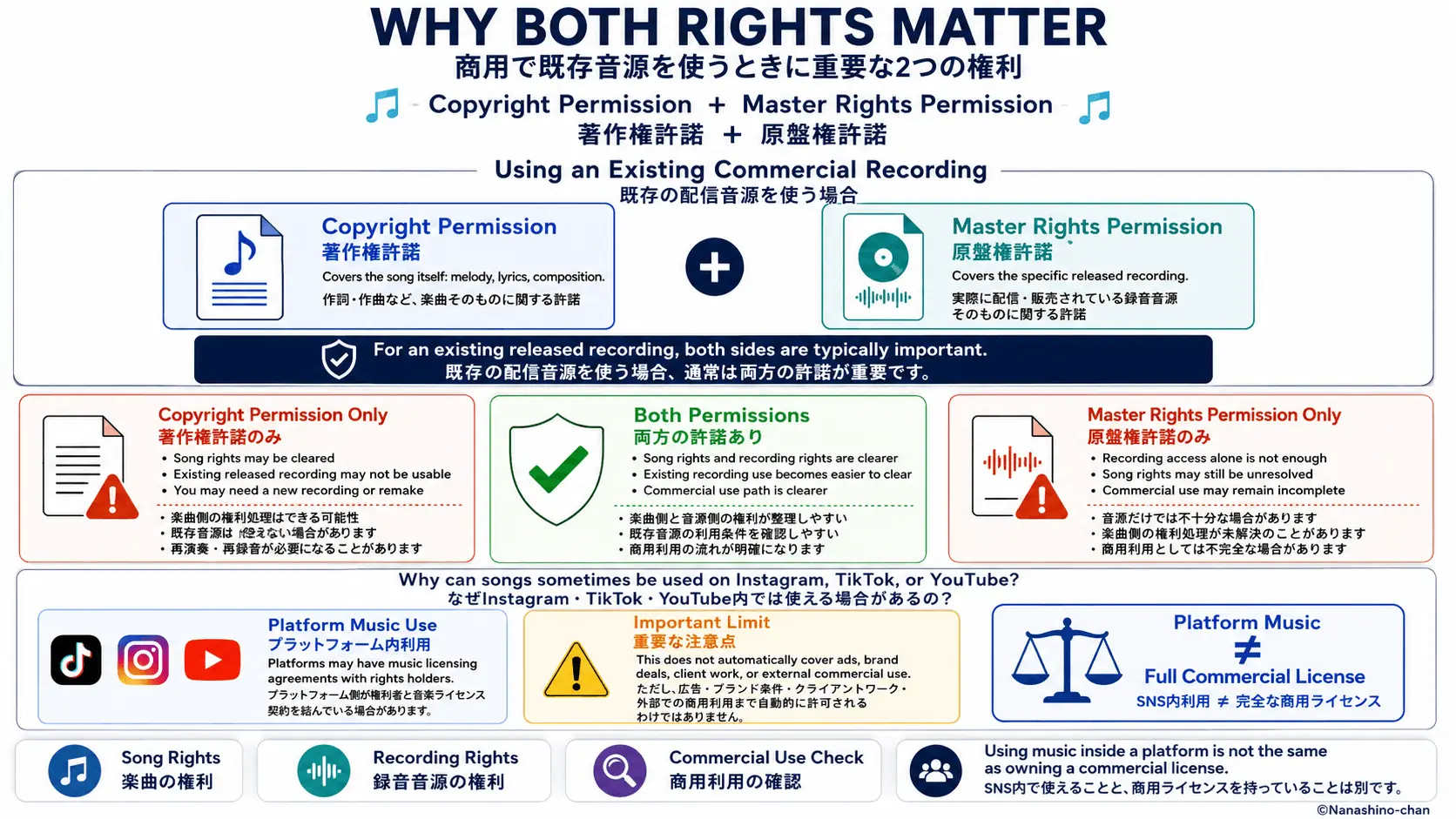 Open full-size rights infographic →
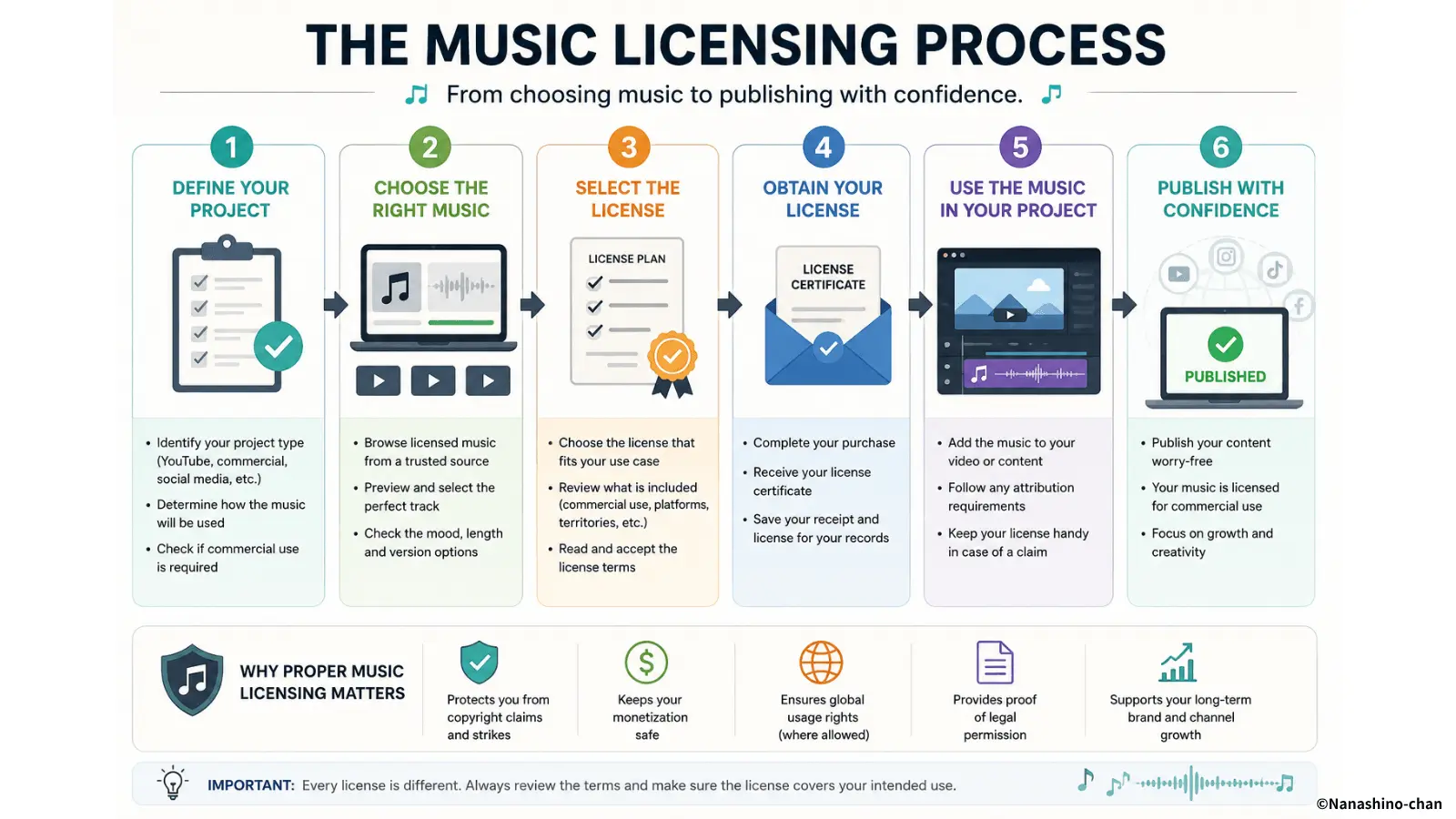 Open full-size licensing process →