Music Subscription vs Single Track License
Music subscriptions and single track licenses solve different problems for creators, brands, agencies, AI video makers, podcasters, advertisers, and businesses.
A subscription can be useful when you need frequent access to many tracks. A single track license can be better when one specific song needs clear documentation for a video, brand campaign, client project, advertisement, podcast, or commercial deliverable.
Quick Answer: Music Subscription or Single Track License?
Choose a music subscription if you publish frequently and need ongoing catalog access. Choose a single track license if you need clear permission for one selected track, project, client, campaign, video, or long-term usage record.
The most important question is not only price or catalog size. It is whether the license covers your actual use.
- Music subscription can be useful for frequent creators who need many tracks.
- Single track license can be useful for specific videos, ads, client work, brand campaigns, or commercial projects.
- Commercial use should be checked when content supports a business, sponsor, brand, product, or client.
- Sync use should be checked when music is combined with video, visuals, ads, Reels, AI footage, or product demos.
日本語:音楽サブスクは、多くの楽曲を頻繁に使いたいクリエイターに向いています。一方、1曲単位ライセンスは、特定の楽曲を特定の動画・広告・企業案件・クライアントワークに使い、許諾範囲と記録を明確にしたい場合に向いています。
Music Subscription vs Single Track License: Comparison Table
Both licensing models can be useful. The right choice depends on your publishing frequency, project type, documentation needs, commercial use, and whether the music will be used in video or visual media.
| Factor | Music Subscription | Single Track License |
|---|---|---|
| Best for | Creators who need frequent access to many tracks. | Projects that need one selected track with clear documentation. |
| Cost structure | Recurring monthly or annual payment. | Single payment for one track and a defined usage scope. |
| Catalog access | Usually broad catalog access while subscribed. | Focused on one selected track or a specific licensed use. |
| Creative flexibility | Good for testing multiple tracks across many videos. | Good when one track is chosen for a defined brand, client, or campaign identity. |
| Proof of license | Depends on subscription records and provider rules. | Often easier to document for a specific track, project, or client. |
| Cancellation risk | You must check what happens to published videos after cancellation. | No subscription dependency if the license grants defined usage rights. |
| Client work | May require higher-tier, agency, or client-work coverage. | Often suitable when the license is issued for a specific client deliverable. |
| Ads and brand campaigns | May be limited or require an advanced plan. | Can be clearer when the campaign scope is defined in the license. |
What Is a Music Subscription?
A music subscription is a licensing model where creators pay a recurring fee to access a catalog of tracks.
This can be useful for creators who publish frequently and need music for ongoing content such as YouTube videos, Shorts, Instagram Reels, TikTok videos, podcasts, livestreams, social media edits, or recurring series.
However, a subscription usually does not mean every track can be used anywhere for any purpose. The subscription terms may still limit commercial use, client work, paid ads, business accounts, AI videos, or what happens after cancellation.
Before choosing a music subscription, check:
- Whether monetized YouTube videos are covered
- Whether sponsored videos and affiliate content are covered
- Whether business accounts and brand content are covered
- Whether client work, agency work, or freelancer deliverables are covered
- Whether paid ads and campaign use are covered
- Whether AI-generated videos are covered
- Whether published videos remain covered after cancellation
- Whether proof of license is available for each project
What Is a Single Track License?
A single track license is a license purchased for one selected song or recording under defined usage terms.
Instead of paying for ongoing catalog access, the buyer obtains permission to use one specific track in a specific way. This can be useful when a video, brand campaign, product demo, advertisement, AI marketing video, podcast series, or client project needs clear documentation.
A single track license may be especially useful when:
- You already know which track you want to use
- You need music for a specific commercial project
- You are delivering a video to a client
- You need proof of license for a brand, sponsor, or agency
- You want the license scope to match a defined campaign
- You need sync rights for a video or advertisement
- You do not need ongoing monthly catalog access
- You want a simpler record for future review
The key advantage is project clarity. A single track license can be easier to connect to a specific track, video, campaign, client, or commercial use.
Which Model Is Better for Your Use Case?
The best choice depends on how often you publish, whether you need one specific track, whether the content is commercial, and whether the project requires long-term proof of permission.
Use this table as a practical guide.
| Use Case | Music Subscription | Single Track License |
|---|---|---|
| Frequent YouTube uploads | Useful if you need many tracks and the subscription covers monetized creator uploads. | Useful for important videos that need a specific track and clear proof of license. |
| Short-form social content | Useful for recurring Reels, TikTok videos, Shorts, and social edits. | Useful for selected campaign videos, brand posts, or paid collaborations. |
| Brand campaign | May require a higher plan, business plan, or separate commercial permission. | Often clearer when the brand, campaign, platform, and usage period are defined. |
| Paid advertisement | Check carefully. Ads may be excluded, limited, or require advanced coverage. | Often better for defined ad campaigns, platforms, and usage periods. |
| Client video project | May require agency, team, or client-work coverage. | Often suitable because the license can be tied to the client deliverable. |
| AI video or AI avatar content | Check whether AI-generated video use is included. | Useful when a specific AI video, product explainer, or campaign needs documentation. |
| Podcast series | Useful if recurring episodes need different background tracks. | Useful for a consistent intro, outro, theme, or show identity. |
| Business video or product demo | May work if business use and sync use are included. | Often clearer for product demos, SaaS videos, company videos, and client presentations. |
In simple terms, subscriptions are useful for volume. Single track licenses are useful for precision.
The Biggest Subscription Risk: What Happens After Cancellation?
One of the most important questions with a music subscription is what happens after you cancel.
Some services may allow previously published videos to remain licensed, while others may limit future uploads, re-uploads, edits, client use, paid ads, or monetization after cancellation. The exact rule depends on the provider and license terms.
Before relying on a subscription, creators should confirm:
- Whether videos published during the subscription remain covered after cancellation
- Whether old videos can remain monetized after cancellation
- Whether re-uploading, editing, or republishing old videos is allowed
- Whether client projects remain covered after the subscription ends
- Whether paid ads or brand campaigns remain covered after cancellation
- Whether downloaded tracks can be used after the subscription ends
- Whether proof of license is available for each track and project
This is why a single track license can be safer for important commercial videos, brand campaigns, client deliverables, and paid advertisements. The project scope can be documented more directly.
Why a Single Track License Can Be Better for Important Projects
A single track license is not always the cheapest option if you need many tracks. However, it can be more practical when one selected song becomes part of a specific project identity.
For example, a brand campaign, podcast intro, product video, SaaS demo, AI avatar series, or client advertisement may need a track that can be documented clearly and reused according to the agreed terms.
A single track license can help when you need:
- A clear link between one track and one project
- Proof of license for a client, sponsor, brand, or agency
- Defined usage rights for a video, ad, or campaign
- Clearer documentation for future platform or rights review
- A stable track identity for a recurring show, intro, or branded asset
- A license that is not dependent on ongoing catalog subscription access
For high-value content, the most important factor is not track quantity. It is whether the music rights are clear enough for the project.
Subscription vs Single Track Is Not the Only Question
The payment model is only one part of music licensing. A subscription and a single track license can both be unsuitable if they do not cover the actual use.
Creators should also understand the difference between creator licensing, commercial licensing, sync licensing, and custom licensing.
| License Type | Typical Use | When to Review Carefully |
|---|---|---|
| Creator License | Personal or limited creator videos, organic posts, simple recurring content. | When monetization, sponsorship, affiliate links, or brand promotion are involved. |
| Commercial License | Business, brand, sponsored, promotional, or client-related content. | When the music supports a product, service, company, campaign, client, or revenue-related goal. |
| Sync License | Music combined with video, visuals, ads, Reels, TikTok videos, product demos, or AI videos. | When the music is edited, looped, embedded, or synchronized with visual media. |
| Custom License | Apps, games, SaaS tools, templates, large campaigns, multi-account use, product integration, or unusual rights needs. | When the music is distributed to users, embedded in a product, or used beyond normal creator/video publishing. |
In simple terms: if the content is personal and organic, creator licensing may apply. If it supports business or promotion, review commercial licensing. If it combines music with video, review sync licensing. If the music becomes part of a product, platform, template, or app, custom licensing is usually required.
Related guides:
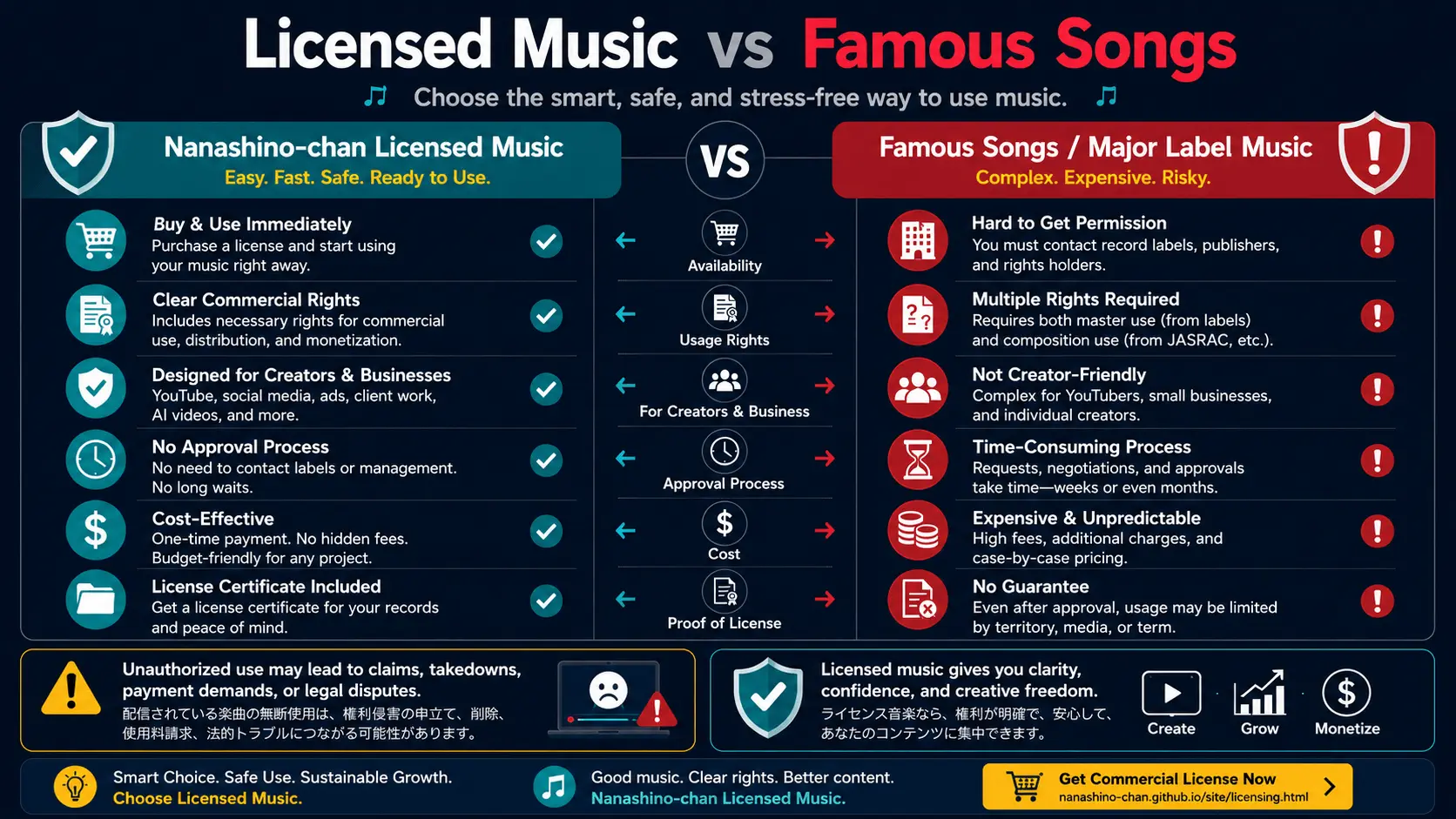
Music Subscription or Single Track License vs Famous Songs
Whether you choose a subscription or a single track license, the goal is often the same: to avoid the uncertainty of using famous songs without proper clearance.
Famous songs and major-label music can involve multiple rights holders, including record labels, publishers, songwriters, master owners, and collecting societies. A video project may require permission for both the sound recording and the musical composition. Approval may take time, pricing may vary, and some songs may not be available for advertising, brand use, or creator campaigns at all.
Unauthorized use of famous songs in promotional videos has led to real lawsuits and substantial damages. For example, Beastie Boys sued Monster Energy over the use of their songs in a promotional video, and a jury awarded $1.7 million.
This does not mean every unauthorized use will lead to the same result. However, it shows why famous songs can carry serious legal and financial risk when used in advertising, promotion, branded content, or business videos without permission.
For creators, brands, agencies, and AI video makers, music with clear creator, commercial, and sync licensing terms can be a more predictable option than trying to clear famous songs or using copyrighted music without permission.
日本語:音楽サブスク・1曲単位ライセンスと有名曲利用の違い
音楽サブスクでも1曲単位ライセンスでも、重要なのは「その用途に必要な許諾が明確かどうか」です。
有名曲やメジャーレーベル楽曲を動画・広告・ブランドキャンペーンで使う場合、レコード会社、出版社、作曲者、原盤権者、管理団体など複数の権利者が関係する可能性があります。許諾に時間がかかる場合や、広告・商用利用が認められない場合もあります。
有名曲をプロモーション動画に無断使用したことで、実際に訴訟や高額な損害賠償につながった事例もあります。たとえば Beastie Boys は、プロモーション動画で楽曲を無断使用した Monster Energy を訴え、陪審は170万ドルの賠償を認めました。
Nanashino-chanのライセンス音楽は、クリエイター、企業、広告制作、AI動画、クライアントワークに向けて、より明確で使いやすいライセンス選択肢として設計されています。
A Clearer Music Licensing Workflow with Nanashino-chan
Nanashino-chan licensed music is designed for creators, brands, agencies, AI video makers, advertisers, podcasters, editors, and client projects that need clearer music usage terms.
Instead of relying only on catalog access or guessing whether one subscription covers every project, creators can use a licensing workflow that separates creator use, commercial use, sync use, and custom use.
Track-Based Clarity
Useful when a specific track, video, campaign, ad, client project, or brand deliverable needs clear documentation.
Built for Video
Useful for YouTube videos, Shorts, Reels, TikTok videos, podcasts, ads, product demos, AI videos, and brand content.
Creator and Client Friendly
Designed for individual creators, small businesses, marketers, freelancers, agencies, editors, and client projects.
This is not just “subscription music” or “single track music.” It is a practical way to reduce uncertainty, avoid unclear licensing claims, and use music with clearer creator, commercial, and sync terms.
Used in Real Brand & Creator Projects
Nanashino-chan music has also been used in real brand and creator projects.
Nanashino-chanの楽曲は、実際のブランド・クリエイタープロジェクトでも使用されています。
Documentation, Content ID, and Proof of License
Whether you use a music subscription or a single track license, documentation matters. Platforms may still detect music through Content ID or other automated audio recognition systems.
A license helps clarify permission, but it does not guarantee that every platform system will behave perfectly. Creators should keep records for monetized, sponsored, commercial, AI-generated, or client-facing projects.
Recommended records include:
- Track title and artist name
- License, receipt, purchase record, subscription record, single track license record, or permission record
- Project title and publication date
- Platform or campaign destination
- Creator channel, brand, sponsor, agency, or client name if relevant
- Scope of use, including monetization, advertising, distribution, editing, and sync details
If a Content ID claim, copyright notice, client rights check, or campaign review occurs, these records can help confirm whether the use matches the licensed scope.
Related guides:
日本語まとめ:音楽サブスクと1曲単位ライセンスの違い
音楽サブスクは、多くの楽曲を頻繁に使いたいクリエイターに向いています。YouTube、Shorts、Reels、TikTok、ポッドキャストなど、継続的に動画を作る場合には便利です。
一方、1曲単位ライセンスは、特定の楽曲を特定の動画、広告、企業案件、クライアントワーク、商品紹介動画、AI動画などに使い、使用範囲と許諾記録を明確にしたい場合に向いています。
重要なのは、サブスクか1曲単位かではなく、そのライセンスが実際の用途をカバーしているかです。収益化、商用利用、Sync利用、広告、クライアントワーク、AI動画、解約後の利用可否などを確認する必要があります。
Nanashino-chanのライセンス音楽は、クリエイター、企業、広告制作、AI動画、クライアントワークに向けて、より明確で使いやすいライセンス選択肢として設計されています。
Preview Music for Your Licensing Workflow
Explore lo-fi music designed for YouTube videos, Shorts, Instagram Reels, TikTok videos, podcasts, AI videos, sponsored content, brand campaigns, ads, client work, and commercial creator workflows.
Before choosing a track, consider whether your project needs ongoing catalog access, a single-track project license, commercial rights, sync rights, client-use coverage, or long-term documentation.
Official Platform Copyright Policies
Music subscriptions and single track licenses are also affected by platform rules. YouTube, Instagram, TikTok, Facebook, and other platforms may apply their own copyright systems, account restrictions, music availability rules, monetization policies, regional limits, and claim workflows.
Before publishing monetized, sponsored, commercial, AI-generated, or client-facing creator content, review the official platform copyright policies:
- YouTube Copyright Help
- YouTube Content ID Information
- Instagram Copyright Help
- TikTok Copyright Policy
- Facebook Copyright Help
A music license helps clarify permission from the music rights holder, but platform behavior may still depend on each platform’s automated systems, policies, regional availability, account type, and monetization rules.
FAQ
What is the difference between a music subscription and a single track license?
A music subscription usually gives ongoing access to a catalog while the subscription is active. A single track license is usually purchased for one selected track and a defined use case, such as a video, campaign, client project, podcast, advertisement, or brand deliverable.
Is a music subscription better for creators?
It can be better for creators who publish frequently and need regular access to many tracks. However, creators should check monetization, sponsorships, commercial use, client work, paid ads, AI videos, and what happens after cancellation.
Is a single track license better for commercial projects?
Often, yes. A single track license can be clearer for a specific commercial video, brand campaign, ad, product demo, AI video, podcast series, or client deliverable because the scope can be tied to the selected track and project.
What happens to my videos if I cancel a music subscription?
It depends on the provider and license terms. Some subscriptions may allow previously published videos to remain licensed, while others may limit future use, re-uploads, edits, client projects, or monetization after cancellation. Always check the cancellation terms before publishing.
Can a music subscription cover monetized YouTube videos?
Only if the subscription terms include monetized YouTube use. Creators should also check whether Shorts, sponsored videos, affiliate content, business channels, multiple channels, and Content ID-related documentation are covered.
Can a music subscription cover client work?
Only if client work is included. Some subscriptions may require a higher-tier, agency, team, or business plan for client deliverables, brand accounts, paid campaigns, or multi-account use.
Can a single track license cover sync use?
Yes, if sync use is included in the license. Sync use means music is combined with visual media such as YouTube videos, Reels, TikTok videos, ads, product demos, AI videos, or brand videos.
Which is better for paid ads: subscription or single track license?
A single track license is often clearer for paid ads when the campaign, platform, brand, duration, selected track, and usage scope are defined. A subscription may work only if paid advertising is clearly included in the plan.
Which is better for AI videos?
It depends on the project. AI-generated videos may require commercial or sync licensing when music is combined with visual media and used for publishing, monetization, marketing, brand communication, or client work. AI training and dataset use are separate rights and are usually not included.
Can licensed music still trigger Content ID detection?
Yes. Automated systems may still detect licensed music. Clear license records, track information, subscription records, single track license records, project details, and usage documentation can help reduce uncertainty and support claim review if needed.
Is a music subscription cheaper than a single track license?
It depends on your publishing volume and use case. A subscription can be cost-effective for frequent creators who need many tracks, while a single track license can be more predictable for specific commercial projects, ads, brand campaigns, and client work.
日本語:音楽サブスクと1曲単位ライセンスの違いは何ですか?
音楽サブスクは、契約中に楽曲カタログへ継続的にアクセスできる仕組みです。1曲単位ライセンスは、特定の楽曲を特定の動画、広告、企業案件、クライアントワークなど、定義された用途に使うための許諾です。
日本語:クリエイターにはどちらが向いていますか?
頻繁に動画を作り、多くの楽曲を使い分けたい場合は音楽サブスクが便利です。一方、広告、企業案件、商品紹介動画、AI動画、クライアント納品など、特定の楽曲と使用範囲を明確にしたい場合は1曲単位ライセンスが向いていることがあります。
Need Music Licensing That Fits Your Project?
If you publish YouTube videos, Shorts, Reels, TikTok videos, podcasts, AI videos, sponsored content, brand campaigns, paid ads, client work, or commercial content, choose a license model that matches the actual project.
Nanashino-chan music is designed for creators, brands, agencies, advertisers, marketers, podcasters, AI video makers, and commercial content workflows that need clearer music licensing terms.
► View Music Licensing Options
For unclear use cases, brand campaigns, client work, multi-account use, or custom licensing:
Contact Nanashino-chan
Related Pages
Continue with these guides if you want deeper information about creator music licensing, commercial use, sync licensing, YouTube music use, Content ID, AI videos, and business workflows.
Compare monthly and one-time licensing models Affordable Music Licensing for Creators
Understand predictable creator music licensing Unlimited Music License for Creators
Understand what “unlimited” really means Music License for YouTube Creators
What YouTubers should keep as proof How to Use Music Legally on YouTube
Practical legal music workflow for YouTube videos Can I Use Music on YouTube?
Legal music use, copyright, monetization, and licensing Music Licensing for Commercial Use
Commercial licensing for creators, brands, and agencies Music License for Business Videos
Music licensing for company videos and brand content Licensing Process
Step-by-step music licensing workflow Music Licensing vs Sync Licensing
Understand the difference before choosing a license How Sync Licensing Works
Sync licensing workflow for videos, ads, and AI content YouTube Content ID Guide
Claims, music detection, rights management, and creator protection How to Avoid Content ID Claims
Checklist before uploading music-based videos Music for AI Video Generators
Licensed music for AI-generated video workflows Licensed Music for AI Commercial Videos
Commercial music licensing for AI video projects ISRC Code Explained
Music identification, rights metadata, and licensing Works
Real brand and creator use cases Licensing Page
Commercial, sync, brand, and custom music licensing
Disclaimer
This page is provided for general information about music subscriptions, single track licenses, creator music licensing, and music usage. It is not legal advice.
Music usage may be affected by copyright law, platform rules, Content ID systems, account type, region, monetization status, metadata, distribution settings, license scope, subscription status, cancellation terms, and policy changes outside the control of Nanashino-chan.
A license helps clarify permitted use from the music rights holder, but it does not guarantee specific outcomes such as monetization approval, video reach, ad performance, claim behavior, or platform availability.
Users are responsible for ensuring that their content complies with the terms, policies, and laws applicable to each platform and jurisdiction.
免責事項
このページは、音楽サブスク、1曲単位ライセンス、クリエイター向け音楽ライセンス、音楽利用に関する一般的な説明を目的としたものであり、法的助言ではありません。
音楽の利用可否や表示・検出・収益化の挙動は、著作権法、各プラットフォームの仕様、Content IDなどの自動検出システム、アカウント種別、地域、メタデータ、配信設定、ライセンス範囲、契約状態、解約条件、ポリシー変更等により影響を受ける場合があります。
ライセンスは権利者からの利用許諾を明確にするものですが、収益化承認、再生数、表示回数、広告成果、Content IDの挙動、各プラットフォーム上での利用可否を保証するものではありません。
利用者は、各プラットフォームの利用規約・ポリシー・適用法令を確認し、適切に遵守する責任を負います。