Music for Animated Panels & Digital Comics
Music for Motion Comics: Licensed Background Music for Animated Panels, Voice Comics & Digital Stories
Motion comics combine illustrated panels with movement, editing, captions, dialogue, narration, sound effects, and music. The music must support the emotional rhythm of the story while leaving enough space for voices, visual information, and scene transitions.
This guide explains how to choose, edit, mix, and license background music for motion comics, voice comics, animated webtoon panels, vertical comic videos, social teasers, monetized episodes, and commercial campaigns.
Direct Answer: What Music Should You Use for a Motion Comic?
Use instrumental music that matches the scene, supports the story’s emotional direction, and remains flexible enough to sit beneath dialogue, narration, captions, and sound effects.
The best choice depends on whether the project is a short teaser, character scene, voice comic, full episode, webtoon adaptation preview, vertical social video, or paid promotional campaign.
- Choose music with enough space for dialogue and narration.
- Match musical changes to panel movement and story transitions.
- Avoid overly dense melodies during important spoken scenes.
- Use volume automation instead of one fixed music level.
- Confirm commercial, client, platform, and advertising rights.
- Review recurring-use rights before publishing multiple episodes.
- Keep the license, receipt, track data, and project records.
What Is a Motion Comic?
A motion comic transforms static comic or webtoon artwork into audiovisual content through controlled movement, editing, sound, and timing. It may remain visually close to the original panels or move toward a more fully animated presentation.
Animated Panels
Comic panels are enhanced with camera moves, zooms, parallax, lighting, particles, transitions, or limited character motion.
Voice Comics
The project adds character voices, narration, dialogue, sound effects, and background music to illustrated scenes.
Digital Comic Trailers
Short promotional edits introduce a series, episode, character, relationship, conflict, or adaptation announcement.
Vertical Comic Videos
Mobile-first 9:16 videos adapt webtoon panels for TikTok, Instagram Reels, YouTube Shorts, and other vertical formats.
Motion Manga
Manga artwork is edited with movement, sound design, captions, music, and sometimes voice acting for online distribution.
Limited Animation
A project may animate selected facial expressions, hair, eyes, environmental effects, or character poses while preserving the illustrated style.
The term “motion comic” covers a wide range of production levels. Licensing should be based on the actual format, distribution, monetization, client, and number of episodes—not only the label used for the project.
Where Music Is Used in Motion Comic Production
Music can support the full narrative or appear only in selected scenes. The production should decide where music adds meaning and where dialogue, ambience, sound effects, or silence should take priority.
Opening Sequence
Establish the world, genre, character, emotional tone, title, and visual identity of the motion comic.
Character Introduction
Give a character a recognizable emotional or stylistic direction without competing with names, dialogue, or narration.
Dialogue Scenes
Maintain atmosphere beneath conversation while preserving clarity, pacing, pauses, and emotional subtext.
Scene Transitions
Connect changes in time, location, viewpoint, mood, character, or chapter without making the edit feel abrupt.
Emotional Reveals
Support confession, betrayal, memory, separation, discovery, fear, hope, healing, or a major story turning point.
Action & Suspense
Add rhythmic movement, tension, pulse, and controlled energy beneath cuts, impacts, animated effects, and confrontations.
Ending & Cliffhanger
Create a resolved ending, emotional afterimage, title card, release notice, next-episode prompt, or deliberate unresolved tension.
Promotional Cutdowns
Adapt the music for short social clips, episode teasers, character edits, paid ads, and platform-specific promotional versions.
Why Music Matters in Motion Comics
Motion comics use fewer animated elements than full animation, so music and sound design often carry more responsibility for movement, atmosphere, emotional continuity, and perceived production quality.
Creates Perceived Movement
Rhythm and phrasing can make pans, zooms, panel reveals, and limited character animation feel more intentional.
Connects Separate Panels
A continuous musical direction helps individual images feel like one developing audiovisual sequence.
Supports Emotional Subtext
Music can express uncertainty, attraction, loneliness, tension, relief, nostalgia, or danger without adding extra dialogue.
Controls Pacing
The beat and arrangement can help determine how long a panel remains visible and when transitions should occur.
Strengthens Character Identity
A consistent musical texture can help distinguish a character, relationship, location, or recurring narrative theme.
Improves Promotional Impact
A strong audio direction helps trailers and social cutdowns communicate genre and mood within the first few seconds.
The Motion Comic Audio Stack
A professional motion comic mix usually contains several layers. Each layer should have a clear role rather than competing for attention.
Music Should Not Fill Every Available Space
Silence, ambience, and reduced musical intensity can make dialogue, visual reveals, emotional pauses, and sound effects more effective.
Music, Voice Acting & Dialogue Clarity
A suitable track can still fail if it is mixed too loudly or occupies the same frequency range as the main voices.
- Choose instrumental tracks when dialogue carries the story.
- Avoid dense lead melodies beneath important spoken lines.
- Lower the music during names, plot information, and emotional dialogue.
- Use quieter musical sections beneath narration-heavy scenes.
- Reduce bass and low-mid buildup when voices sound unclear.
- Use pauses or arrangement changes before major reveals.
- Review the mix on mobile speakers, headphones, and laptop speakers.
- Keep sound effects intentional rather than layering every element at equal volume.
The goal is not simply to make the music quieter. The better approach is to select a track with suitable arrangement space and then automate its level according to the scene.
Motion Comic Formats and Music Requirements
| Format | Typical Duration | Music Requirement | Main Production Risk |
|---|---|---|---|
| Character teaser | 6–20 seconds | Immediate hook, one clear mood, a compact edit, and a defined ending or loop | A slow musical introduction may not establish the character quickly enough |
| Episode preview | 15–45 seconds | Short narrative development, dialogue space, tension or emotional lift, and a final title card | Too many musical changes can compete with captions and story information |
| Voice comic scene | 30 seconds–3 minutes | Dialogue-friendly arrangement, controlled dynamics, transitions, and selective silence | Continuous loud music can make voices tiring or difficult to understand |
| Full motion comic episode | 3–15 minutes or longer | Multiple cues, narrative progression, scene-specific edits, recurring motifs, and resolved transitions | One repeating loop may make the episode feel static and emotionally flat |
| Vertical social motion comic | 10–60 seconds | Fast emotional communication, mobile-friendly mix, caption space, and short-form pacing | Visual rhythm may become too dependent on the beat and reduce readability |
| Paid motion comic advertisement | 6–60 seconds | Strong opening, approved cutdowns, campaign-ready versions, clear ending, and suitable advertising rights | Organic-use music may not be licensed for paid distribution or cross-platform advertising |
Choosing Music by Motion Comic Genre
The most effective music does not simply match a broad genre label. It supports the specific emotional promise of the scene, the character’s point of view, and the pace of the visual storytelling.
Romance & Relationship Drama
Warm lo-fi beats, soft piano, mellow jazzhop, restrained guitar, and gentle ambient textures can support attraction, hesitation, intimacy, separation, memory, and emotional distance.
Slice of Life
Relaxed rhythms, café-inspired instrumentation, light keys, subtle vinyl texture, and understated beats work well for school, work, friendship, family, and everyday routines.
Urban & Night Stories
Chillwave, synthwave, nocturnal lo-fi, muted bass, and atmospheric electronic music can support city lights, late-night travel, loneliness, ambition, and modern relationships.
Fantasy & Supernatural
Ambient layers, mysterious piano, reversed textures, subtle percussion, and cinematic lo-fi hybrids can create wonder, uncertainty, magic, or spiritual tension.
Psychological Drama
Minimal harmony, slow pulses, low drones, sparse percussion, and unstable textures can support internal conflict, memory, doubt, fear, and unreliable perception.
Comedy
Playful jazz elements, light percussion, short musical stops, quirky rhythms, and clear accents can support reactions, awkward timing, misunderstandings, and visual punchlines.
Action & Suspense
Pulsing bass, controlled percussion, electronic tension, rhythmic builds, and concise impact points can support confrontation, pursuit, danger, and rapid transitions.
Healing & Reflection
Soft ambient lo-fi, gentle piano, slow acoustic textures, and low-intensity beats can support recovery, self-discovery, memory, nature, and emotionally quiet scenes.
Music Direction by Scene Type
| Scene Type | Recommended Music Direction | Editing Approach | Common Mistake |
|---|---|---|---|
| Opening title | A clear sonic identity that establishes genre and mood quickly | Use a recognizable intro, short logo cue, or strong opening texture | Beginning with a long fade that delays the emotional message |
| Character introduction | Music that reflects personality, status, energy, vulnerability, or mystery | Keep the arrangement simple enough for names, captions, and voice lines | Using an overly dramatic cue that reveals more than the scene intends |
| Dialogue scene | Low-density instrumental music with controlled rhythm and limited melodic competition | Reduce volume and arrangement intensity during important lines | Keeping the music at one constant level under the entire conversation |
| Romantic scene | Warm harmony, soft piano, mellow beat, gentle guitar, or restrained ambient music | Allow gradual development rather than forcing an immediate climax | Using sentimental music so strongly that the scene feels emotionally predetermined |
| Suspense reveal | Minimal pulse, low texture, controlled dissonance, or gradual rhythmic tension | Use silence, pauses, and carefully timed sound effects before the reveal | Adding too many layers and reducing the impact of the visual reveal |
| Action sequence | Rhythmic music with clear momentum, controlled bass, and defined structural changes | Align selected hits or transitions rather than cutting every panel to every beat | Making all visual movement dependent on the music’s tempo |
| Memory or flashback | Filtered texture, soft piano, ambient lo-fi, slower rhythm, or reduced instrumentation | Use tonal contrast from the present-day scene | Relying only on reverb or a visual filter without changing the emotional sound |
| Cliffhanger ending | Suspended harmony, unresolved texture, sudden stop, dark pulse, or delayed resolution | Reserve space for the final image, title card, or next-episode message | Ending the music too early or continuing it after the dramatic moment has passed |
How to Edit Music Around Motion Comic Panels
The music should be edited around the story structure rather than used as an unchanging background loop. A well-planned cue helps the motion comic feel deliberate even when the visual animation is limited.
Mark Story Beats
Identify character entrances, important dialogue, visual reveals, emotional shifts, action points, transitions, and ending cards.
Map the Music Structure
Locate the intro, groove, breakdown, lift, pause, climax, and ending in the selected track.
Match Sections, Not Every Beat
Align musical sections with narrative sections rather than forcing every panel movement to follow the rhythm.
Create Clean Edit Points
Cut at phrase endings, percussion transitions, sustained notes, or natural arrangement changes whenever possible.
Automate Volume
Lower the music beneath dialogue, raise it during visual transitions, and reduce it again before important lines.
Design the Ending
Use a musical stop, fade, resolved chord, unresolved texture, or final accent that supports the intended ending.
A strong motion comic edit does not need constant synchronization. Strategic alignment at major story moments is usually more effective than cutting every movement to the beat.
Using One Track Across a Full Motion Comic Scene
One track can work across a complete scene when it has enough internal variation. However, the editor may still need to restructure the cue to match dialogue, visual pacing, and narrative development.
- Choose a track with a clear intro, middle section, and ending.
- Use quieter sections under dialogue-heavy material.
- Move stronger sections closer to reveals, transitions, or action.
- Repeat short passages only when the repetition is not obvious.
- Avoid extending the same four-bar loop across an entire episode.
- Create a clean ending rather than relying only on a long fade.
- Confirm that editing, trimming, and looping are allowed by the license.
Editing Permission Is Not Always Unlimited
A music license may permit trimming, fading, and basic synchronization edits while restricting remixing, extracting stems, altering the composition, adding lyrics, or creating a new standalone derivative track.
When to Use Multiple Music Cues
Longer motion comics often benefit from more than one track or cue. Multiple cues can help distinguish locations, characters, emotional states, and narrative stages.
Scene Changes
A new cue can clarify a shift in location, time, perspective, or story phase.
Character Themes
Recurring musical textures can help identify a character, relationship, organization, or emotional conflict.
Genre Shifts
A scene may move from comedy to tension, romance to conflict, or reflection to action.
Episode Structure
Opening, development, confrontation, resolution, and ending may each need different intensity.
Dialogue vs Action
A dialogue-friendly cue may not provide enough momentum for a later chase, fight, or dramatic reveal.
Promotional Versions
Short trailers and social cutdowns may need a different edit or track from the full episode.
Music Loops in Motion Comics
Loops can be useful for long dialogue scenes or limited-animation sequences, but obvious repetition can reduce emotional impact and make the production feel unfinished.
Short Seamless Loop
Useful for background ambience, menus, internal scenes, and quiet conversations when the harmonic movement is minimal.
Extended Music Bed
A longer track with gradual changes can support narrative development without obvious repetition.
Custom Editorial Loop
The editor repeats selected bars, removes sections, or rearranges the track while preserving natural musical phrasing.
- Do not loop across a strong fill, crash, vocal sound, or obvious transition.
- Avoid repeating a memorable melody too frequently.
- Use ambience and sound effects to reduce the perception of repetition.
- Introduce a new layer or music cue when the story meaningfully changes.
- Review whether the license permits editing and looping.
Music for Dialogue-Heavy Motion Comics
Dialogue-heavy scenes require music that can remain emotionally present without drawing attention away from the actors, captions, or story information.
Use Sparse Arrangements
Tracks with fewer lead instruments and less harmonic density leave more space for speech.
Avoid Strong Vocal-Like Melodies
Lead instruments in the same register as the voice can compete with dialogue even at low volume.
Control the Low-Mid Range
Excess energy in the low-mid frequencies can make narration and character voices sound muddy.
Use Volume Automation
Reduce music level during important lines and restore it during pauses, reaction shots, and transitions.
Use Silence Intentionally
A short silent moment before a confession, reveal, or emotional reaction can increase impact.
Test on Small Speakers
A mix that sounds clear on studio headphones may lose dialogue clarity on a phone or laptop.
Music for Voice Comics and Narrated Scenes
Voice comics add performers and narration to illustrated material. The music should reinforce the dramatic interpretation without making the performance sound overproduced or emotionally inflexible.
- Choose music after reviewing the voice performance when possible.
- Match the cue to the actor’s pacing rather than forcing the actor to follow the beat.
- Reduce musical density beneath whispered or restrained performances.
- Use stronger musical moments between spoken sections.
- Avoid sudden musical changes beneath continuous dialogue.
- Preserve enough headroom for sound effects and vocal emphasis.
- Use ambience to connect sections where music is intentionally reduced.
The voice performance should remain the narrative focus. Music should support interpretation, not dictate every emotional response before the actor delivers the scene.
Music for Vertical Motion Comics
Vertical motion comics are designed for mobile-first viewing on platforms such as TikTok, Instagram Reels, and YouTube Shorts. Their music must communicate quickly while remaining compatible with captions and small-screen visual pacing.
Immediate Emotional Signal
The first seconds should establish genre, character, tension, or mood before the viewer scrolls away.
Caption-Friendly Rhythm
Visual timing should allow users to read text without every cut being forced to the music.
Mobile Speaker Clarity
Music, dialogue, and sound effects should remain understandable on small speakers with limited bass response.
Loop-Aware Ending
A smooth return to the beginning may help repeated viewing when it supports the story and platform format.
Multiple Durations
Create 6-second, 15-second, 30-second, and 60-second edits only when the license permits campaign variations.
Platform Rights Review
Confirm whether the music is licensed for organic posts, monetized content, paid promotion, or cross-platform reuse.
Organic Motion Comic Posts vs Paid Advertising
The same motion comic video may be treated differently when it moves from an unpaid post to a sponsored or paid campaign.
| Use | Example | Licensing Direction | Documentation Priority |
|---|---|---|---|
| Personal non-commercial post | An independent creator shares an original motion comic experiment without monetization, business promotion, or client involvement | A personal or non-commercial license may be suitable when the exact use is included | Keep the license terms, receipt, track title, and post URL |
| Organic creator promotion | A creator posts a motion comic to promote an official title, paid chapter, crowdfunding campaign, commission service, or professional work | A Commercial Creator License may be appropriate when promotional use is covered | Record the project, publishing account, platform, and commercial purpose |
| Official studio or publisher post | A company publishes a motion comic episode, character scene, launch trailer, or social teaser | Use a commercial license that covers business publication and the final rights holder | Keep client, publisher, project, platform, and license records |
| Monetized episode | A full motion comic is distributed through a monetized video channel or subscription platform | The license must expressly cover monetization and the relevant media | Keep upload URLs, monetization details, license proof, and Content ID instructions |
| Paid social campaign | A motion comic teaser is used in boosted posts, social ads, app promotion, retargeting, or launch advertising | A Sync License or campaign-specific agreement is generally the safer direction | Document advertiser, campaign period, platforms, territory, and approved versions |
| Recurring paid series | Multiple episodes or ads are released across an extended campaign | A custom agreement may be required for repeated synchronization and long-term use | Record episode quantity, term, campaign scope, versions, and distribution |
Commercial Creator License vs Sync License for Motion Comics
Commercial Creator License
Generally suited to eligible monetized creator videos, organic business content, client-facing projects, and defined commercial audiovisual uses.
Sync License
Generally suited to paid advertising, launch campaigns, sponsored distribution, and time-limited commercial synchronization with visual content.
Custom License
May be required for recurring episodes, adaptations, platform integration, long-term series use, broadcast, exclusivity, or large-scale campaigns.
A Trailer License May Not Cover a Full Episode
A short promotional video, a monetized motion comic episode, and a recurring animated series are materially different uses. Confirm the number of projects, duration, media, platforms, term, and reuse before publication.
Can Social Platform Music Be Used in Motion Comics?
Music available inside Instagram, TikTok, YouTube, or another platform should not automatically be treated as a portable commercial license for a motion comic production.
- Music availability may depend on account type and region.
- Organic use may not include paid advertising or boosted distribution.
- Platform access may not permit reuse on another platform or website.
- A client may require written proof of music permission.
- A full motion comic episode may fall outside the intended short-form platform context.
- Downloading and extracting platform music may violate applicable terms.
- Catalog availability and platform rules can change over time.
Dedicated commercial licensing is generally easier to document when the motion comic will be reused across platforms, delivered to a client, monetized, archived, localized, or promoted through paid media.
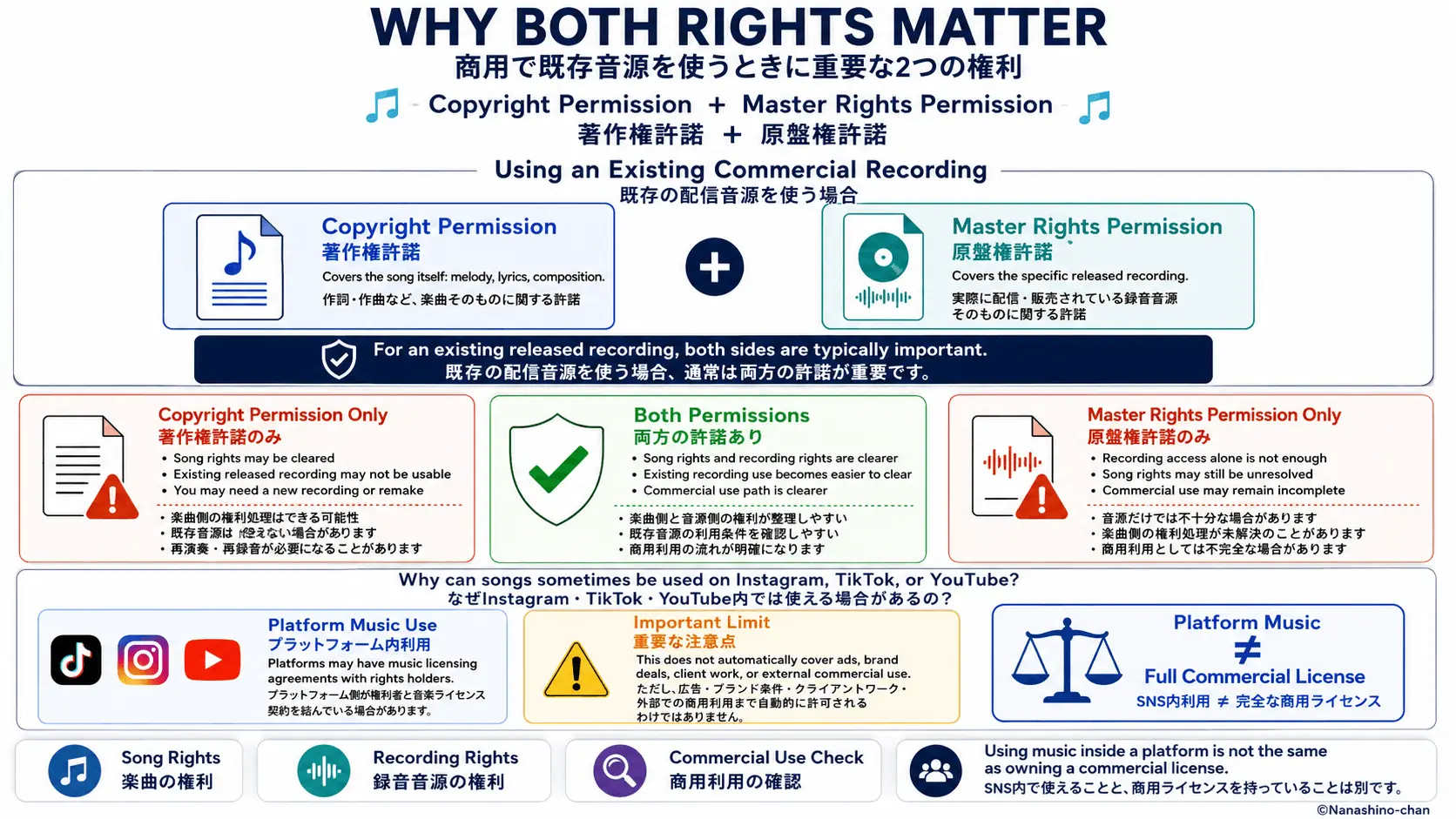
Master Rights, Composition Rights & Motion Comic Synchronization
A motion comic combines music with visual storytelling, making synchronization permission a central rights issue.
Master Recording Rights
These rights concern the specific recorded performance and audio file used in the motion comic.
Composition Rights
These rights concern the underlying melody, harmony, structure, and musical work.
Synchronization Rights
These rights concern combining the music with panels, animation, captions, narration, dialogue, trailers, or advertisements.
Distribution Scope
The agreement should clarify where the finished motion comic may be uploaded, shared, monetized, advertised, archived, or delivered.
Editing Scope
The license should clarify permitted trimming, fading, looping, cutdowns, and basic synchronization edits.
Recurring Use
Repeated use across episodes, seasons, characters, or titles may require broader permission than a single-project license.
Nanashino-chan directly manages the offered original recordings and underlying compositions. This can simplify many standard licensing discussions because the project does not need to begin by locating separate recording and composition owners.
Actual licensing requirements depend on the project, distribution, monetization, campaign, jurisdiction, and written agreement. This page provides general educational information and is not legal advice.
Music Licensing Documentation for Motion Comics
A motion comic project may involve creators, editors, voice actors, studios, publishers, agencies, and platform teams. Clear records help every party understand which music was licensed, which project is covered, and how the finished production may be distributed.
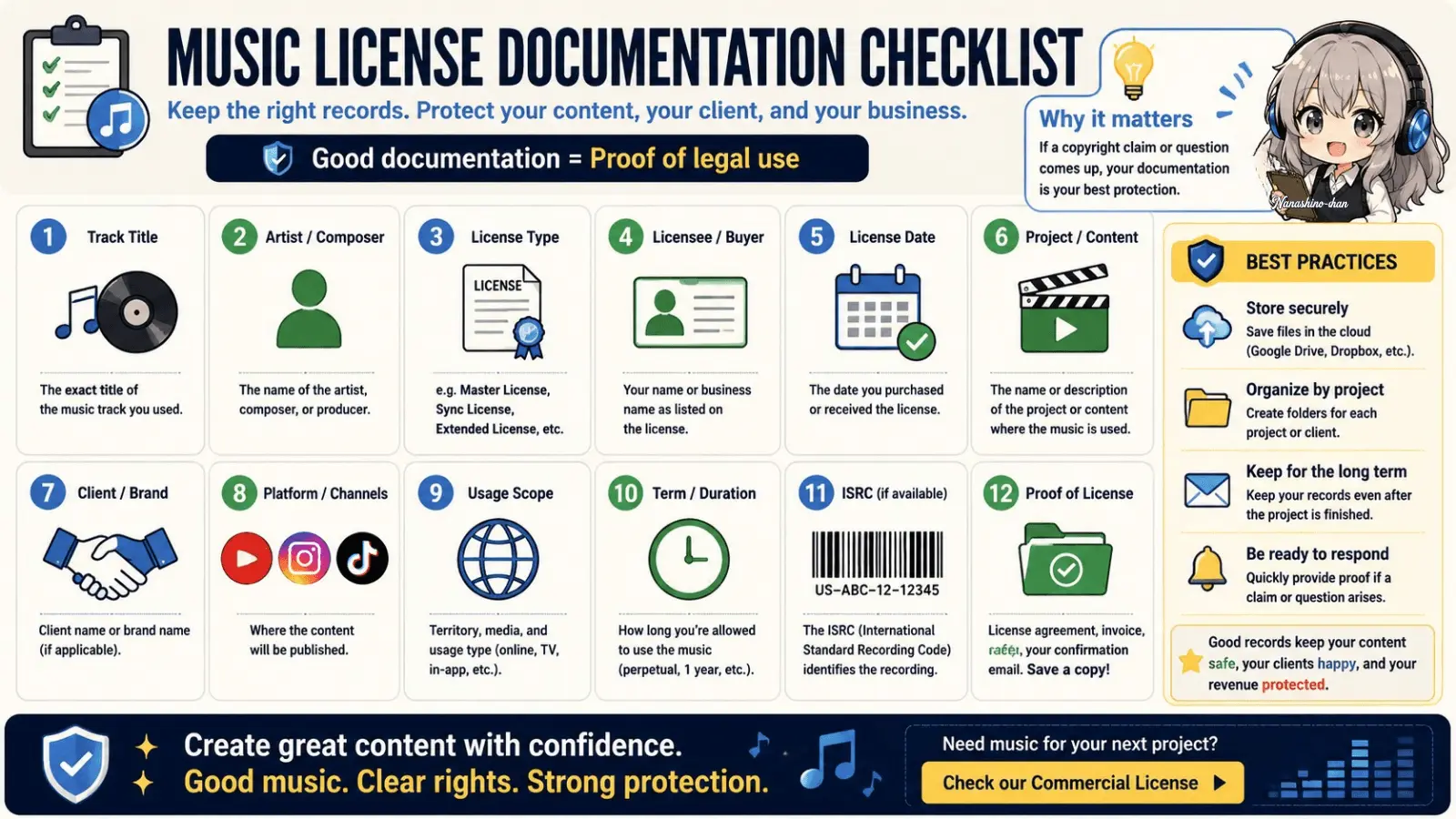
Track Identification
Save the track title, artist name, album or release URL, ISRC when available, version, edit length, and exact audio file used.
License Record
Keep the license name, purchase date, buyer, receipt or invoice, certificate, full terms, restrictions, and licensing contact.
Project Record
Record the motion comic title, episode, webtoon or manga property, client, publisher, studio, editor, and final rights holder.
Distribution Record
List all websites, apps, social platforms, monetized channels, partner accounts, territories, and publication dates.
Campaign Record
For advertising, save the advertiser, agency, campaign start and end dates, approved creative versions, territories, and paid media platforms.
Final Creative Files
Keep copies of the approved episode, trailer, vertical cutdowns, localized versions, subtitle versions, and advertising edits.
What Proof of Permission Should a Motion Comic Team Keep?
- The applicable music license and full terms.
- The purchase receipt, invoice, or transaction record.
- The license certificate when available.
- The track title, artist, version, and source URL.
- The project title, episode number, and client name.
- The permitted platforms, media, territory, and term.
- The approved number of videos, episodes, and campaign variations.
- The final upload URLs and publication dates.
- Any Content ID claim instructions or written approvals.
- Copies of the final motion comic and promotional versions.
A Receipt Does Not Explain the Full Rights Scope
A payment receipt proves that a purchase occurred, but it may not show whether the music can be used in multiple episodes, client work, paid advertising, localized versions, platform distribution, or animated adaptations.
Store the receipt together with the full license terms and any certificate or written permission.
Licensing Music for Client Motion Comic Projects
In client work, the person purchasing the license may not be the same person editing, publishing, monetizing, or advertising the finished motion comic.
The Licensed Buyer
The individual, studio, agency, publisher, or organization that purchases or receives the music license.
The Production Team
The editor, animator, motion designer, sound designer, voice production team, or subcontractor using the music during production.
The Final Publisher
The creator, studio, platform, publisher, advertiser, or IP owner distributing the finished motion comic.
The license should clarify whether the production team may access the music, whether the completed video may be delivered to the client, and whether the final publisher may upload, monetize, advertise, localize, and archive the project.
Do Not Transfer the Standalone Music File Without Permission
Many licenses allow delivery of a finished motion comic but do not allow the original music file to be resold, redistributed, uploaded to a shared asset library, or transferred to the client as a standalone file.
Questions Freelancers, Studios & Agencies Should Confirm
- Who will purchase the music license?
- Who is named as the licensed party?
- Which motion comic title or episode is covered?
- Can subcontractors and production partners access the track?
- Can the completed project be delivered to the client?
- Can the editor or agency display the project in a portfolio?
- Are organic social posts included?
- Are monetized channels included?
- Are paid ads and boosted posts included?
- Can the client create shorter versions from the approved production?
- Can the same music be reused in later episodes?
- Can localized or translated versions be published?
- Who is responsible for storing license documentation?
Music Licensing for Episodic Motion Comics
A recurring motion comic series creates different licensing questions from a single teaser or one-off episode. The agreement should define how many episodes, seasons, titles, and promotional versions are permitted.
| Series Situation | Music Use | Main Licensing Question | Planning Direction |
|---|---|---|---|
| One pilot episode | A single test episode, proof of concept, or publisher presentation | Does the license cover public release, client delivery, monetization, and portfolio display? | A single-project commercial license may be suitable when the precise use is covered |
| Short promotional series | Several character clips, episode teasers, or launch videos for one title | How many videos and campaign versions are permitted? | Confirm project quantity, term, platforms, and campaign scope |
| Recurring motion comic episodes | The same track or several tracks appear throughout an ongoing series | Does the license permit repeated synchronization across episodes and seasons? | A custom series agreement may be required |
| Multiple webtoon titles | A studio reuses the same music catalog across unrelated properties | Is the license limited to one project, one title, or one client? | Use a catalog, studio, or multi-project agreement when available |
| International localized series | The same episodes are released with different languages, captions, voices, and regional accounts | Are localization, territories, partner distribution, and versioning included? | Define permitted territories and localized creative versions in writing |
| Permanent platform archive | Episodes remain available indefinitely on a platform, app, website, or monetized channel | Does the license include an archive period after the active campaign or term? | Clarify continued availability, monetization, and takedown obligations |
Using Recurring Musical Themes
Recurring themes can strengthen character identity, relationships, locations, and story continuity. However, repeated use must remain within the permitted licensing scope.
Main Character Theme
A recognizable track or motif can reinforce personality, growth, vulnerability, or narrative importance.
Relationship Theme
A recurring musical direction can connect romantic, family, friendship, rivalry, or partnership scenes.
Location Theme
Specific textures can identify a city, school, café, fantasy world, workplace, home, or recurring environment.
Conflict Theme
A darker or more unstable cue can return when a threat, secret, antagonist, or unresolved problem appears.
Memory Theme
A softened or rearranged version can support flashbacks, emotional callbacks, and changes in perspective.
Series Identity
A consistent opening or ending direction can give separate episodes a unified audiovisual identity.
Using the same track repeatedly across episodes may require broader permission than using it once in a trailer. Confirm recurring-use rights before building the series identity around a licensed track.
Music Licensing for Localized Motion Comics
Motion comics can be adapted for different languages, territories, platforms, and audiences. Each localized version should remain within the approved license scope.
Translated Captions
Subtitle and on-screen text changes may create additional versions of the original motion comic.
Localized Voice Acting
New character voices or narration tracks create separate audiovisual masters that should remain within the agreement.
Regional Accounts
A publisher may upload the same episode through country-specific, language-specific, or partner-owned channels.
Territory Expansion
A production licensed for one market may need review before wider international release.
Platform-Specific Versions
Vertical clips, horizontal episodes, app previews, website trailers, and presentation versions may use different edits.
Partner Distribution
Regional publishers, licensors, broadcasters, adaptation partners, and promotional partners may require explicit authorization.
Localization Can Create Several New Creative Versions
A translated subtitle version, dubbed version, shortened vertical edit, and regional advertisement may all be treated as separate project variations. Confirm that the license permits these versions before distribution.
Content ID and Motion Comic Uploads
A valid music license does not always prevent an automated platform claim. Content identification systems may detect the recording before they know that the uploader has permission.
Automated Music Claim
A platform may identify the recording and apply monetization, tracking, visibility, or territorial settings.
Copyright Strike
A formal removal request or strike is generally more serious than an automated identification claim.
License Evidence
The uploader may need the license terms, receipt, certificate, project details, track information, and dispute instructions.
- Check whether the selected track may be registered with a content identification system.
- Save the music license before uploading the motion comic.
- Use the correct licensed name for the creator, studio, or client.
- Keep the final upload URL and claim information.
- Follow the licensor’s claim release or dispute procedure.
- Do not claim ownership of music you did not create.
- Allow enough time for claim review before a major launch or campaign.
A Claim Does Not Automatically Mean the Use Is Unauthorized
Automated systems identify matching audio. They do not always know whether a specific creator, studio, or publisher purchased permission for the project. The stored license record helps establish authorized use.
Common Motion Comic Music Mistakes
Using One Loop for the Entire Episode
A repetitive loop can flatten emotional development and make scene changes feel less meaningful.
Mixing Music Too Loudly
Dialogue, narration, captions, and sound effects lose clarity when music remains at one dominant level.
Cutting Every Panel to the Beat
Constant beat synchronization can make reading difficult and reduce the natural pace of dialogue and storytelling.
Using Platform Music as a Production Asset
In-app access does not automatically authorize cross-platform, client, monetized, episodic, or advertising use.
Ignoring Recurring Episode Rights
A license for one motion comic may not cover later episodes, seasons, characters, or unrelated titles.
Transferring the Music File
Delivering the original audio file to clients or partners may fall outside the permitted workflow.
Publishing Before Licensing
Purchasing permission after a complaint, campaign launch, or client review may not authorize earlier use.
Failing to Keep Records
Teams can lose licenses, receipts, track data, and project details when freelancers, agencies, or staff members change.
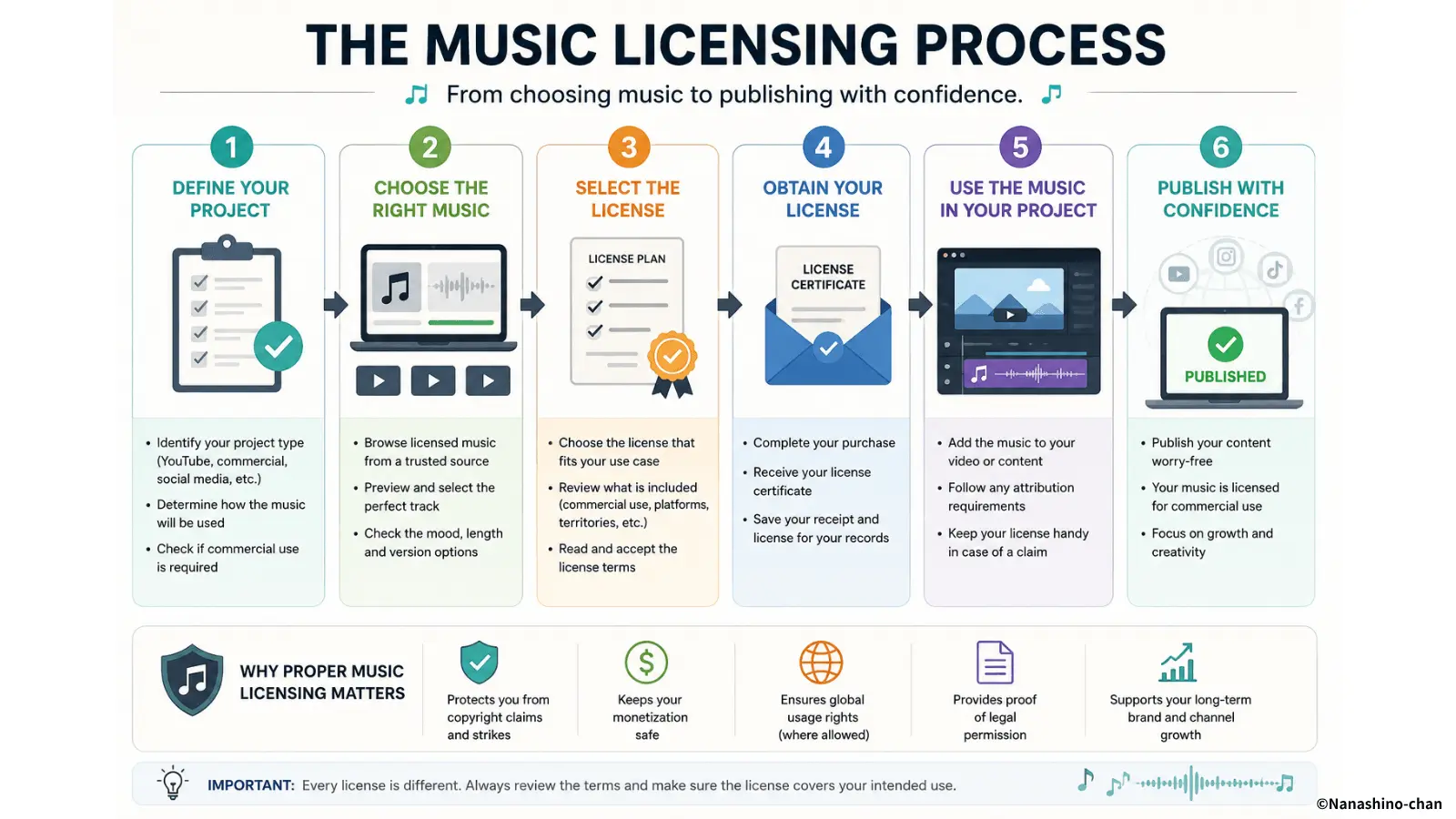
A Practical Motion Comic Music Workflow
Define the Format
Identify whether the project is a teaser, character video, voice comic, full episode, vertical clip, or advertisement.
Map the Story
Mark dialogue, narration, character entrances, emotional shifts, reveals, action, transitions, and the ending.
Choose the Music Direction
Select a mood, genre, intensity, tempo, and arrangement that supports the story and voice performance.
Confirm Distribution
List every planned website, platform, app, monetized channel, client account, advertisement, and partner channel.
Select the License
Choose personal, commercial, sync, or custom permission based on the complete use.
Edit the Music
Use clean phrase edits, scene transitions, volume automation, pauses, and an intentional ending.
Mix the Audio
Balance dialogue, narration, sound effects, ambience, and music across mobile and desktop playback.
Store Documentation
Save the license, receipt, certificate, project details, track data, creative files, and upload URLs.
Review Every New Use
Check the license again before monetizing, advertising, localizing, extending, adapting, or reusing the project.
Industry Participation & Digital Storytelling Context
Nanashino-chan participated in the U-KNOCK 2026 in Japan Summit in Tokyo to explore music, licensing, and IP collaboration opportunities with Korean content companies working across webtoons, web novels, animation, character IP, AI video, and digital storytelling.
The event provided practical context for considering how original music can support motion comics, voice comics, animated panels, character videos, vertical storytelling, adaptation promotion, and cross-border content development.
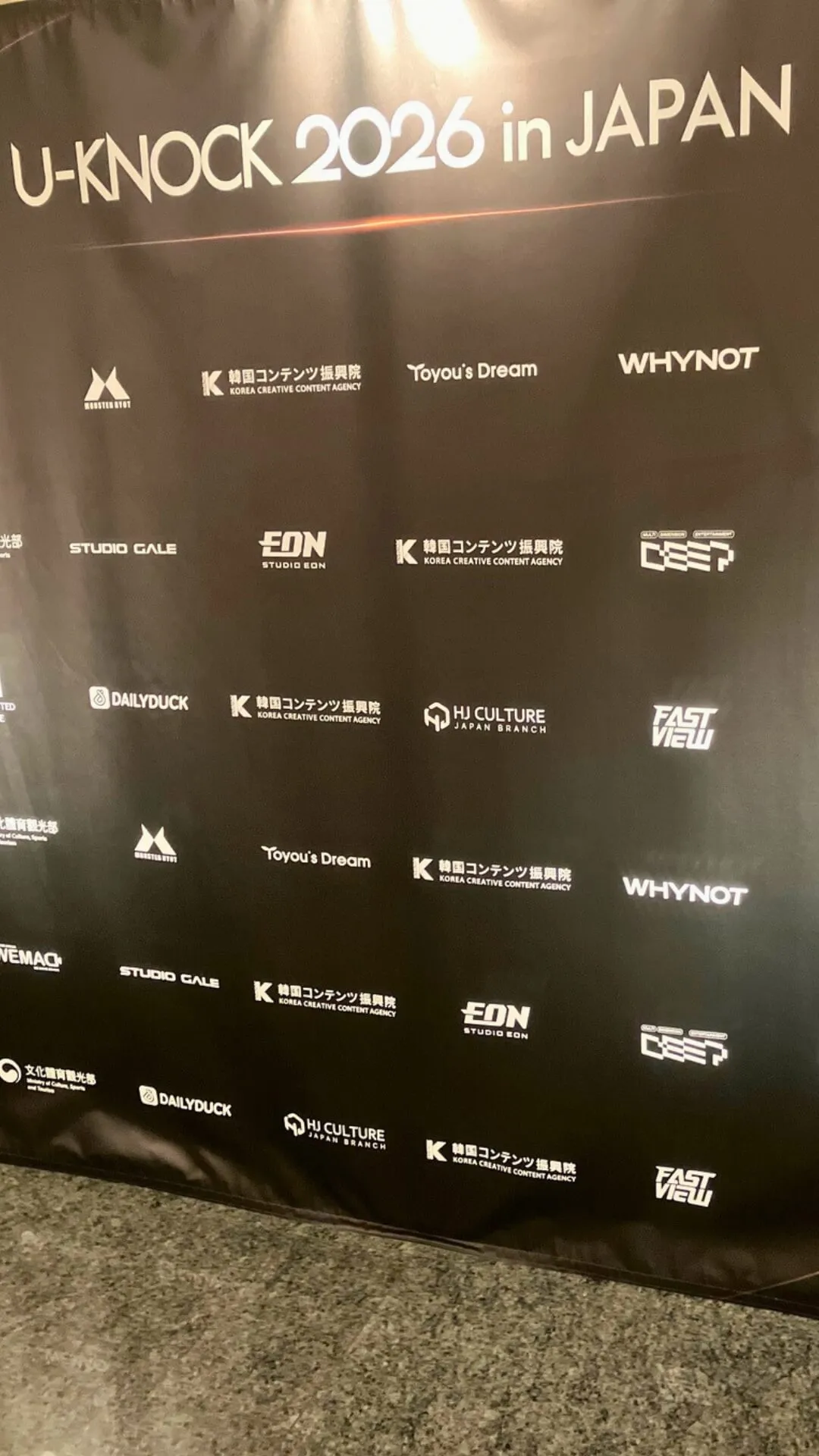
Event and Professional References
- U-KNOCK 2026 in Japan Summit
- Korea Creative Content Agency (KOCCA)
- beSUCCESS Media Group
- Nanashino-chan LinkedIn Profile
- U-KNOCK 2026 Participation Post
Participation does not imply endorsement, sponsorship, partnership, official affiliation, or a confirmed business relationship with KOCCA, U-KNOCK, beSUCCESS Media Group, participating companies, or displayed organizations.
Nanashino-chan Music for Motion Comics
Nanashino-chan provides original lo-fi music for motion comics, voice comics, animated panels, webtoon trailers, digital storytelling, creator videos, business promotion, and selected advertising campaigns.
2,000+ Original Lo-Fi Tracks
The catalog includes lo-fi hip hop, chillhop, jazzhop, ambient, chillwave, synthwave, emotional, urban, calm, and reflective music.
Dialogue-Friendly Options
Many tracks are suitable for background use beneath narration, voice acting, captions, transitions, and visual storytelling.
Direct Rights Workflow
Nanashino-chan manages the offered original recordings and underlying compositions, simplifying many standard licensing discussions.
Commercial Creator Licensing
Available for eligible monetized videos, creator projects, business content, client-facing media, and defined commercial uses.
Campaign Sync Licensing
Available for eligible paid advertisements, social campaigns, launch activity, and time-limited promotional synchronization.
Custom Series Review
Studios, publishers, agencies, and IP owners can discuss recurring episodes, adaptations, platform integration, and longer distribution.
Quick License Decision Guide for Motion Comics
Choose the licensing direction according to the project’s commercial purpose, number of episodes, distribution, advertising method, client structure, and future reuse.
| Project Situation | Likely Licensing Direction | Review Before Publishing |
|---|---|---|
| Private, unpublished motion test | Internal use may not require public distribution rights, but the music file must not be redistributed or supplied to unrelated parties | Confirm that the video will remain private and will not be used for promotion, client delivery, monetization, or advertising |
| Non-commercial personal motion comic | Personal Use License when the project is genuinely non-commercial and remains within the applicable terms | Check portfolio promotion, commissions, crowdfunding, monetization, sponsorship, client involvement, and business activity |
| Monetized motion comic episode | Commercial Creator License when monetized video and the relevant platform are included | Confirm the licensed buyer, title, episode, channel, platform, and permitted number of projects |
| Official organic studio or publisher upload | Commercial Creator License when business video and organic social promotion are covered | Confirm client use, publishing account, platform distribution, localization, and future promotional versions |
| Paid motion comic advertisement | Sync License or campaign-specific agreement | Confirm advertiser, campaign period, paid platforms, territory, creative versions, and permitted archive period |
| Recurring motion comic series | Custom License or broader episodic-use agreement | Confirm the number of episodes, seasons, titles, tracks, platforms, territories, term, and monetization model |
| Motion comic expanded into animation | Custom license review before reuse | Confirm whether the existing permission includes animation, broadcast, streaming, platform integration, games, audio drama, or adaptation promotion |
| Exclusive character or series theme | Separate custom negotiation | Confirm exclusivity, ownership, competitor restrictions, term, territory, media, and whether the track remains available to other licensees |
The length of the video does not determine the license by itself. A 15-second paid advertisement may require broader commercial permission than a ten-minute private test video.
Frequently Asked Questions
What kind of music works for motion comics?
Music should support character emotion, dialogue, narration, panel movement, scene transitions, and story pacing without overwhelming the artwork or voices. Lo-fi, ambient, jazzhop, piano, electronic, and cinematic hybrid music can work depending on the genre and scene.
Do motion comics need a music license?
Public, monetized, promotional, client-funded, commercial, and advertising uses should have permission covering the recording, composition, synchronization with visual content, platforms, and intended reuse.
Can one license cover several episodes?
Not automatically. A single-project license may cover only one defined video or title. Repeated use across several episodes, seasons, characters, or properties may require broader or custom licensing.
Can Instagram or TikTok music be used in a motion comic?
In-app music access should not automatically be treated as a portable commercial license. Cross-platform reuse, monetization, client delivery, paid advertising, and full-length episodes may require separate permission.
How loud should the music be under voice acting?
There is no universal volume setting. Dialogue and narration should remain clear on mobile speakers, headphones, laptops, and other common devices. Volume automation is usually more effective than one fixed music level.
Can music be trimmed or looped?
It depends on the license. Many audiovisual licenses permit basic trimming, fading, looping, and synchronization edits while restricting remixing, stems, standalone derivatives, and major alterations.
Does a trailer license cover a full motion comic?
Not necessarily. A short promotional trailer, full episode, recurring series, paid campaign, and animated adaptation are materially different uses and may require different permission.
Can Nanashino-chan music be used for motion comics?
Nanashino-chan offers original music and licensing options for eligible motion comics, voice comics, animated panels, webtoon trailers, organic business videos, monetized content, and selected paid campaigns.
Official Platform Music Resources
Platform features, commercial catalogs, account restrictions, and advertising rules can change. Review the current official guidance before relying on in-app music for a motion comic, client project, monetized episode, or paid campaign.
- Meta Music Guidelines
- Meta Sound Collection
- TikTok Commercial Use of Music
- TikTok Commercial Music Library
- YouTube Audio Library Help
This page provides general educational information and does not constitute legal advice. The applicable music license, platform terms, production agreement, and local law determine the final rights position.
Choose a Nanashino-chan License for a Motion Comic
Nanashino-chan offers licensing options for eligible personal projects, monetized creator content, commercial videos, business social media, client projects, and paid campaigns.
Personal Use License
For eligible non-commercial projects that do not involve monetization, client delivery, business promotion, advertising, sponsorship, or commercial campaign use.
Commercial Creator License
For eligible monetized videos, creator projects, business social media, client-facing content, and other commercial audiovisual uses included in the license terms.
1-Month Sync License
For eligible paid advertisements, launch campaigns, promotional distribution, social media advertising, and time-limited synchronization with visual content.
3-Month Sync License
For longer eligible promotional and advertising campaigns requiring an extended campaign period across approved platforms.
Custom Review May Be Required
Recurring episodes, multiple seasons, animated adaptations, permanent platform integration, broadcast, game use, soundtrack release, exclusive rights, and large international campaigns may fall outside standard license products.
Recommended Music Directions for Motion Comics
The Nanashino-chan catalog includes 2,000+ Original Lo-Fi Tracks for romance, slice-of-life, city nights, emotional drama, character development, dialogue scenes, suspense, and reflective storytelling.
Smooth Groove
A warm and polished direction for romance, character introductions, lifestyle scenes, everyday dialogue, and modern visual storytelling.
Vaporwave Streets
A synth-influenced urban direction for city nights, technology, mystery, stylish character scenes, and modern fantasy.
Smooth Transitions
A flexible background direction for panel movement, scene changes, dialogue, title cards, and promotional edits.
Stillness Vibes
A quiet emotional direction for reflection, internal monologue, memory, healing, loneliness, and restrained dramatic scenes.
Lazy Afternoon Vibes
A relaxed direction for slice-of-life stories, cafés, friendships, school scenes, daily routines, and calm character moments.
Soft Lights, Quiet Thoughts
A subtle atmospheric direction for narration, night scenes, emotional distance, reflective dialogue, and introspective storytelling.
Related Motion Comic, Webtoon & Licensing Guides
Continue with related guides about webtoon trailers, creator licensing, digital storytelling, vertical animation, commercial music rights, and proof of permission.
Need Licensed Music for a Motion Comic?
Use original lo-fi music for animated panels, voice comics, character scenes, webtoon adaptations, vertical videos, social promotion, monetized episodes, and paid campaigns.
Choose the license according to the actual project, client, number of episodes, platforms, monetization, advertising method, campaign period, and future reuse.
Home | All Guides | Music | Licensing | Works | About | Contact