Webtoon Rights & Commercial Music Licensing
Music Licensing for Webtoon Creators: Commercial Rights, Social Media & Sync Licensing
Webtoon creators increasingly use music in series trailers, character PVs, motion comics, animated panels, voice comics, short-form videos, launch campaigns, and adaptation announcements.
Choosing a suitable track is only one part of the process. Creators, studios, publishers, editors, and agencies must also confirm that the music license covers the project, client, platforms, advertising method, campaign period, and future reuse.
Direct Answer: When Does a Webtoon Creator Need a Music License?
You should confirm music permission whenever a recording is combined with webtoon artwork, animation, dialogue, captions, narration, advertising, or promotional video.
The required license depends on what the finished content does. A private concept edit, public portfolio video, monetized YouTube trailer, official publisher Reel, client deliverable, paid advertisement, motion comic episode, and animated adaptation do not necessarily require the same permission.
- Identify whether the project is personal, commercial, monetized, or client-funded.
- Confirm whether the music will appear in organic posts, paid ads, or both.
- List every platform where the finished video may be published.
- Check whether the license covers both the recording and composition.
- Confirm the permitted campaign period, territory, and number of projects.
- Keep the license terms, receipt, certificate, and project records.
Who This Music Licensing Guide Is For
The person editing the video is not always the final publisher or advertiser. Music licensing should reflect every party involved in producing, approving, distributing, or monetizing the project.
Independent Webtoon Creators
Creators producing personal teasers, portfolio trailers, crowdfunding videos, character introductions, and social media promotion.
Webtoon Studios
Production teams managing several creators, titles, episodes, promotional formats, localized versions, and adaptation projects.
Publishers & Platforms
Companies publishing official trailers, app campaigns, episode announcements, platform promotions, pitch materials, and IP expansion content.
Video Editors & Motion Designers
Freelancers and production teams delivering character PVs, motion comics, animated panels, Reels, Shorts, and campaign assets to clients.
Agencies & Marketing Teams
Agencies planning paid promotion, launch campaigns, influencer content, branded collaborations, localization, and multi-platform distribution.
Animation & Adaptation Producers
Teams developing voice comics, vertical animation, web animation, audio drama previews, animated adaptations, and recurring series.
Webtoon Projects That Commonly Use Licensed Music
Music licensing requirements are determined by the actual audiovisual use—not simply by calling the content a trailer or social media post.
Series Launch Trailers
Videos introducing a new webtoon title, visual world, main conflict, genre, release date, and publication platform.
Character PVs
Short promotional videos built around a character’s personality, relationship, voice, backstory, costume, or emotional theme.
Episode & Season Teasers
Cliffhanger clips, return announcements, special episodes, finale promotions, and short-form preview content.
Motion Comics
Animated panels combining camera movement, transitions, sound effects, captions, narration, and voice acting.
Voice Comics
Digital comics that add performers, character dialogue, narration, sound design, and background music.
Organic Social Promotion
Unpaid promotional posts published by creators, studios, publishers, or businesses through Reels, TikTok, Shorts, and other social channels.
Paid Advertising
Boosted posts, conversion campaigns, app-install ads, launch promotions, retargeting videos, and sponsored distribution.
Publisher Presentations
Business matching materials, investor presentations, licensing pitches, exhibition reels, and adaptation proposals.
Adaptation Announcements
Videos introducing animation, drama, game, audio, merchandise, translated editions, or other expansions of a webtoon IP.
Start With the Intended Use, Not the File Type
The same MP4 video may require different permission depending on who publishes it, why it is distributed, and whether money is spent to reach an audience.
Define the Project
Identify the title, video format, client, publisher, production team, and final rights holder.
Define the Business Purpose
Separate personal use, portfolio use, monetized content, business promotion, client work, and advertising.
Define Distribution
List social platforms, websites, apps, landing pages, presentations, advertisements, and partner channels.
Define Time & Territory
Determine whether the use is one-time, campaign-based, recurring, permanent, domestic, regional, or worldwide.
Define Future Reuse
Consider localization, cutdowns, trailers, paid ads, adaptation promotion, archived posts, and later campaigns.
Choose the License
Select personal, commercial, sync, or custom permission based on the complete use—not the initial upload alone.
A video that begins as an unpaid social post may later become a paid advertisement, publisher asset, localized campaign, app-store creative, or client deliverable. The music license should be reviewed before each material change in use.
Personal, Portfolio, Commercial & Advertising Use
| Use Category | Webtoon Example | Typical Licensing Direction | Main Question |
|---|---|---|---|
| Private development | An internal mood test, storyboard draft, or unpublished concept video | May not require public distribution rights, but the music still should not be redistributed or supplied to unrelated parties | Will the video remain private and internal? |
| Non-commercial personal use | A creator shares a personal fan-style concept or non-monetized original-project teaser without business promotion | A personal or non-commercial license may be suitable when the precise use is permitted | Is the content genuinely non-commercial? |
| Portfolio use | An artist, editor, animator, or creator displays a completed teaser to demonstrate professional skills | The license must expressly allow portfolio display and should define whether client or fictional projects are included | Does the portfolio promote paid professional services? |
| Organic commercial use | A creator, publisher, studio, or business posts an unpaid trailer promoting an official webtoon | A Commercial Creator License may be suitable when business social promotion is covered | Is the post promoting a product, service, title, platform, or business? |
| Monetized content | A trailer or motion comic is published on a monetized video channel | Use a license that expressly covers monetization and the relevant platform | Is revenue generated directly or indirectly from the content? |
| Client work | An editor or agency produces a trailer for a publisher, platform, studio, or IP owner | The license should cover client delivery, the final publisher, and intended distribution | Who is the licensed party and who will publish the finished video? |
| Paid advertising | The trailer is used in promoted posts, social ads, app-install campaigns, or paid audience acquisition | A Sync License or campaign-specific agreement is generally the safer direction | What advertiser, campaign period, media, platforms, and territories are covered? |
| Recurring series use | The music appears across multiple motion comic episodes, animated shorts, or an ongoing web series | A custom or broader recurring-use agreement may be necessary | How many episodes, versions, years, and distribution channels are included? |
These categories are practical planning concepts rather than universal legal classifications. The final license terms control the permitted use.
Three Music Rights Questions Every Webtoon Creator Should Ask
Before publishing a trailer, motion comic, character PV, or campaign video, separate the project into three rights questions. These questions are related, but they are not interchangeable.
1. Can You Use the Recording?
This concerns the specific audio recording placed in the video. Permission may come from the recording owner, label, distributor, artist, music library, or another authorized licensor.
2. Can You Use the Composition?
This concerns the underlying musical work, including the melody, harmony, and composition. The composition may be controlled separately from the recording.
3. Can You Synchronize It With Visuals?
This concerns combining music with webtoon artwork, animation, captions, narration, dialogue, trailers, advertising, and other visual content.
Owning an Audio File Is Not the Same as Owning the Rights
Buying a download, subscribing to a streaming service, finding a song inside a social platform, or receiving an audio file from an editor does not automatically grant permission to synchronize that recording with a commercial webtoon project.
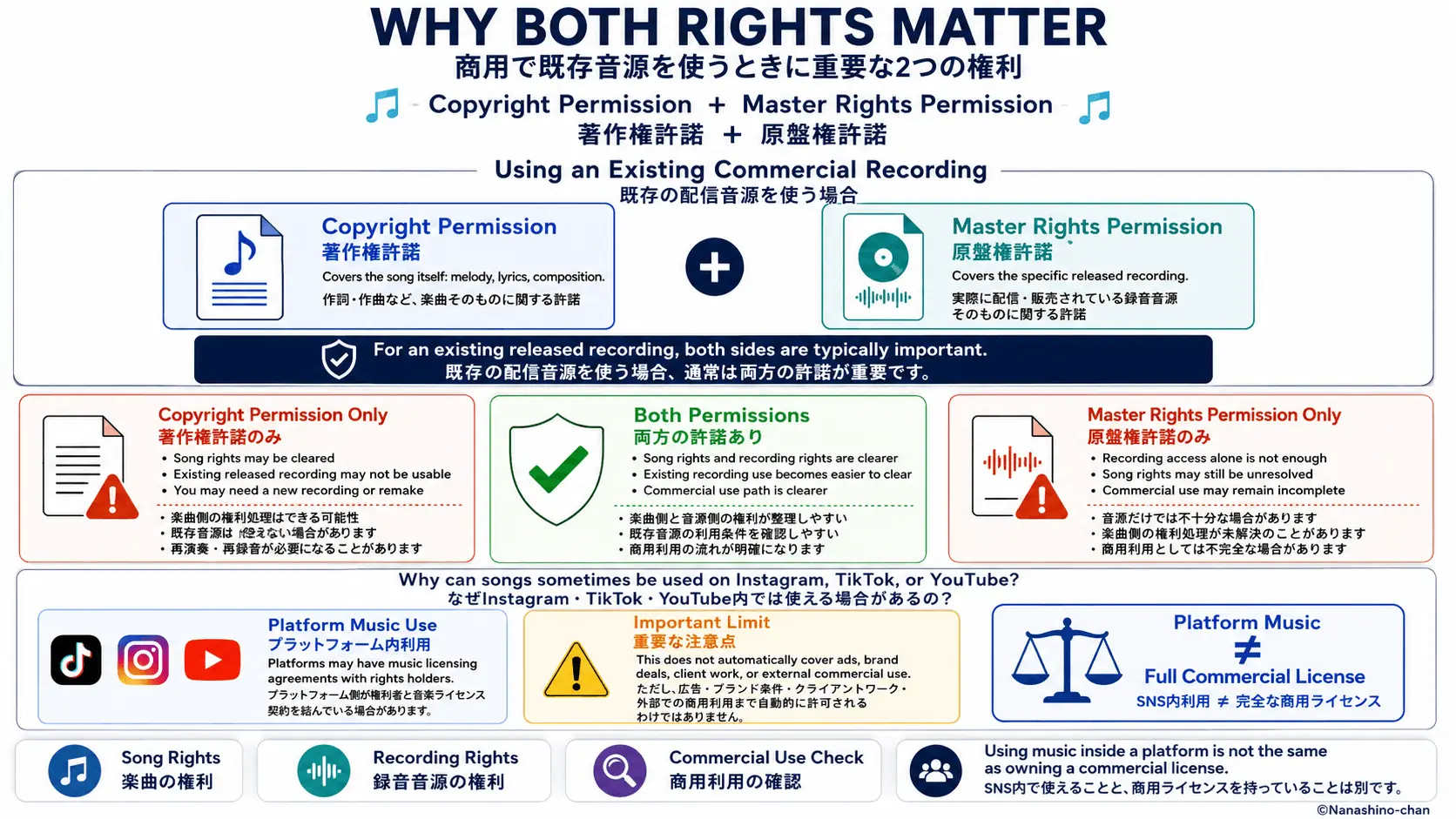
Master Rights, Composition Rights & Synchronization Rights
Music licensing terminology can seem complex because a single song may involve several rights holders and several types of permission.
Master Recording Rights
The master right concerns the specific recorded version used in the project. Two different recordings of the same composition may have different owners and different licensing terms.
Composition Copyright
The composition right concerns the underlying music. A composer, publisher, collecting society, or other rights administrator may be involved.
Synchronization Permission
Synchronization permission allows music to be combined with visual media, such as a trailer, motion comic, animation, advertisement, or presentation.
Public Performance & Platform Use
Platforms, broadcasters, venues, and collecting societies may manage additional rights connected to public communication or performance.
Mechanical & Reproduction Rights
Certain uses may involve reproducing or distributing the composition or recording in ways that go beyond a standard online video license.
Adaptation & Editing Restrictions
Some licenses restrict remixing, extracting, reselling, translating lyrics, creating derivative works, or making the music available as a standalone file.
Nanashino-chan directly manages the original recordings and underlying compositions offered through its licensing workflow. This can simplify standard commercial licensing because the project does not need to begin by contacting separate recording and composition owners.
Direct control of the offered music rights does not mean that every possible use is automatically included. The applicable license still determines the permitted media, project type, campaign period, platforms, territory, and restrictions.
Why Famous Songs Are Difficult for Webtoon Promotion
A well-known song may create immediate recognition, but that recognition does not make the song easy to clear for a commercial webtoon trailer.
Multiple Rights Holders
The master recording and composition may be controlled by different labels, publishers, songwriters, and administrators.
Campaign-Specific Approval
Approval may depend on the title, story, advertiser, territory, platform, campaign length, audience, and creative treatment.
Higher Cost
Recognizable commercial recordings can require significant licensing fees, minimum guarantees, negotiations, and legal review.
Longer Clearance Time
A launch schedule may be delayed while several parties review the request or while the production team waits for written permission.
Limited Reuse
Permission for one trailer or one territory may not cover cutdowns, translations, paid advertising, future seasons, or adaptation campaigns.
No Guaranteed Approval
Even a well-funded project may be declined because of brand conflicts, exclusivity, artist policy, story context, or rights availability.
Original independently controlled music can offer a more direct licensing route for webtoon creators who need clear documentation, faster approval, and practical use across social promotion, client work, and campaign assets.
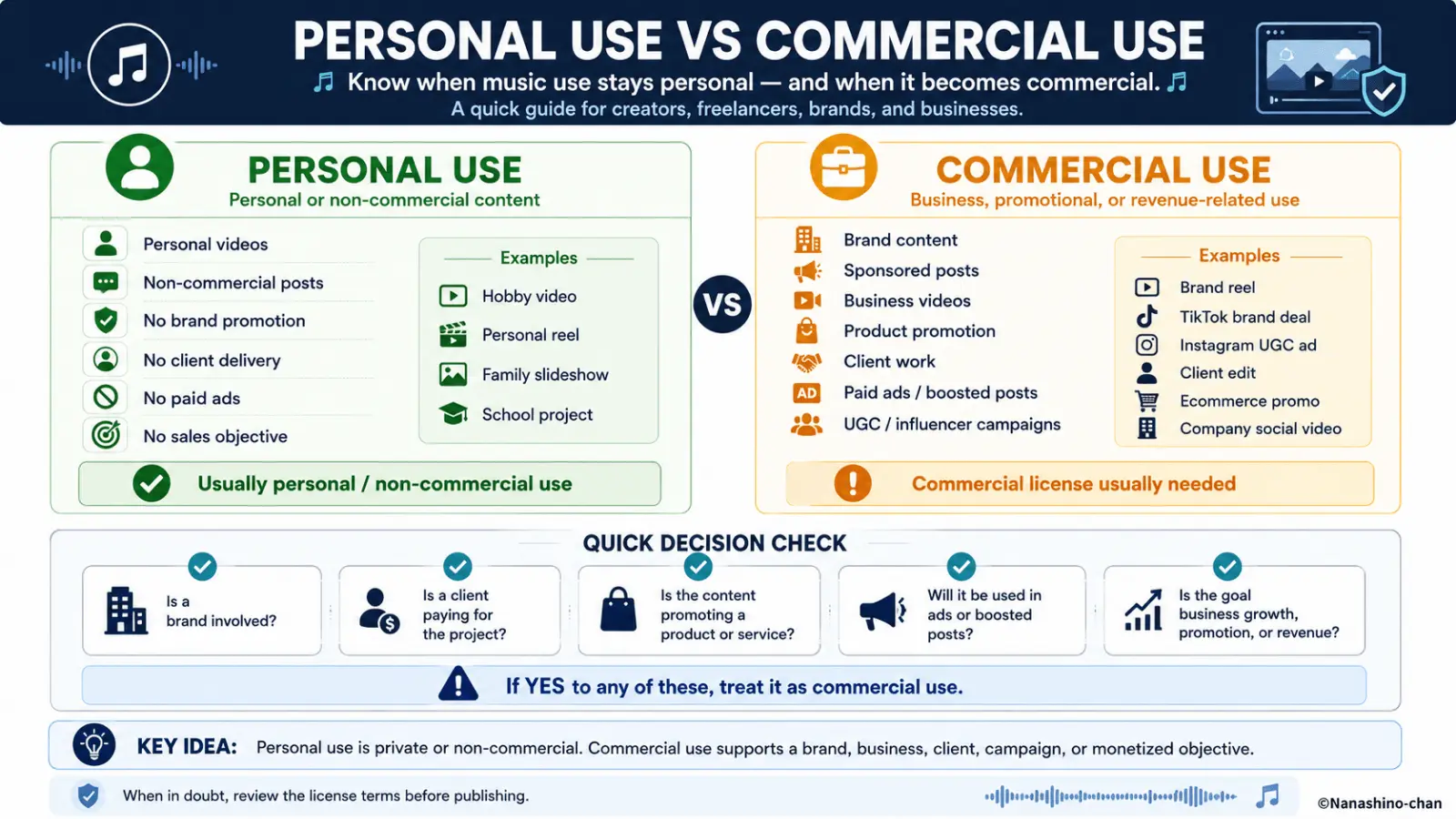
When a Webtoon Project Becomes Commercial
Commercial use is broader than direct ticket sales or paid downloads. A free-to-view trailer can still serve a commercial purpose.
- The video promotes an official webtoon, app, platform, publisher, studio, agency, or business.
- The creator earns advertising revenue, sponsorship income, subscriptions, commissions, or client fees.
- The trailer supports crowdfunding, preorders, merchandise, paid chapters, or membership sales.
- The content is published on a monetized channel or commercial account.
- The video is delivered to a client, publisher, platform, or rights holder.
- The trailer is used to obtain commissions, production work, licensing deals, or professional opportunities.
- Advertising spend is used to boost, sponsor, or distribute the video.
- The project promotes an adaptation, event, product, collaboration, or business campaign.
Free Access Does Not Automatically Mean Non-Commercial
A trailer may be free for viewers while still promoting a monetized title, paid service, commercial platform, publisher, client, or future licensing opportunity.
Music Licensing by Webtoon Production Scenario
| Production Scenario | Who Publishes? | Rights Concern | Recommended Planning |
|---|---|---|---|
| Creator publishes an original teaser | The independent creator | Personal versus commercial purpose, monetization, platform use, and future reuse | Choose a license based on whether the project promotes professional or commercial activity |
| Freelance editor creates a character PV | The client, studio, or publisher | Client use, final rights holder, portfolio display, distribution, and paid promotion | Confirm whether the license follows the editor, the client, the project, or a defined combination |
| Studio produces several episode teasers | The webtoon studio | Multiple videos, repeated use, project quantity, team access, and recurring publication | Confirm the number of projects, titles, episodes, platforms, and permitted reuse |
| Publisher launches a new title | The publisher or platform | Business promotion, official distribution, localization, app marketing, and partner channels | Use a commercial or campaign license that matches the full launch plan |
| Agency manages paid social advertising | The advertiser, agency, or media account | Paid media, campaign period, advertiser identity, ad versions, territory, and audience targeting | Use a sync or campaign-specific license and document the approved creative versions |
| Production expands into animation | The animation producer, platform, or IP owner | Episodic synchronization, adaptation, long-term distribution, media, territory, and possible exclusivity | Request custom licensing before reusing trailer music in the animated production |
Can Webtoon Creators Use Music From Instagram?
Music available through Instagram should be understood within the context of Meta’s platform tools and current terms. Access to a song does not automatically create a portable commercial license for every business or advertising use.
The available catalog can vary by account type, region, feature, and business context. Music used in an organic Reel may not necessarily be suitable for a paid advertisement, client deliverable, website video, YouTube upload, or reusable campaign asset.
- A song visible to a personal account may not be available to a business account.
- Music availability may differ by country or account configuration.
- Organic use and paid advertising may be subject to different rules.
- Downloading and reposting a video elsewhere may fall outside the original platform context.
- A publisher or agency may require separate written proof of permission.
- Platform terms and catalog availability may change after publication.
For a webtoon trailer intended for several platforms, client delivery, long-term reuse, or paid distribution, dedicated music licensing can provide a clearer permission record than relying only on in-app music access.
Can Webtoon Creators Use TikTok Sounds?
TikTok distinguishes between general platform sounds and music intended for commercial use. Businesses and creators promoting a product, service, title, platform, or commercial project should review the current commercial-use guidance before selecting music.
A trending sound may be popular and easily available, but popularity does not confirm that it is licensed for a publisher campaign, paid advertisement, agency deliverable, app promotion, or cross-platform reuse.
- Confirm whether the account and content qualify as commercial activity.
- Check whether the track appears in TikTok’s applicable commercial music resources.
- Do not assume that permission extends to Instagram, YouTube, websites, or presentations.
- Review the license again before converting an organic post into an advertisement.
- Keep documentation when the trailer is produced for a client or business.
- Avoid extracting platform audio for use as a standalone production asset.
Can Webtoon Creators Use YouTube Audio Library Music?
YouTube Audio Library can be useful for eligible video projects, but creators should review the conditions attached to the selected track and confirm whether attribution is required.
A YouTube-focused music option may not provide the same project-specific documentation, client-use language, campaign scope, or multi-platform clarity as a dedicated commercial music license.
Check Attribution
Some tracks may require specific credit language. Save the exact attribution instructions at the time of use.
Check External Use
Confirm whether the chosen track and applicable terms support the intended use outside YouTube.
Check Client Requirements
A publisher, studio, or agency may request a license certificate, invoice, rights statement, or project-specific documentation.
Check Advertising Scope
Paid campaigns, reusable launch assets, and multi-platform advertising may benefit from more explicit commercial licensing.
Platform Access vs Dedicated Commercial Music License
| Question | In-App Platform Music | Dedicated Commercial License |
|---|---|---|
| Where can the music be used? | Usually connected to the relevant platform, feature, account type, catalog, and current terms | Defined by the written license, including eligible platforms and media |
| Can the video be reused elsewhere? | Cross-platform permission may be unclear or limited | Reuse can be expressly included or excluded in the agreement |
| Can it be used in paid advertising? | May require separate commercial resources, restrictions, or approval | A sync or advertising license can expressly define paid campaign use |
| Can it be delivered to a client? | The platform tool may not provide project-specific client licensing documentation | The license can identify the buyer, project, client, and permitted distribution |
| What proof can be kept? | Platform terms, screenshots, account records, and applicable music information | License terms, invoice or receipt, certificate, track data, and project records |
| Can the permission change? | Catalog availability and platform terms can change | The rights are governed by the license agreed at the time of purchase or approval |
Commercial Creator License vs Sync License for Webtoon Projects
Both licenses may allow music to appear with visual content, but they are designed for different commercial situations.
Commercial Creator License
Designed for eligible commercial creator videos, monetized content, business social media, client-facing media, and other uses included in the applicable terms.
Sync License
Designed for eligible paid advertising, campaign-based promotion, launch activity, sponsored distribution, and time-limited synchronization with commercial visual media.
Custom License
Designed for uses outside standard products, including recurring episodes, animated adaptations, platform integration, broadcast, large distribution, exclusivity, or extended campaigns.
| Project | Commercial Creator License | Sync License | Custom Review |
|---|---|---|---|
| Organic official webtoon Reel | Potentially suitable when business social promotion is included | Usually unnecessary unless paid distribution is involved | May be needed for unusual platform or client requirements |
| Monetized YouTube trailer | Potentially suitable when monetized video is included | May apply when the upload is part of a paid promotional campaign | Review if the project includes extensive client, platform, or broadcast use |
| Publisher launch advertisement | Organic versions may be covered separately | Generally the more appropriate direction for paid campaign use | Review large territories, long terms, or unusual media |
| Motion comic episode | May be suitable for a defined single project | Relevant when the episode is distributed as paid advertising | Review recurring or multi-episode use |
| Animated web series | Usually insufficient for an ongoing production without explicit recurring rights | Campaign promotion may be licensed separately | Recommended for episodic synchronization and long-term distribution |
| Exclusive title theme | Standard non-exclusive terms generally do not provide exclusivity | Campaign rights do not automatically create exclusive ownership | Required for exclusivity, buyouts, or specially commissioned terms |
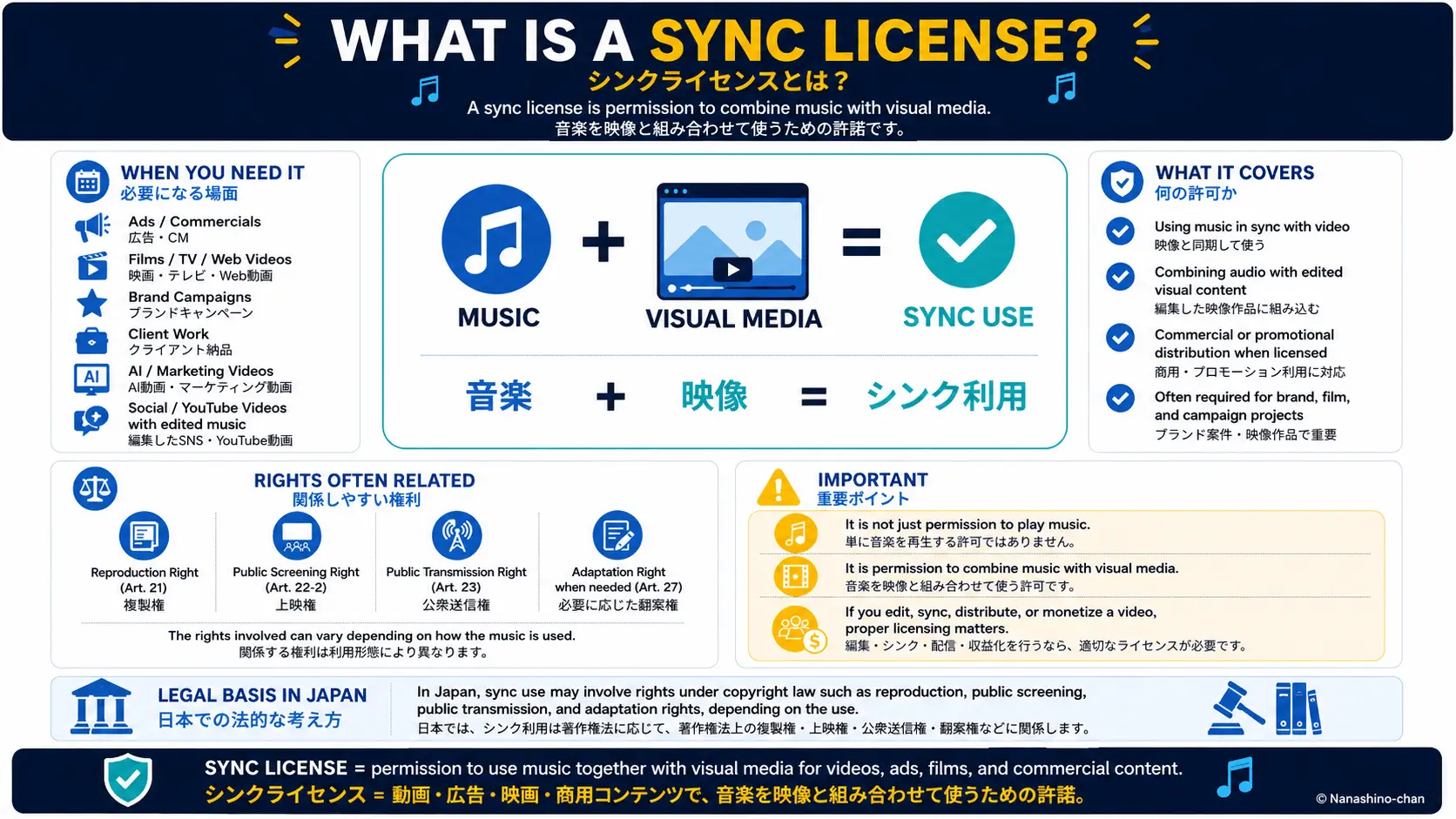
What a Webtoon Sync License Should Clarify
- The licensed track and version of the recording.
- The webtoon title, campaign, trailer, or project name.
- The advertiser, publisher, studio, creator, or authorized client.
- The approved platforms, media, websites, apps, and social channels.
- The campaign start date, end date, and permitted archive period.
- The territory or geographic distribution scope.
- Whether paid social, boosted posts, and performance advertising are included.
- Whether multiple edits, cutdowns, languages, and aspect ratios are permitted.
- Whether agencies, editors, and production partners may access the music.
- Whether the license is exclusive or non-exclusive.
- How credit, reporting, Content ID, and proof of permission are handled.
A 15-second advertisement and a 60-second trailer may use the same track, but the agreement should clarify whether both creative versions belong to one approved campaign.
When Standard Licensing May Not Be Enough
Some webtoon projects require broader negotiation because the music becomes part of the IP production rather than a single promotional video.
Recurring Motion Comic Episodes
Repeated synchronization across several episodes may require a series-based agreement rather than a single-video license.
Animated Adaptation
Permanent use inside an animated production involves broader media, territory, term, and distribution considerations.
Platform Integration
Music embedded in a reading app, interactive product, game, website experience, or content platform may require custom permission.
Broadcast & Theatrical Use
Television, cinema, festival screening, transportation media, and other offline distribution may fall outside standard online terms.
Exclusive Music Rights
Exclusivity, category restrictions, competitor restrictions, and ownership transfers require separate negotiation.
Large International Campaigns
Long campaign periods, broad territories, substantial media spend, and many localized creatives may require custom scope.
Music License Documentation for Webtoon Creators
A license is most useful when the project team can prove what music was used, who obtained permission, which project was approved, and where the finished content may be distributed.
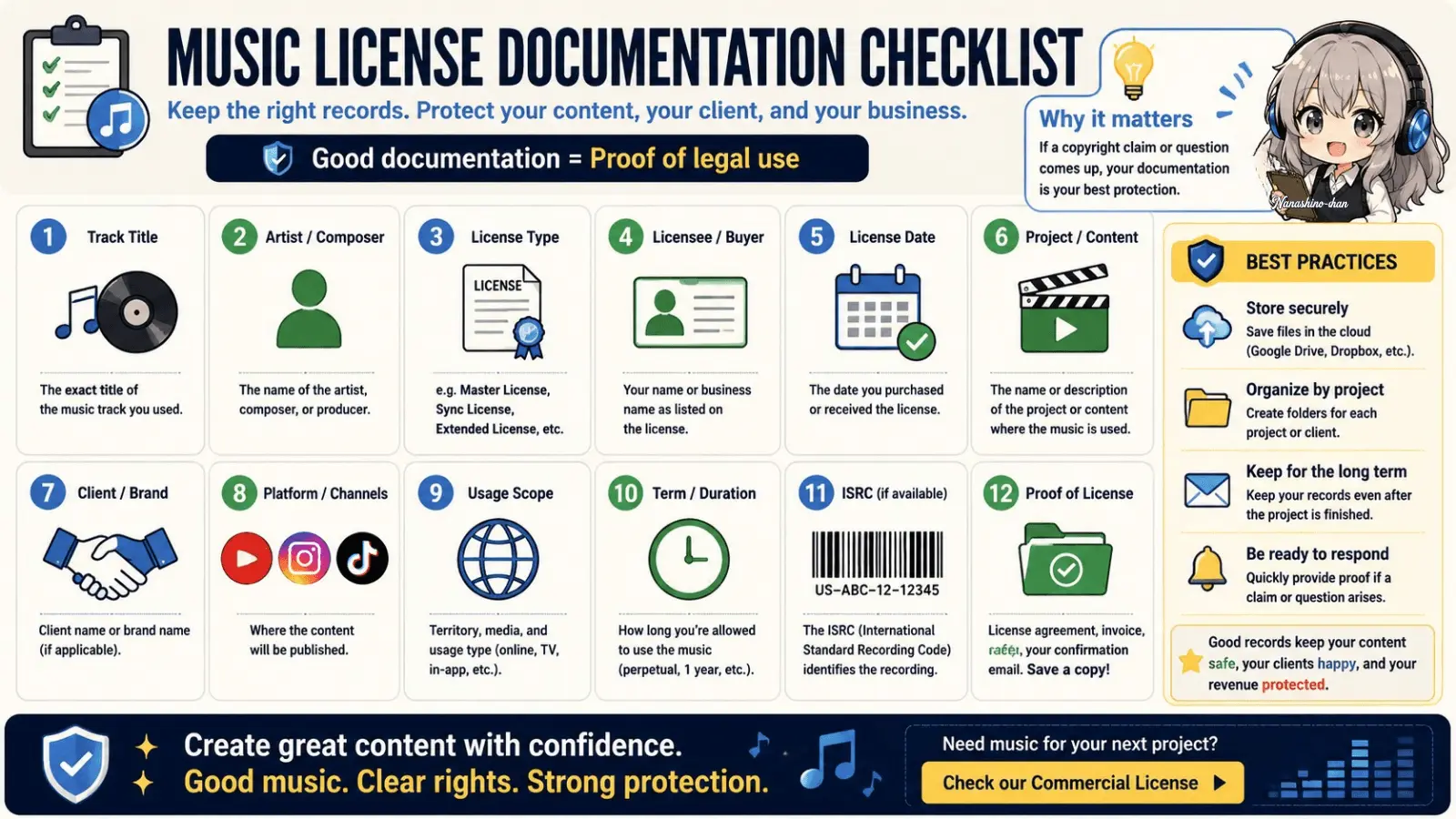
Track Identification
Record the track title, artist name, album or release URL, ISRC when available, version, edit length, and exact audio file used.
License Record
Save the license name, purchase date, buyer, receipt or invoice, certificate, terms, restrictions, and licensing contact.
Project Record
Record the webtoon title, trailer name, episode, character, campaign, client, studio, publisher, editor, and final rights holder.
Distribution Record
List every platform, website, app, presentation, paid media channel, partner account, territory, and publication date.
Campaign Record
For advertising, save the campaign start and end dates, advertiser, agency, budget category, approved creative versions, and territories.
Final Creative Files
Keep copies of the approved master video, vertical cutdowns, subtitle versions, localized edits, trailers, teasers, and advertisements.
What a Music License Certificate Should Show
A certificate should not replace the full license terms, but it can provide a concise record that is easier to share with publishers, agencies, clients, platform teams, and production partners.
- The name of the music licensor or rights holder.
- The licensed track or catalog reference.
- The license type and permitted use category.
- The name of the buyer or licensed organization.
- The purchase or issue date.
- The approved commercial, social, advertising, or synchronization scope.
- The applicable term, platform, territory, or campaign period when relevant.
- A reference to the full license terms.
- Contact information for verification or rights questions.
A Receipt Alone May Not Explain the Rights
A payment receipt proves that a transaction occurred, but it may not explain whether the music can be used in client work, monetized video, paid advertising, recurring episodes, or cross-platform promotion.
Keep the receipt together with the full license terms and any certificate or written approval.
Licensing Music for Client Webtoon Projects
Client work requires more planning because the person buying the music, the person editing the video, and the organization publishing the finished project may be different parties.
The Buyer
The individual or organization that purchases or receives the music license.
The Production Team
The editor, motion designer, animator, agency, studio, or contractor that accesses and uses the music during production.
The Final Publisher
The creator, publisher, webtoon platform, advertiser, IP owner, or business that distributes the final content.
A suitable client license should explain whether the buyer may create work for another party, whether the final client may publish the video, and whether the music file may be transferred to the client or only embedded in the completed production.
Do Not Transfer the Standalone Music File Without Permission
Many music licenses permit delivery of a completed video but do not permit the buyer to resell, redistribute, upload, share, or transfer the original music file as a standalone asset.
Questions Agencies and Freelancers Should Confirm
- Who will purchase the music license?
- Who is named as the licensed party?
- Which client or webtoon title is covered?
- Can subcontractors and production partners access the track?
- Can the completed project be delivered to the client?
- Can the creator or agency show the work in a portfolio?
- Are organic social posts included?
- Are monetized channels included?
- Are paid ads, boosted posts, or sponsored placements included?
- Can the client create additional edits from the approved video?
- Can the music be reused for another title, season, or campaign?
- Who is responsible for storing the license documentation?
Music Licensing for Localized Webtoon Campaigns
Webtoon content frequently moves across languages, territories, platforms, and promotional formats. Localization can create new versions of the same audiovisual asset even when the underlying artwork remains unchanged.
Translated Captions
Confirm whether subtitle and text changes are treated as permitted versions of the original project.
Localized Voice Acting
New narration or character voices may create additional versions that should remain within the approved license scope.
Regional Social Accounts
A publisher may distribute the same trailer through separate country, language, or platform accounts.
Territory Expansion
A campaign licensed for one market may need review before launch in additional countries or worldwide.
Platform-Specific Cutdowns
TikTok, Reels, Shorts, app-store videos, and website banners may use different durations and aspect ratios.
Partner Distribution
Adaptation partners, licensors, distributors, broadcasters, and regional publishers may need separate authorization.
Localization does not necessarily require a completely new license, but the agreement should permit translated, resized, shortened, and regionally distributed versions when those uses are planned.
Music Licensing for Motion Comics and Voice Comics
Motion comics and voice comics sit between static publishing and full animation. Their licensing needs depend on episode length, publication model, monetization, number of episodes, and distribution strategy.
| Format | Typical Music Use | Licensing Concern | Planning Direction |
|---|---|---|---|
| Short motion comic teaser | Music supports animated panels, captions, transitions, and a final title card | Single project, commercial promotion, platform use, and possible monetization | A defined commercial license may be suitable when the exact use is covered |
| Voice comic preview | Music plays under narration, dialogue, character voices, and sound effects | Voice clarity, synchronization, public distribution, and reuse in other versions | Confirm that the license permits audiovisual synchronization and the planned platforms |
| Full motion comic episode | Several music sections support scenes, dialogue, transitions, and narrative development | Longer synchronization, episode distribution, monetization, and possible repeated use | Review whether one project license covers the complete episode |
| Recurring motion comic series | Tracks or themes appear across multiple episodes and promotional cuts | Episode quantity, recurring use, term, audience, monetization, and distribution | A broader or custom series agreement may be required |
| Paid promotional episode | A motion comic is distributed through advertising or sponsored placement | Paid media, advertiser, campaign period, versions, territory, and platform | Use a sync or campaign-specific license |
Music Licensing for Webtoon Adaptations
Music cleared for a webtoon trailer should not automatically be carried into an animation, audio drama, game, live-action production, or other adaptation.
Animated Series
An animated series may require episodic synchronization rights, longer terms, wider territories, broadcast rights, and platform distribution.
Audio Drama
Audio-only storytelling may involve different reproduction, distribution, download, podcast, or platform considerations.
Game Adaptation
Interactive use, looping, implementation in software, downloads, updates, and gameplay synchronization usually require custom permission.
Live-Action Adaptation
Film, streaming, television, festival, theatrical, and promotional rights can extend beyond a standard web video license.
Character Merchandise
A video license does not automatically allow music to be sold, bundled, downloaded, or embedded in physical or digital products.
Official Soundtrack
Releasing music as a soundtrack, album, download, NFT, bonus file, or standalone product requires separate authorization.
Content ID and Webtoon Video Uploads
A valid music license and an automated platform claim are related but separate issues. Content identification systems may detect a recording even when the uploader has permission to use it.
Copyright Claim
A platform may identify the music and apply monetization, tracking, visibility, or territorial rules according to the rights-management settings.
Copyright Strike
A formal removal request or strike is generally more serious than an automated Content ID claim and may affect the account.
License Evidence
The uploader may need the license, receipt, certificate, track information, project details, and dispute instructions.
- Check whether the track may be registered with a content identification system.
- Save the license before publishing the video.
- Use the licensed buyer or organization name consistently.
- Keep the final upload URL and platform claim details.
- Follow the licensor’s dispute or release procedure.
- Do not submit false ownership disputes or claim that you created the music.
- Allow enough time for review before an important campaign launch.
A Claim Does Not Automatically Mean the License Is Invalid
Automated systems identify audio matches. They do not always know which uploader purchased permission for a particular project. The license record helps establish authorized use.
Common Music Licensing Mistakes in Webtoon Projects
Using a Trending Sound Without Reviewing Rights
Popularity, availability, and ease of access do not prove that a song is cleared for business promotion or advertising.
Buying the Music After Publication
Obtaining permission after a dispute, client complaint, or campaign launch may not retroactively authorize earlier use.
Confusing Personal and Commercial Use
A public portfolio, official trailer, monetized channel, client project, or crowdfunding video may have a commercial purpose.
Ignoring the Final Client
A freelancer’s personal license may not cover publication by a studio, publisher, platform, or advertiser.
Assuming One Platform Covers Every Platform
Permission inside one social platform does not automatically transfer to websites, apps, YouTube, presentations, or other services.
Turning an Organic Post Into an Ad
Boosting or sponsoring an existing post can change the licensing context from organic promotion to paid media.
Reusing the Track Across Several Titles
A project-based license may not permit unlimited use across unrelated webtoon titles, clients, seasons, or campaigns.
Failing to Store Proof
Teams may lose the receipt, license terms, track details, and project record after staff, freelancers, or agencies change.
A Practical Music Licensing Workflow for Webtoon Teams
Identify the Rights Holder
Confirm who controls the recording, composition, and authority to grant synchronization permission.
Define the Project
Record the webtoon title, client, production format, trailer purpose, and final publisher.
List Every Intended Use
Include organic posts, monetized uploads, paid ads, websites, apps, presentations, partners, and localization.
Select the License
Choose personal, portfolio, commercial, sync, or custom permission based on the complete use.
Complete the Purchase or Approval
Obtain the written terms before publishing, advertising, delivering, or distributing the project.
Store the Documentation
Save the receipt, license, certificate, track data, project record, campaign dates, and final creative files.
Review the Final Video
Check audio editing, permitted duration, credit, platform requirements, Content ID guidance, and client approval.
Review Every New Use
Check the license again before boosting, localizing, extending, adapting, transferring, or reusing the content.
Industry Participation & Digital Storytelling Context
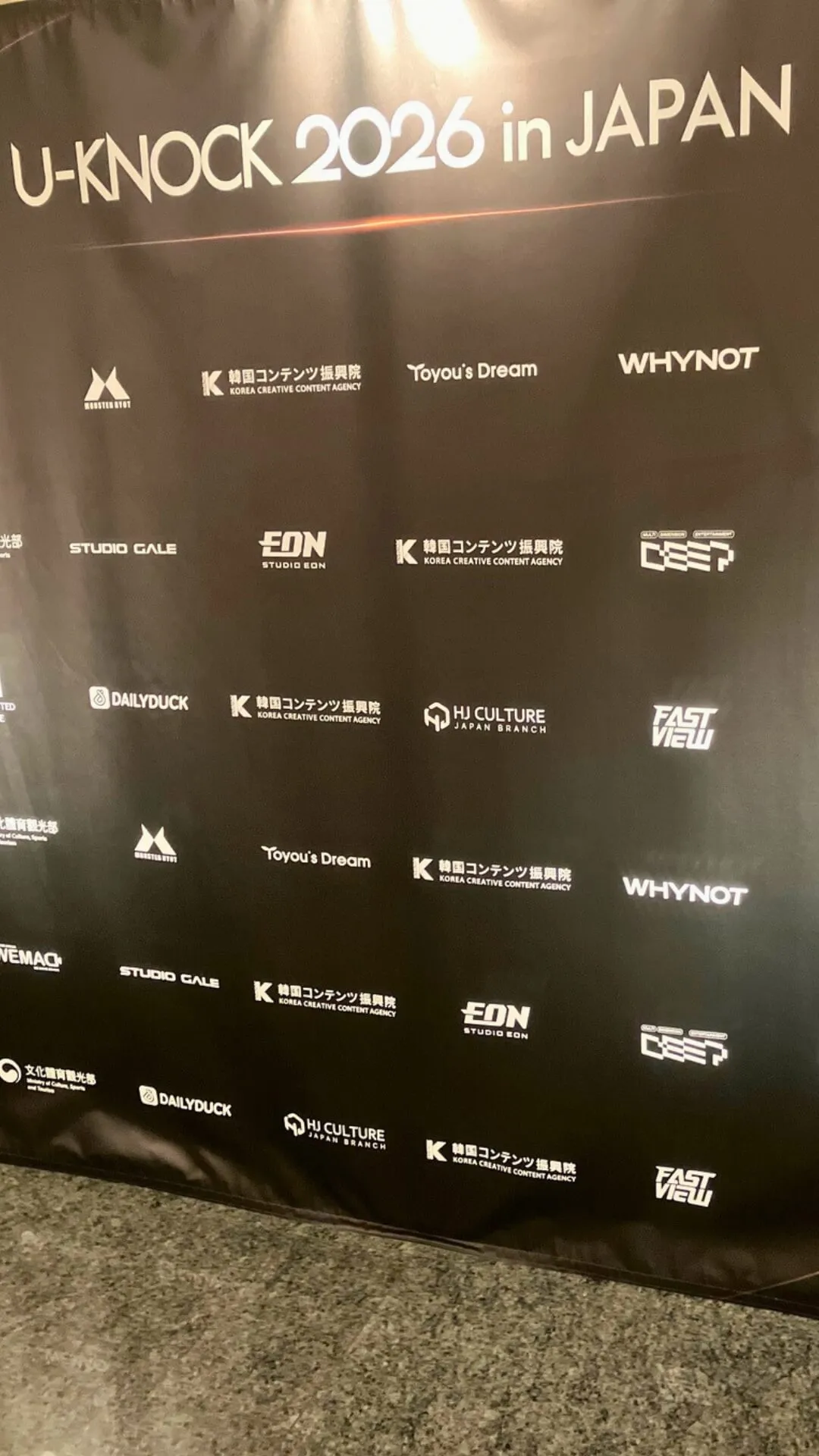
Nanashino-chan participated in the U-KNOCK 2026 in Japan Summit in Tokyo to explore music, licensing, and IP collaboration opportunities with Korean content companies working across webtoons, web novels, animation, character IP, AI video, and digital storytelling.
The event provided practical context for considering how original music and clearer rights documentation can support cross-border webtoon promotion, character videos, motion comics, animated content, social campaigns, and adaptation development.
Event and Professional References
- U-KNOCK 2026 in Japan Summit
- Korea Creative Content Agency (KOCCA)
- beSUCCESS Media Group
- Nanashino-chan LinkedIn Profile
- U-KNOCK 2026 Participation Post
Participation does not imply endorsement, sponsorship, partnership, official affiliation, or a confirmed business relationship with KOCCA, U-KNOCK, beSUCCESS Media Group, participating companies, or displayed organizations.
Nanashino-chan Music Licensing for Webtoon Projects
Nanashino-chan provides original lo-fi music for webtoon trailers, character PVs, motion comics, digital storytelling, creator videos, business promotion, and selected advertising campaigns.
2,000+ Original Lo-Fi Tracks
The catalog includes lo-fi hip hop, chillhop, jazzhop, ambient, chillwave, synthwave, emotional, urban, calm, and reflective music.
Direct Rights Workflow
Nanashino-chan manages the offered original recordings and underlying compositions, simplifying many standard licensing discussions.
Commercial Creator Licensing
Available for eligible creator videos, monetized uploads, business social media, and defined commercial projects.
Campaign Sync Licensing
Available for eligible paid advertisements, social campaigns, launch activity, and time-limited promotional use.
License Documentation
Buyers can retain the applicable terms, Gumroad receipt or invoice, and certificate as evidence of permission.
Custom Project Review
Studios, publishers, agencies, and IP owners can discuss recurring episodes, adaptations, platform use, longer terms, and unusual distribution.
Quick License Decision Guide for Webtoon Creators
Use the project’s commercial purpose, distribution method, and future reuse to identify the most appropriate licensing direction.
| Project Situation | Likely Direction | Review Before Publishing |
|---|---|---|
| Private, unpublished concept test | Internal use may not require public distribution rights, but the audio file must not be redistributed | Confirm that the video will remain private and that no client or commercial party will receive it |
| Non-commercial personal webtoon teaser | Personal Use License when the project is genuinely non-commercial and within the license terms | Check monetization, portfolio promotion, crowdfunding, commissions, sponsorship, and business activity |
| Monetized creator trailer | Commercial Creator License when monetized video and the relevant platform are included | Confirm the licensed buyer, channel, project, platform, and permitted number of uses |
| Official organic publisher or studio post | Commercial Creator License when business social media promotion is covered | Confirm client use, publishing account, cross-platform distribution, and future reuse |
| Paid webtoon advertisement | Sync License or campaign-specific commercial agreement | Confirm advertiser, campaign term, territory, platforms, paid media, and approved creative versions |
| Recurring motion comic or animated series | Custom License or broader recurring-use agreement | Confirm episode quantity, term, media, territories, platform distribution, archive rights, and exclusivity |
| Webtoon trailer reused for adaptation promotion | License review required before reuse | Confirm whether the existing permission covers animation, audio drama, game, live action, broadcast, or partner distribution |
When the same video changes from an organic post into a paid advertisement, or from a creator portfolio piece into an official publisher asset, review the music license again before reuse.
Frequently Asked Questions
Do webtoon creators need a music license?
Webtoon creators should obtain permission whenever music is synchronized with a trailer, character video, motion comic, advertisement, monetized video, client deliverable, or other audiovisual project. The required license depends on whether the use is personal, commercial, organic, paid, client-facing, or part of a recurring series.
What music rights are needed for a webtoon trailer?
A webtoon trailer may involve permission for the specific recording, the underlying composition, and synchronization of the music with visual content. The agreement should also define platforms, term, territory, advertising, client use, and reuse.
Can webtoon creators use music from Instagram or TikTok?
Music available inside a platform should not automatically be treated as permission for every commercial use. Business content, branded promotion, paid advertising, client work, and cross-platform reuse may require different or additional permission.
What license is needed for a paid webtoon advertisement?
Paid advertising generally requires a synchronization or campaign-specific license that defines the advertiser, campaign period, platforms, media, territory, and permitted creative versions.
Does a trailer license cover a motion comic or animated series?
Not automatically. A trailer, motion comic, recurring web series, animated adaptation, and permanent platform integration are different uses. Episodic or long-term use may require broader or custom licensing.
What proof of music permission should creators keep?
Keep the license terms, receipt or invoice, certificate when available, track title, artist, project name, client, platforms, publication date, campaign period, URLs, and copies of the final creative.
Official Platform Music Resources
Platform features, commercial music catalogs, account restrictions, and advertising rules can change. Review the latest official guidance before relying on in-app music for a webtoon trailer, business post, client project, or paid campaign.
- Meta Music Guidelines
- Meta Sound Collection
- TikTok Commercial Use of Music
- TikTok Commercial Music Library
- YouTube Audio Library Help
This page provides general educational information and does not constitute legal advice. The applicable music license, platform terms, project agreement, and local law determine the final rights position.
Choose a Nanashino-chan Music License
Nanashino-chan offers licensing options for personal projects, commercial creator content, business social media, paid advertising, and longer campaign use.
Personal Use License
For eligible non-commercial projects that do not involve monetization, business promotion, paid advertising, client delivery, or commercial campaign use.
Commercial Creator License
For eligible monetized videos, creator projects, business social media, client-facing content, and other commercial uses included in the license terms.
1-Month Sync License
For eligible paid advertisements, launch campaigns, promotional videos, social media advertising, and time-limited synchronization with visual content.
3-Month Sync License
For longer eligible advertising and promotional campaigns requiring a broader campaign period across approved platforms.
Custom Review May Be Required
Recurring motion comic episodes, animated adaptations, web series, platform integration, broadcast, large international campaigns, exclusive rights, and permanent soundtrack use may fall outside standard license products.
Recommended Music for Webtoon Videos
The Nanashino-chan catalog includes 2,000+ Original Lo-Fi Tracks for romance, slice-of-life, city nights, character development, emotional scenes, motion comics, digital storytelling, and modern promotional video.
Smooth Groove
A warm, polished direction for romance, lifestyle stories, character introductions, everyday scenes, and modern publisher content.
Vaporwave Streets
A synth-influenced night-city direction for mystery, technology, urban fantasy, stylish character videos, and late-night narratives.
Smooth Transitions
A flexible background track for motion comics, scene changes, title cards, presentation videos, and visual storytelling edits.
Stillness Vibes
A quiet emotional direction for internal monologue, reflection, memory, healing, separation, and restrained dramatic moments.
Related Webtoon, Digital Storytelling & Licensing Guides
Continue with practical guides about webtoon trailers, motion comics, digital storytelling, commercial social media, advertising rights, and license documentation.
Need Music Rights for a Webtoon Project?
Use original licensed lo-fi music for webtoon trailers, character PVs, motion comics, voice comics, animated panels, social promotion, publisher videos, and paid campaigns.
Choose the license according to the actual commercial purpose, client, platforms, campaign period, advertising method, and future reuse—not simply the length or format of the video.
Home | All Guides | Music | Licensing | Works | About | Contact