Music for YouTube Automation Channels
YouTube automation channels, faceless channels, recurring video formats, AI-assisted video workflows, narration videos, Shorts, podcast clips, and monetized creator channels need music that can be used repeatedly and documented clearly.
If your channel publishes videos at scale, the music choice is not just a creative decision. It affects monetization, Content ID risk, brand safety, workflow consistency, and long-term channel operations.
Important: This Guide Is for Legitimate Recurring YouTube Workflows
The phrase “YouTube automation” can mean different things. This page focuses on legitimate, high-quality recurring video workflows such as faceless educational videos, narration channels, podcast clips, AI-assisted production, Shorts series, productivity videos, study content, and creator businesses.
It is not a recommendation to produce spam, reused content, misleading videos, low-effort mass uploads, or content that violates YouTube policies.
For sustainable YouTube growth, music should support original value, clear storytelling, audience retention, and compliant monetization workflows.
Quick Answer: What Music License Do YouTube Automation Channels Need?
YouTube automation channels and faceless video channels often need music that covers YouTube use, monetization, sync use, commercial use, repeated publishing, Shorts, and Content ID documentation.
The key issue is not only whether the music can be downloaded. The key issue is whether the music can be safely used across many published videos over time.
- YouTube use should cover videos published on a YouTube channel.
- Monetization coverage may be needed when videos are monetized, sponsored, affiliate-supported, or part of a creator business.
- Sync license may be needed because music is combined with visual media, narration, captions, AI visuals, stock footage, or edited video.
- Commercial license may be needed when the channel is operated as a business, brand, client project, or revenue-generating asset.
- Documentation matters because recurring videos can trigger repeated claims if track records are unclear.
日本語:YouTube automation / faceless channel / AI補助の継続投稿チャンネルでは、単に無料で使える音源ではなく、YouTube利用・収益化・Sync利用・商用利用・Content ID対応・継続投稿に耐えるライセンス確認が重要です。
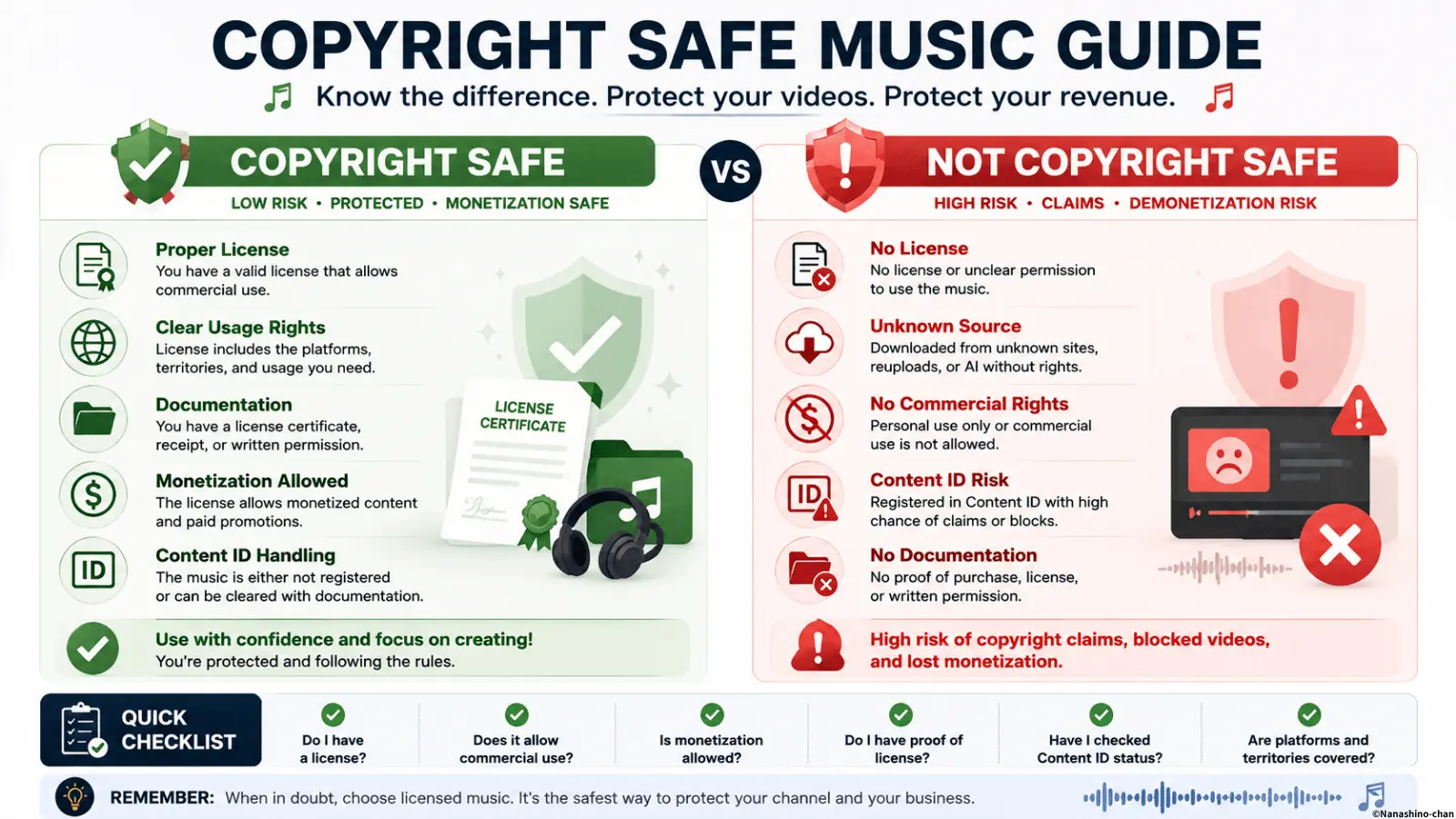
What Are YouTube Automation Channels?
In creator workflows, “YouTube automation channels” often refers to channels that use repeatable production systems instead of filming a person on camera every time.
These channels may use scripts, narration, stock footage, animation, AI visuals, templates, editing systems, freelancers, podcast clips, or batch production workflows.
Examples include:
- Faceless educational videos
- Explainer channels
- AI-assisted narration videos
- Productivity and study channels
- Podcast clip channels
- Motivational narration videos
- Documentary-style edits
- News-style commentary videos
- Calm background video channels
- YouTube Shorts series
- Compilation-style videos with original editing and commentary
- Client-managed recurring YouTube content
- Brand-owned educational channels
Because these channels publish repeatedly, music licensing should be scalable, documented, and clear enough for long-term use.
Why Music Matters in Faceless and Recurring YouTube Videos
Music helps recurring YouTube videos feel consistent, polished, and less empty. It can support narration, pacing, editing rhythm, emotional tone, and retention without becoming distracting.
For faceless channels, music often works as part of the channel identity. Viewers may not see a host on camera, so the sound design becomes more important.
Music can help with:
- Supporting narration and voiceover
- Creating consistent channel atmosphere
- Improving pacing in educational videos
- Reducing silence in AI-assisted edits
- Making Shorts feel more complete
- Adding warmth to faceless videos
- Supporting study, productivity, and calm content
- Improving transitions between sections
- Making recurring formats feel more professional
- Helping long videos feel less static
Lo-fi music can work well because it is subtle, repeatable, and voice-friendly. It supports the video without overpowering narration, captions, or visuals.
Common YouTube Channel Types That Need Licensed Music
Different YouTube automation and faceless channel formats use music differently. The license should match the actual publishing and monetization workflow.
Faceless Educational Channels
Music for explainers, tutorials, documentaries, commentary videos, historical videos, science videos, and narration-based learning content.
AI-Assisted YouTube Videos
Music for AI visuals, AI narration, AI avatars, automated editing workflows, template videos, and recurring AI-assisted production.
YouTube Shorts Series
Music for recurring Shorts formats, short educational clips, daily tips, quote videos, podcast clips, and social-style series.
Podcast Clip Channels
Music for video podcast clips, highlight reels, interview moments, episode teasers, intro/outro clips, and short-form repurposing.
Study and Productivity Channels
Music for Pomodoro videos, study sessions, work-with-me videos, focus videos, calm visuals, and background ambience.
Brand-Owned Channels
Music for company education channels, SaaS explainers, product tutorials, customer education, thought leadership, and recurring brand content.
Music Licensing Checklist for YouTube Automation and Faceless Channels
Before using music in a YouTube automation channel, faceless channel, recurring video series, or AI-assisted production workflow, confirm how the music will be used across videos over time.
The risk is higher when a channel publishes repeatedly, monetizes content, uses the same track across many videos, or relies on a repeatable production system.
- ✔ Will the videos be published on a monetized YouTube channel?
- ✔ Will the music be used repeatedly across many videos?
- ✔ Will the videos include narration, AI voice, stock footage, AI visuals, captions, or templates?
- ✔ Will the content also be cut into YouTube Shorts?
- ✔ Will the videos be used for a brand, business, client, or creator business?
- ✔ Will the channel include sponsorships, affiliate links, product mentions, or ad revenue?
- ✔ Does the license cover YouTube use?
- ✔ Does the license cover monetized videos?
- ✔ Does the license cover sync use?
- ✔ Does the license cover commercial use?
- ✔ Can you provide proof of license if Content ID or a client review occurs?
If the channel is built for repeated publishing, the music license should be clear enough to support long-term use, documentation, and claim review if needed.
Monetization, Content ID, Shorts, and AI-Assisted Production
YouTube automation and faceless channel workflows often involve monetization, repeat publishing, short-form repurposing, AI-assisted visuals, voiceovers, templates, and background music. Each of these can affect music licensing.
Monetized YouTube Videos
If your videos are monetized, sponsored, affiliate-supported, or part of a creator business, commercial licensing should be reviewed. A music source that works for a personal video may not be enough for a revenue-generating channel.
Content ID and Automated Detection
Licensed music can still be detected by YouTube’s automated systems. A Content ID claim does not always mean unauthorized use, but it can affect monetization, visibility, workflow, and client confidence.
For recurring channels, documentation is especially important because the same music may be used across many uploads.
YouTube Shorts
Shorts may involve different music workflows from long-form videos. If you edit music into a video file, reuse clips across platforms, monetize content, or publish branded Shorts, the license should match the full use case.
AI-Assisted Production
AI-generated visuals, AI narration, AI avatars, automated editing, or template-based production do not remove the need to license music used in the final video.
If the channel uses AI-assisted production at scale, music records should be organized carefully so each video can be connected to the track and license used.
Free Music, Subscription Music, Platform Audio, and Direct Licensing
Recurring YouTube workflows often need a reliable music source. Free tracks, platform audio, stock libraries, subscriptions, and direct licenses can all work in some situations, but the terms can differ significantly.
The safest question is not only “Can I use this track?” but “Can I use this track repeatedly across monetized YouTube videos, Shorts, AI-assisted content, and commercial channel workflows?”
| Music Source | Useful For | Risk to Check |
|---|---|---|
| Free music | Drafts, personal projects, experiments, or low-risk videos when terms are clear. | May have unclear ownership, attribution rules, weak documentation, commercial limits, or Content ID risk. |
| YouTube or platform audio | Some in-platform creator workflows depending on the platform rules. | May not cover external edits, multi-platform use, client work, paid ads, or all monetized workflows. |
| Music subscription | Channels that need frequent access to many tracks. | Check cancellation rules, channel registration, old-video coverage, Content ID clearing, client use, and commercial scope. |
| Stock music | YouTube videos, brand videos, explainers, Shorts, and recurring production if the license fits. | Licenses vary by provider, plan, platform, monetization, paid ads, broadcast, and client work. |
| Direct licensed music | Monetized YouTube channels, faceless videos, AI-assisted videos, Shorts, client channels, and commercial recurring workflows. | The license must still match the actual channel, platform, monetization, and commercial scope. |
For repeat publishing, the value of music is not only creative quality. Clear usage terms and proof of license can reduce friction as the channel grows.
Music Licensing Does Not Fix Low-Quality or Reused Content
A music license can clarify permission to use the track, but it does not make a low-quality or reused-content channel compliant by itself.
For sustainable YouTube automation or faceless channel growth, the content should provide original value through scripting, editing, commentary, research, structure, visuals, narration, education, entertainment, or useful presentation.
Be careful with workflows that rely only on:
- Mass-uploaded template videos with little added value
- Reused clips without meaningful transformation
- Misleading titles or thumbnails
- Copied scripts or duplicated narration
- AI-generated videos published without review
- Channels built only to exploit monetization without audience value
Licensed music should be part of a legitimate content workflow, not a shortcut around quality, originality, or platform compliance.
Why Famous Songs Are Risky for YouTube Automation Channels
Famous songs can make a video feel recognizable, but they are usually impractical for recurring YouTube production, monetized channels, faceless videos, Shorts, AI-assisted videos, and commercial creator workflows.
A single popular song can involve multiple rights holders, including record labels, master owners, publishers, songwriters, composers, distributors, and collecting societies. If you use the original recording in a YouTube video, the project may involve master rights, composition rights, sync rights, commercial rights, and platform detection.
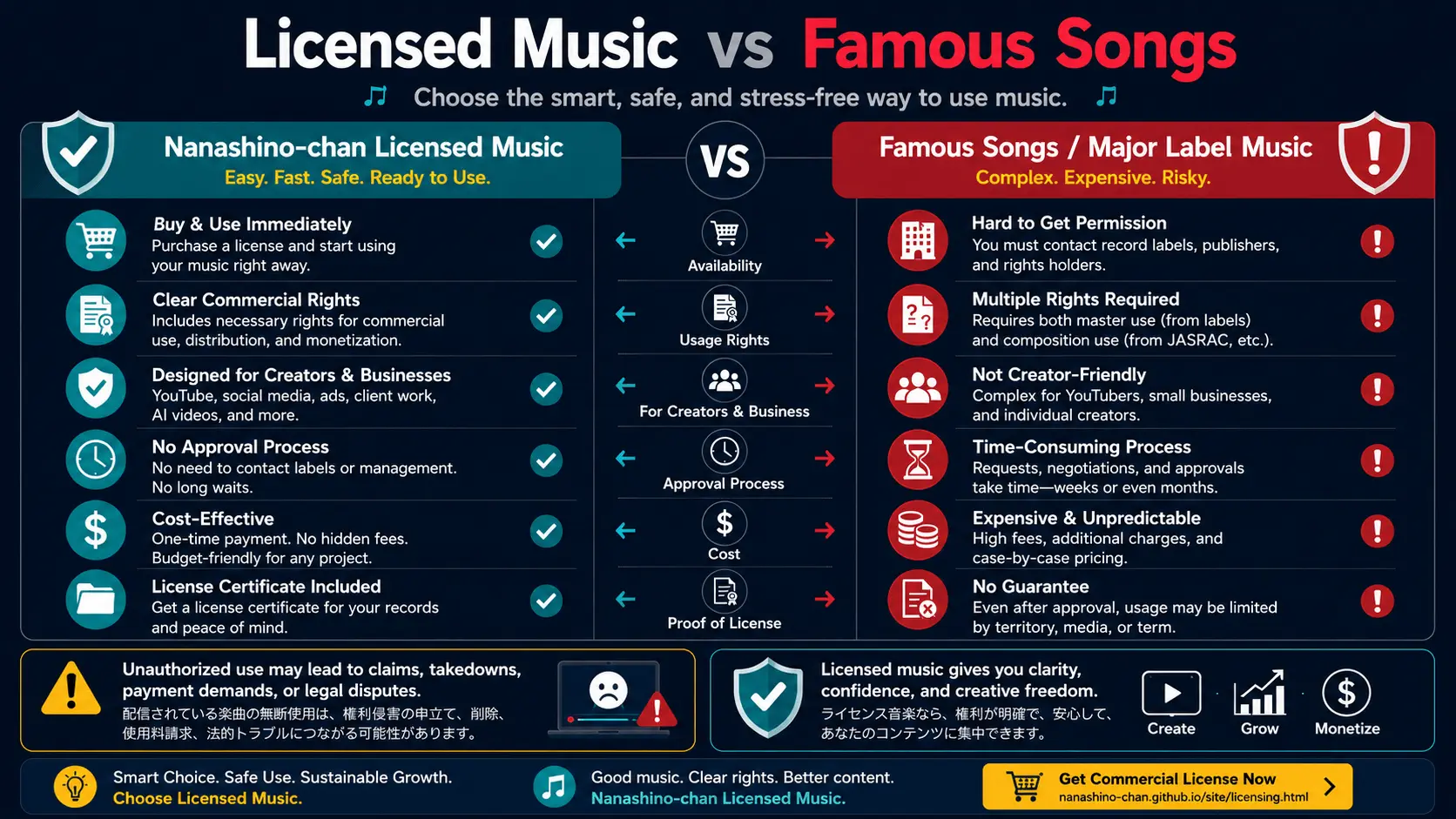
Unauthorized use of famous songs in promotional videos has led to real lawsuits and substantial damages. For example, Beastie Boys sued Monster Energy over the use of their songs in a promotional video, and a jury awarded $1.7 million.
This does not mean every unauthorized use will lead to the same result. However, it shows why famous songs can carry serious legal and financial risk when used in advertising, promotion, branded content, or business videos without permission.
日本語:YouTube自動化・顔出しなしチャンネルで有名曲を使うリスク
YouTube automation、faceless channel、AI補助動画、継続投稿チャンネルでは、有名曲を使うと権利処理が非常に複雑になりやすいです。
有名曲を使う場合、原盤権者、出版社、作曲者、作詞者、管理団体など複数の権利者が関係する可能性があります。さらにYouTubeではContent IDなどの自動検出も関係します。
そのため、収益化・継続投稿・AI動画・企業チャンネル・クライアントチャンネルでは、YouTube利用・商用利用・Sync利用・Content ID対応に向いたライセンス音楽を使う方が、権利処理の不確実性を減らしやすくなります。
A Clearer Music Licensing Workflow for YouTube Automation Channels
Nanashino-chan licensed music is designed for creators, YouTubers, faceless channels, AI video makers, brands, agencies, advertisers, editors, and client projects that need clearer music usage terms.
For YouTube automation channels, the goal is not just to fill silence. The goal is to use music that fits recurring video formats while reducing uncertainty around YouTube monetization, Content ID, sync use, commercial use, Shorts, AI-assisted production, and repeated uploads.
Built for Recurring Videos
Useful for faceless videos, narration channels, Shorts series, podcast clips, AI-assisted videos, explainers, and recurring content.
Clearer Commercial Use
Designed for channels that publish monetized, sponsored, affiliate-supported, business, brand, or client-facing video content.
Voice-Friendly Lo-Fi
Lo-fi music can support narration, captions, educational structure, calm visuals, AI voiceovers, and long-form retention.
This is not just “music for YouTube automation.” It is a practical way to reduce uncertainty, avoid unclear licensing claims, and use music with clearer creator, commercial, sync, and documentation terms.
Used in Real Brand & Creator Projects
Nanashino-chan music has also been used in real brand and creator projects.
Nanashino-chanの楽曲は、実際のブランド・クリエイタープロジェクトでも使用されています。
Documentation for Recurring YouTube Music Use
YouTube automation and faceless channels often publish many videos over time. Good documentation helps if a Content ID claim appears, a client asks for proof, a channel is reviewed, or a video is repurposed.
Recommended records include:
- Track title and artist name
- License, receipt, purchase record, or permission record
- YouTube channel name and channel URL
- Video title, video URL, and publication date
- Whether the video is long-form, Short, podcast clip, AI-assisted video, or brand video
- Usage scope, including monetization, sponsorship, affiliate content, sync use, Shorts, editing, repurposing, and client delivery
- Campaign, brand, sponsor, or client name if relevant
- ISRC or recording identifier if available
A license does not guarantee a specific platform outcome, but clear documentation can reduce uncertainty and support review if needed.
Related guides:
日本語まとめ:YouTube Automation / Faceless Channel向けの音楽ライセンス
YouTube automation、faceless channel、AI補助動画、ナレーション動画、ショート動画シリーズ、Podcast切り抜きなどでは、継続的に使える音楽ライセンスが重要です。
特に、収益化、スポンサー、アフィリエイト、企業チャンネル、クライアント案件、AI動画、YouTube Shorts、Content IDが関係する場合は、YouTube利用・Sync利用・商用利用・証明書類の確認が必要になります。
また、音楽ライセンスは低品質な自動生成コンテンツや再利用コンテンツの問題を解決するものではありません。継続運営する場合は、オリジナル性、編集、構成、ナレーション、視聴者価値、YouTubeポリシーへの適合も重要です。
Nanashino-chanのライセンス音楽は、YouTubeクリエイター、faceless channel、AI動画、継続投稿チャンネル、企業チャンネル、クライアントワークに向けて、より明確で使いやすいライセンス選択肢として設計されています。
Preview Music for YouTube Automation and Faceless Channels
Explore lo-fi music designed for YouTube automation channels, faceless videos, recurring video workflows, AI-assisted YouTube videos, narration videos, Shorts series, podcast clips, study videos, productivity content, brand channels, and commercial creator workflows.
Before choosing music, consider whether your videos will be monetized, sponsored, affiliate-supported, published repeatedly, used in Shorts, edited with AI tools, repurposed across platforms, or produced for a brand, business, client, or creator channel.
Official Platform Copyright and Monetization Policies
YouTube automation channels, faceless channels, recurring video workflows, AI-assisted videos, Shorts, podcast clips, and monetized creator channels are also affected by platform rules. YouTube may apply its own copyright systems, Content ID processes, monetization policies, reused content reviews, advertiser-friendly content rules, and channel eligibility standards.
Before publishing recurring YouTube videos, review the official YouTube policies:
- YouTube Copyright Help
- YouTube Content ID Information
- YouTube Partner Program Overview
- YouTube Monetization Policies
- YouTube Community Guidelines
A music license helps clarify permission from the relevant rights holder, but it does not guarantee monetization approval, Content ID outcomes, channel eligibility, video reach, or platform acceptance.
FAQ
Do YouTube automation channels need licensed music?
Yes, they may. YouTube automation channels, faceless channels, recurring video channels, and AI-assisted YouTube workflows may need licensed music when videos are monetized, published repeatedly, used commercially, or distributed as part of a creator business.
What music license do faceless YouTube channels need?
Faceless YouTube channels often need music that covers YouTube use, monetization, sync use, commercial use, repeated video production, Shorts, and Content ID documentation.
Can I use free music for YouTube automation videos?
Free music can be risky for recurring YouTube workflows if ownership, commercial rights, monetization use, attribution, Content ID behavior, or proof of license are unclear. For long-term channels, clear documentation is especially important.
Can I use YouTube Audio Library music?
YouTube Audio Library music can be useful, but creators should still check the specific track terms, attribution requirements, permitted uses, and whether the music fits the channel’s monetization and distribution plan.
Can licensed music still trigger Content ID?
Yes. Licensed music may still be detected by automated systems such as Content ID. A valid license can help clarify permission, but creators should keep license records, track details, video titles, channel information, publication dates, and usage scope.
Do AI-assisted YouTube videos need music licensing?
Yes, they may. AI-generated visuals, AI narration, AI editing, or automated production workflows do not remove the need to license music used in the final YouTube video.
Can I use the same licensed track across many YouTube videos?
Only if the license allows repeated use or the specific usage scope you need. If the same track will appear across many monetized videos, Shorts, or recurring formats, confirm that the license covers repeated publishing.
Can licensed music help my channel get monetized?
Licensed music can help reduce music-rights uncertainty, but it does not guarantee YouTube monetization approval. Channel monetization also depends on YouTube policies, originality, reused content review, advertiser suitability, watch time, subscribers, and other eligibility factors.
Does music licensing fix reused content problems?
No. A music license only clarifies permission to use the music. It does not make reused, low-effort, spammy, misleading, or policy-violating videos acceptable. The video itself still needs original value and platform compliance.
Is lo-fi music good for faceless YouTube videos?
Lo-fi music can work well for faceless YouTube videos because it supports narration, educational videos, compilation-style content, productivity videos, podcast clips, study videos, calm visuals, and recurring formats without overpowering the message.
日本語:YouTube automation channelに音楽ライセンスは必要ですか?
必要になる可能性があります。収益化、継続投稿、AI補助動画、ナレーション動画、YouTube Shorts、企業チャンネル、クライアントチャンネルでは、YouTube利用・商用利用・Sync利用・Content ID対応・証明書類の確認が重要です。
日本語:無料音源をYouTube自動化チャンネルに使えますか?
使える場合もありますが、権利者、商用利用、収益化、Content ID、クレジット表記、証明書類が不明確な場合はリスクがあります。継続投稿チャンネルでは、ライセンス範囲が明確な音楽の方が安全です。
Need Licensed Music for YouTube Automation or Faceless Channels?
If your project involves YouTube automation channels, faceless videos, recurring content, AI-assisted videos, narration videos, Shorts, podcast clips, monetized channels, brand-owned channels, or client YouTube workflows, choose music with licensing terms that match the actual use.
Nanashino-chan music is designed for YouTubers, faceless channels, AI video makers, brands, agencies, advertisers, editors, and commercial creator workflows that need clearer music licensing options.
► View Music Licensing Options
For unclear use cases, monetized channels, recurring uploads, AI-assisted production, client channels, Shorts series, or custom licensing:
Contact Nanashino-chan
Related Pages
Continue with these guides if you want deeper information about YouTube music licensing, Content ID, sync rights, AI videos, commercial music use, and creator-safe workflows.
What YouTubers should keep as proof Can I Use Music on YouTube?
Legal music use, copyright, monetization, and licensing How to Use Music Legally on YouTube
Practical legal music workflow for YouTube videos YouTube Content ID Guide
Claims, music detection, rights management, and creator protection How to Avoid Content ID Claims
Checklist before uploading music-based videos What Happens If You Use Copyrighted Music?
Claims, takedowns, legal risk, and monetization impact Music for AI Video Generators
Licensed music for AI-generated video workflows Licensed Music for AI Commercial Videos
Commercial music licensing for AI video projects How to License Music for AI-Generated Videos
Music licensing workflow for AI video creators Music for Freelance Video Editors
Music licensing for client videos and commercial edits Music for Content Marketers
Licensed music for brand content, campaigns, and social videos Music Licensing for Commercial Use
Commercial licensing for creators, brands, and agencies Music License for Business Videos
Music licensing for company videos and brand content What Are Sync Rights?
Understand music rights for videos, ads, and social content What Is Sync Licensing?
Understand music use with video and visual media How Sync Licensing Works
Sync licensing workflow for videos, ads, and AI content How Music Rights Work
Master rights, sync rights, copyright, and commercial use Music Copyright FAQ
Common questions about music copyright and licensing ISRC Code Explained
Music identification, rights metadata, and licensing Works
Real brand and creator use cases Licensing Page
Commercial, sync, brand, and custom music licensing
Disclaimer
This page is provided for general information about YouTube automation channels, faceless channels, music licensing, copyright, sync rights, commercial use, Content ID, AI-assisted production, monetized videos, and creator music workflows. It is not legal advice.
Music usage may be affected by copyright law, platform rules, YouTube policies, YouTube Partner Program rules, reused content policies, advertising policies, Content ID systems, account type, region, monetization status, metadata, distribution settings, license scope, rights ownership, campaign settings, client contracts, and policy changes outside the control of Nanashino-chan.
A license helps clarify permitted use from the relevant rights holder, but it does not guarantee specific outcomes such as YouTube monetization approval, channel eligibility, reach, video performance, claim behavior, ad suitability, audio availability, client approval, or platform acceptance.
Users are responsible for ensuring that their content complies with the terms, policies, contracts, and laws applicable to each platform, channel, campaign, client, sponsor, and jurisdiction.
免責事項
このページは、YouTube automation channel、faceless channel、音楽ライセンス、著作権、Sync権、商用利用、Content ID、AI補助制作、収益化動画、クリエイター向け音楽利用に関する一般的な説明を目的としたものであり、法的助言ではありません。
音楽の利用可否や表示・検出・広告審査・収益化の挙動は、著作権法、YouTubeポリシー、YouTube Partner Programの条件、再利用コンテンツに関する審査、広告ポリシー、Content IDなどの自動検出システム、アカウント種別、地域、メタデータ、配信設定、ライセンス範囲、権利者の管理状況、キャンペーン設定、クライアント契約、ポリシー変更等により影響を受ける場合があります。
ライセンスは権利者からの利用許諾を明確にするものですが、YouTube収益化承認、チャンネル審査、リーチ、動画成果、Content IDの挙動、広告適合性、音源利用可否、クライアント承認、各プラットフォーム上での利用可否を保証するものではありません。
利用者は、各プラットフォームの利用規約・広告ポリシー・契約条件・適用法令を確認し、適切に遵守する責任を負います。